Allan Merrill remembers subdividing his backyard with yellow Tonka trucks. There are cheaper introductions to property development, though few come with such forgiving lenders. Years later, he would advise a homebuilding business on its stock-market debut, join it as chief financial officer, and run it through a long argument about what buyers should expect from a house. The toy trucks make a pleasing beginning. The more revealing detail is how often he has changed the question.
When the assignment was to sell a housing business, he suggested buying another. When he became a builder’s CEO, he challenged the choice between environmental performance and household economics. His career has moved among Wall Street, internet listings and construction sites, with the same practical interest following him: what, exactly, is the customer paying for?
The banker who brought a buying list
Homebuilding became tangible during college summers. Merrill worked in land development, land acquisition and sales. A site could become a neighborhood; a sales conversation could end with someone buying a home. There was a visible result at the end of the work. That appealed to him before the business became a succession of transactions and balance sheets.
After Wharton, he joined Dillon, Read & Co. in 1987. The firm and its successors, including UBS, would occupy the next thirteen years of his career. He eventually became co-head of the Global Resources Group, overseeing relationships with construction and building-materials businesses around the world. The young employee who had spent summers around housing had found a way into its financial machinery.
Barbara Alexander, a former boss, helped bring him into the orbit of Brian Beazer. In 1992, with housing depressed, Merrill was working on the disposal of the American homebuilding operation. He proposed an acquisition instead. Beazer bought Watt Housing Corp.; the enlarged business went public in 1994. It was an early instance of Merrill looking at the assigned task and finding a different transaction inside it.

A house needs more than a listing
In 2000, Merrill left banking to become the first president of Homebuilder.com. He later served as executive vice president of corporate development and strategy at Move, Inc. Housing search was moving onto screens. He had shifted from helping businesses raise money to working on how those businesses met their customers.
That experience still bothers him in an interesting way. At a 2025 sustainability symposium, he argued that online home search had advanced too little beyond familiar filters. Beds, baths and location are easy to specify. The qualities a buyer values in everyday life are harder to find through a search box. For someone who entered the business at the beginning of its digital migration, twenty-five years was a long time to keep asking roughly the same questions.
His broader curiosity reaches beyond listings. In that conversation, he considered how artificial intelligence might help people search by values and how fractional ownership could widen access. These were possibilities he discussed, rather than achievements he claimed. He sounded like a former internet executive who still thought the internet had unfinished work to do.
First, keep the balance sheet standing
Merrill joined Beazer as executive vice president and CFO in May 2007. The timing placed him inside a homebuilder as the housing downturn intensified. By June 2011, when he became president and CEO, his work had included recapitalizing the company, increasing equity, reducing debt and removing material debt maturities before 2015.
Those achievements are less photogenic than a new kitchen. They also explain why his later language about homeownership so often comes back to recurring costs. A finance executive learns to notice obligations that remain after the celebratory transaction. For a builder, that means debt. For a buyer, the obligations arrive in the mailbox every month.
The CEO appointment put an adviser and finance specialist in charge of the operating business. He became chairman in November 2019. Across those roles, the span of responsibility widened: arranging capital, allocating it, choosing the product and asking employees to build it consistently. A clever proposal can be made in a meeting. A construction standard has to survive thousands of ordinary decisions.
The bill that arrives after the keys
A house can look affordable at the closing table and prove expensive to inhabit. Merrill has made that distinction central to his pitch. In a November 2025 interview, he described reducing the energy required to operate a home as a particular preoccupation. Materials and construction choices influence expenses long after a buyer has stopped admiring the model home.
His argument gives sustainability a household ledger. A buyer is taking on a purchase price, financing costs, utilities and upkeep. Improving one line can matter even when another remains stubborn. This is a more demanding proposition than putting an attractive appliance in the kitchen: the savings depend on how the whole building behaves.
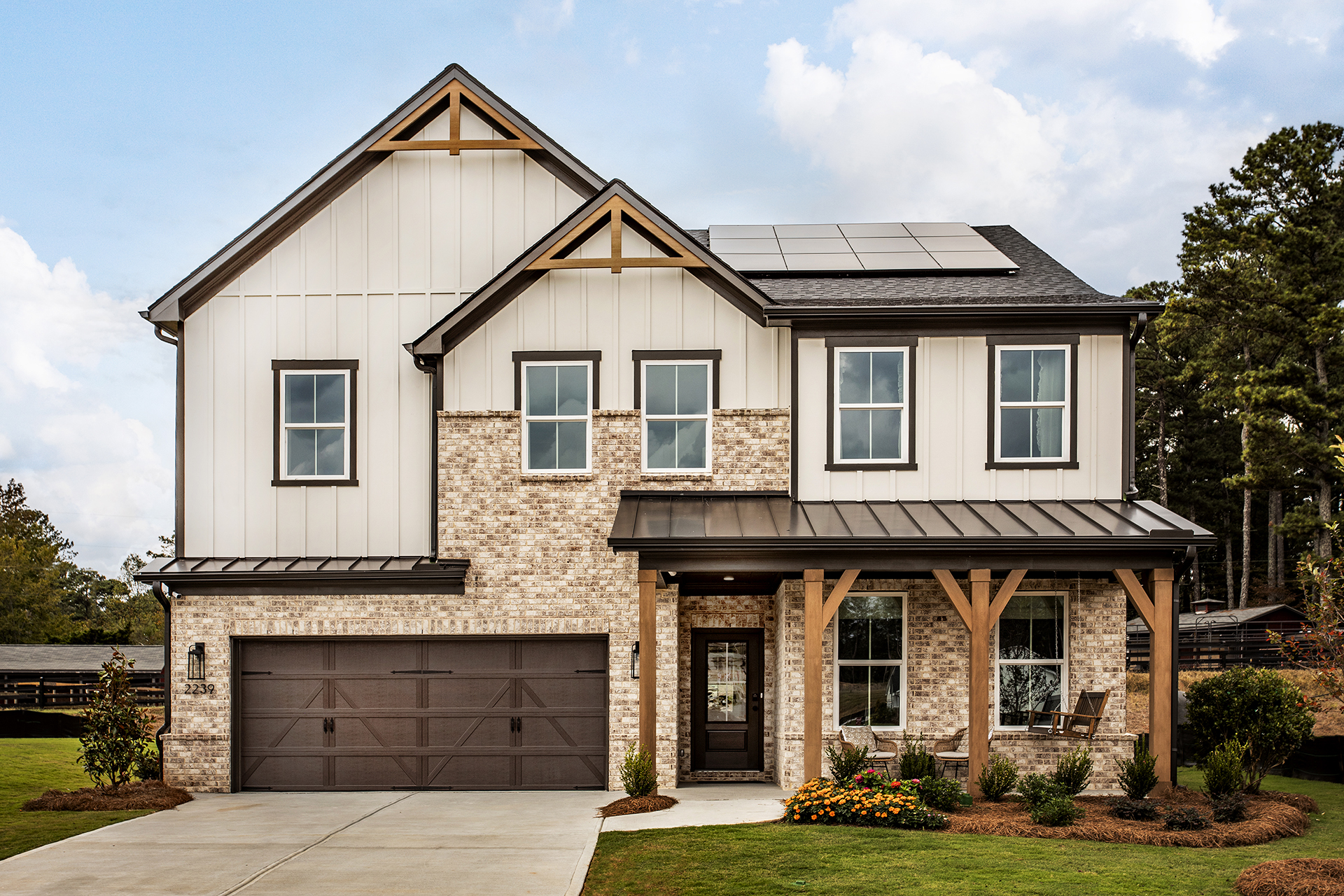
At Beazer, that meant pursuing the Department of Energy’s Zero Energy Ready standard across its homes. The company’s fiscal 2025 annual report said it had effectively achieved its goal of building entirely to that standard. The distinction matters: an efficient home prepared for renewable energy does not automatically come with a zero electricity bill. Actual generation and consumption still count.
“We were optimizing for selling homes, not for living in them.”
Allan Merrill, 2026
The sentence catches the problem with a sales process that ends too neatly at the front door. Merrill’s preferred test extends into occupancy. Does the home perform as promised once it contains people, furniture and a utility account? A closing is a date. Living in a house is a much longer examination.
A smaller number, a more efficient home
Even the floor has a job interview
The details can become wonderfully unglamorous. Beazer worked with Boise Cascade on consistent floor-system performance across its homes. A floor has to account for the weight and placement of things such as kitchen islands and bathtubs. A grading number for an individual component cannot, by itself, describe the behavior of the finished system.
Merrill and his team wanted predictable stiffness and comfort across different plans and regions. It is an unusually useful detail in a housing executive’s story. Buyers can see countertops. They tend to notice the floor’s engineering only when something moves that ought to stay still.
In his February 2026 interview, Merrill explained the same approach through the building envelope, insulation, heating and cooling, and sealing. The parts have to work together. Scale makes that harder: a good outcome in one demonstration house is a different accomplishment from a repeatable result across communities. His ambition rested on making performance ordinary enough to become an expectation.
A grocery-store analogy, with mortgages
Merrill has compared Beazer to Trader Joe’s. The analogy is about a deliberately chosen assortment and a recognizable experience. A homebuilder cannot put houses in a cheerful paper bag, but it can decide how many choices to offer and whether those choices help the customer.
Financing supplied a concrete example. Beazer’s Mortgage Choice program put multiple lenders in competition for a buyer’s business. In a June 2025 conversation, Merrill described a model in which Beazer took no marketing fees from the lenders. A house purchase already asks customers to make enough consequential decisions; comparing financing offers is more useful than adding ceremonial complexity.
His network has also extended into housing finance and policy. He served on Freddie Mac’s board from September 2020 to April 2025 and has been chairman of Leading Builders of America. Ally appointed him to its board effective November 3, 2025. These roles connect the construction business to the institutions that help determine whether buyers can finance the result.
The reluctant runner’s other operating model
One of Merrill’s less predictable projects began with a half marathon in Nashville. Encouraged by his assistant, he took up running; Brian Beazer later joined him in a race and fundraising effort. The activity eventually developed into the company’s Rock. Run. Raise! campaign. The executive accustomed to financing developments had acquired another reason to ask people for money.
By March 2026, Beazer said its employees and partners had helped raise more than $10 million for Fisher House Foundation, supporting housing for military and veteran families. The company also developed Charity Title and Charity Home Insurance, with net profits supporting its charitable foundation. The structure reflects a familiar Merrill interest: finding an operating arrangement that can sustain an intention.
The transaction comes full circle
The 2026 housing market supplied a stern examination. Beazer’s second fiscal quarter brought homebuilding revenue of $397.7 million, down 28.5% from a year earlier, and a $0.9 million net loss. A distinctive product still has to sell in a market where financing and confidence constrain buyers. Technical progress and commercial pressure can occupy the same balance sheet.
In May, Beazer rejected unsolicited proposals from Dream Finders Homes. In August, the companies agreed to a cash acquisition at $33.50 per share. The transaction closed on October 20, with an enterprise value of approximately $2.2 billion. Beazer became a wholly owned subsidiary. Merrill resigned from its board; the closing terms continued the company’s officers in their posts.
The buyer has its own plans. Dream Finders said at closing that it intended to transition homes in Beazer communities to its floor plans, emphasizing buyer affordability, lower construction costs and shorter build times. Merrill’s long experiment now sits within a larger business making its own choices about cost and product.
He helped bring Beazer onto the stock exchange in 1994. Thirty-two years later, its trading stopped with the acquisition. Between those events lies a career spent examining houses from several useful distances: the transaction, the search screen, the construction site and the monthly bill. The backyard subdivision was easier. Nobody had to explain the mortgage to a Tonka truck.