Before Dream Finders Homes could become a national homebuilder, somebody had to agree to wait. In 2008, Patrick Zalupski borrowed $200,000 from the Clay County Housing Finance Authority. A developer agreed to collect payment for three homesites after the houses sold. The arrangement solved a rather practical problem: a small builder could begin building without first finding all the money for the ground.
- Start with buyers the previous housing boom priced out.
- Control access to lots while limiting upfront land ownership.
- Buy regional builders, then put national purchasing power behind them.
Seventeen years after its first full year of closings, that little negotiation has an imposing descendant. On October 20, 2026, Dream Finders completed its acquisition of Beazer Homes, a transaction carrying approximately $2.2 billion in enterprise value. The company says the combination makes it America's sixth-largest homebuilder by calendar 2025 revenue. The interesting part is how much the enlarged business still depends on the original question: when, exactly, must the land be paid for?
A bad condo project. A useful constraint.
Zalupski did not arrive at homebuilding with an untouched record of good decisions. Before Dream Finders, he had a condominium project that struggled during the housing crash. In a later interview, he described seeing an opening among entry-level buyers excluded by the preceding run-up in prices. Expensive housing had helped create the problem. Less expensive houses offered a way back into business.
The first financing came with income restrictions for purchasers. Those restrictions narrowed the customer pool, but they also pointed the builder toward people still willing to buy. Dream Finders closed 27 homes in 2009. Traditional bank financing followed in 2011. A constraint had supplied a market, a financing arrangement and a reason to keep the first operation small.
“My initial goal was to just sell homes and try to turn a modest profit.”
Patrick Zalupski, recalling the company's beginnings in 2025

There is a useful distinction here between a grand strategy and a working arrangement. The founding deal did not require predicting a national expansion. It required three houses, qualified buyers and a developer prepared to take payment later. Readers running smaller businesses can copy the question: which expensive input must you own immediately, and which could you secure through a contract?
The ground beneath the balance sheet
Today, Dream Finders describes its approach as asset-light. It uses finished-lot options and land-bank arrangements to secure future building sites, purchasing lots as needed rather than tying up all that money in a large owned land inventory. Land suppliers and financing partners carry part of the waiting period. The builder concentrates its capital on getting houses built and sold.
- 01Partner holds
the land - 02Builder deposits
for access - 03Lots purchased;
homes built - 04Buyer closes;
capital returns
This is an established homebuilding technique. NVR was an explicit reference point for Zalupski in a 2020 interview. The trade-off is equally established: somebody must be compensated for holding the land. Lower upfront ownership can mean accepting a higher lot cost. The advantage depends on how effectively the released capital gets used.
Nor does an option eliminate exposure. At December 2025, Dream Finders reported $545 million in lot deposits and 63,121 lots controlled through option contracts. Deposits can become nonrefundable. If a neighborhood stops making economic sense, walking away may preserve future cash while sacrificing money already paid. Flexibility has a receipt.
Where the buyer meets the spreadsheet
For a customer, Dream Finders is a seller of new homes: single-family houses, townhomes and communities aimed at different budgets and life stages. Buyers can search available homes for a quicker move or choose a home with personalization options. The attraction is recognizable: a new house with choices, without commissioning every detail of an independent custom build.
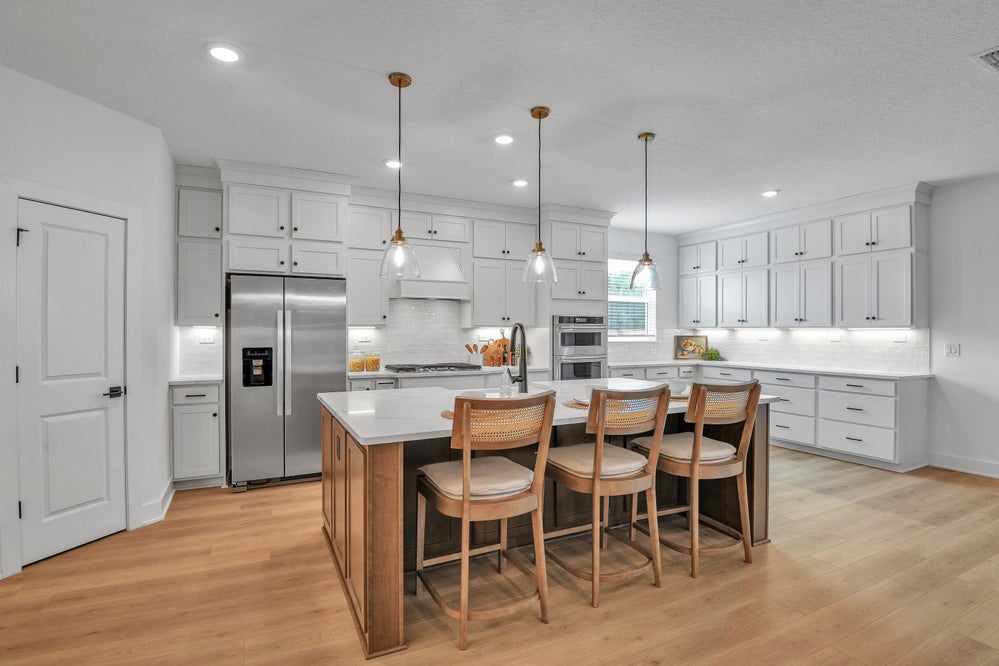
Its design studios turn that proposition into specific decisions. A one-to-one appointment with an interior design consultant covers choices such as countertops, cabinets, flooring, appliances and lighting. Availability depends on the home and community. A buyer comparing builders should ask for the finished price with desired selections, alongside the advertised starting price.
The portfolio stretches beyond the starter house. Reverie emphasizes resort-style amenities and social activities. DF Luxury Homes serves custom-home buyers around Jacksonville and Ponte Vedra Beach. Coventry Homes gives the group a Texas presence. Mortgage banking through Jet HomeLoans and title services extend the business into the paperwork that turns a selected house into an owned one.
Those services offer convenience and additional revenue opportunities. They also make comparison shopping worthwhile: buyers can compare financing terms, closing costs and the complete monthly payment. A handsome kitchen does not settle those questions.
Buying the next neighborhood
Acquisitions supply teams, local knowledge and communities that would take time to assemble from scratch. Dream Finders' January 2021 IPO delivered $133.5 million in net proceeds. That October, it bought McGuyer Homebuilders' businesses for $471 million in cash at closing, before adjustments and other consideration, expanding through the Coventry brand in Texas.
Beazer is a much larger test. Its acquisition adds California, Nevada, Indiana and Delaware to the footprint. Management intends to introduce Dream Finders floor plans in Beazer communities and use greater scale to reduce construction costs. More than $100 million in expected annual cost synergies remains a target, rather than an accomplished saving.
The sale can grow. The profit can shrink.
Scale does not repeal affordability. In 2025, Dream Finders closed 8,608 homes, against 8,583 in 2024. Yet total revenue fell to $4.323 billion, and net income attributable to the company fell from $335.3 million to $217.2 million. Sales incentives helped move houses while putting pressure on the economics.
The pressure continued into the second quarter of 2026: closings rose 3%, while attributable net income fell to $28 million from $57 million. Targeted mortgage buydowns supported demand. Paying to make the payment affordable is still a cost.
That is the condition attached to the founding idea. Deferred land purchases work when sites arrive, financing remains available and buyers can close at prices that cover construction and capital costs. They offer less protection against weak demand, expensive credit or integration mistakes. Dream Finders has become very good at securing the next opportunity. Its enlarged business now has to earn the money to pay for it.
Open the next door
Find a home · Explore design choices · The Window blog · Company news
LinkedIn · X · Instagram · Facebook · Home tours on YouTube