A kitchen counter is an odd place to look for a business model. Yet at KB Home, the counter, the cabinet beneath it and the floor under your feet help explain the enterprise. Buyers get a menu of choices inside a production system. The question is how much individuality that system can deliver before time and money get in the way.
- Choose a home from a repeatable set of plans, then personalize the details.
- Keep construction predictable enough to make those choices affordable.
- Remember that financing and running costs can outweigh the appeal of the showroom.
A house, with a menu
The idea has an ancestor in Detroit. In 1957, Eli Broad and Donald Kaufman launched a company using slab construction to help make ownership affordable for first-time buyers. The company later became KB Home. Its early proposition concerned the building itself: change how a house is made, and more people might be able to buy one.
Today, KB sells new homes in communities across the United States. First-time and first move-up buyers have accounted for an average of more than 75% of annual deliveries over the preceding decade-plus, according to its business overview. These are customers for whom a home must accommodate both a life and a budget. A spare bedroom is useful. So is qualifying for the mortgage.
KB introduced its built-to-order model in 1996 and opened design showrooms the following year. Customers select from available homesites, floor plans, exterior styles and interior options. A consultant helps them navigate flooring, fixtures and finishes. This is bounded personalization: the buyer chooses inside an established system. Someone wanting an architect to invent an entirely new house is shopping for a different service.
The alternatives include resale homes and builders such as Lennar, D.R. Horton and PulteGroup. KB’s distinction is the emphasis it places on buyer participation. Its menu includes national brands such as Moen, Shaw Floors and Sherwin-Williams, although availability varies. The expertise sits partly in design and partly in organizing land, suppliers, trades and construction around those selections.
The schedule was the weak link
The operating sequence matters. KB generally begins construction after securing a signed sales contract and preliminary credit approval or other evidence that the buyer can pay. Selling first gives the builder information before it commits more money to construction. The customer gets influence over a product that does not yet exist.
Then comes the wait. The fiscal 2025 filing describes a historical six-to-seven-month interval from sale to delivery, including four to five months of construction. Supply-chain disruption stretched build times. KB expanded suppliers and construction providers, ordered materials earlier and simplified design options. Even the menu had to answer to the calendar.
By the end of fiscal 2025, the company said build times had returned to their historical average. It linked the improvement to a renewed emphasis on built-to-order homes in 2026. The change was operational: shorter, more predictable production made the original proposition easier to deliver again. Choice needs a reliable timetable.
“To be the most customer-obsessed homebuilder in the world.”KB Home’s published vision
The company’s culture language follows the same logic. Sales counselors, design consultants, construction superintendents and customer service staff surround the buyer through different stages. KBHS Home Loans adds an affiliated mortgage option through a joint venture. Buyers are free to use another lender. Personal relationships may help coordinate the purchase; they cannot substitute for the actual specification, schedule or loan terms.
The bill after the bill
A house keeps charging its owner after closing. KB’s energy-efficiency work addresses that less photogenic part of ownership. The company reports reaching its 200,000th ENERGY STAR certified home in 2024. Certification gives the efficiency proposition a defined standard, though any household’s actual bills still depend on local prices, weather and behavior.

In Menifee, California, the company went beyond the individual home. Its microgrid project brought together solar generation, batteries and all-electric houses with partners including SunPower, Schneider Electric, Southern California Edison and UC Irvine. The effort received a $6.65 million Department of Energy grant. That figure describes grant support, rather than the full price of building the development.
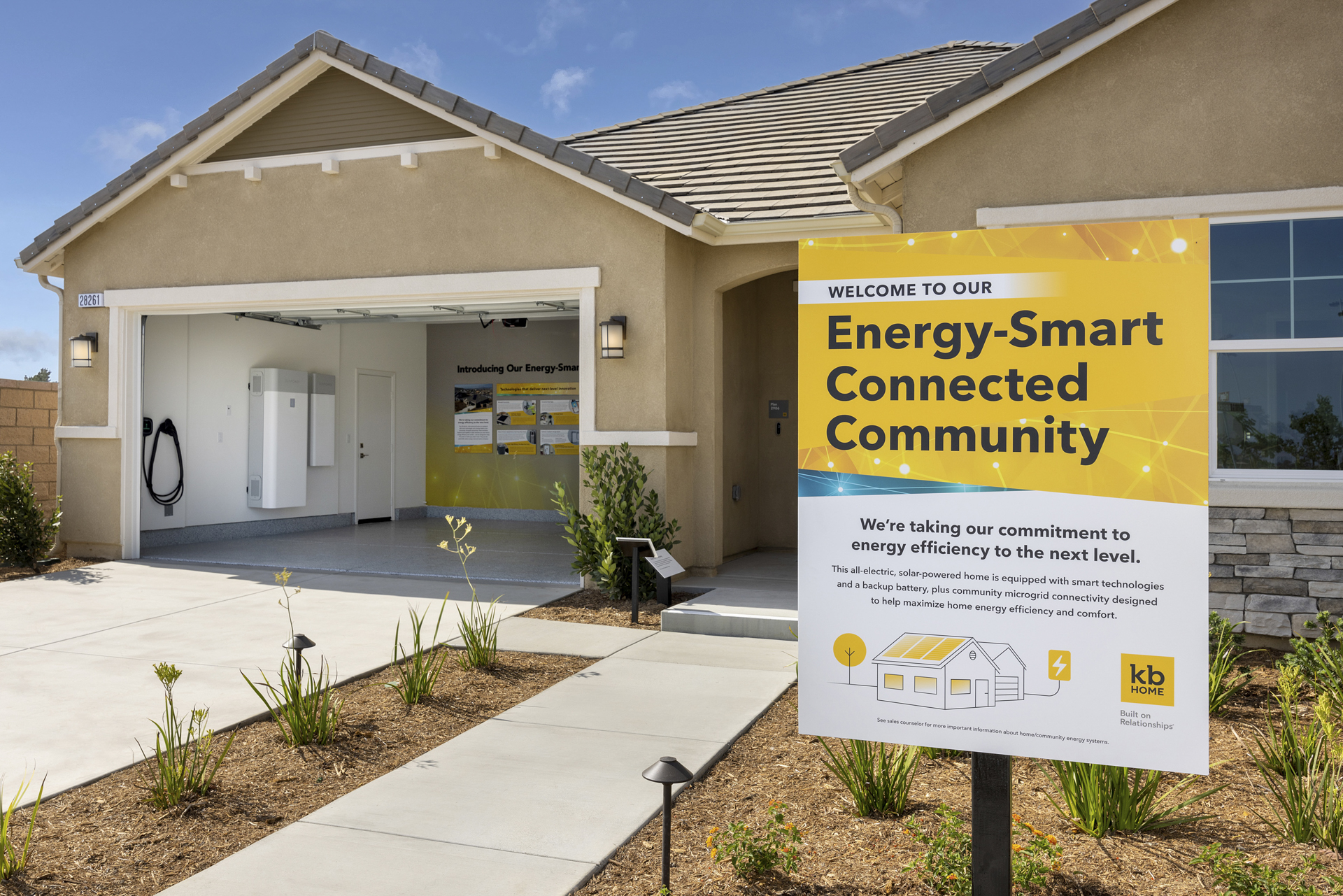
The experiment asks whether neighboring homes and shared infrastructure can provide more reliable energy together. Copying it requires utility coordination, engineering and capital as well as rooftops. It is a specific demonstration, not a feature a buyer should assume comes with every KB address.
Choice meets the credit market
KB earns most of its revenue by developing communities and selling homes. Fiscal 2025 produced 12,902 deliveries and about $6.24 billion in revenue. Land and construction absorb substantial capital before a sale closes. At August 31, 2026, inventory stood at $5.98 billion. This business has considerable weight beneath the showroom samples.
Quarterly revenue, down 20%
Fiscal quarters ended August 31. Rounded total revenue.
Robert McGibney became CEO in March 2026. By the third quarter, built-to-order homes represented nearly three-quarters of deliveries. Yet revenue fell 20% year over year to $1.30 billion, and housing gross margin fell to 16.5% from 18.2%. Management pointed to mortgage rates, affordability pressures and cautious buyers. A more personal product still has to survive the payment calculation.
Take the showroom home, carefully
There is also a distinction between choice and control. A buyer can select a finish while remaining dependent on permits, utility connections and the availability of construction crews. Those dependencies make a promised move-in date part of the product. Anyone comparing a new build with an existing home should give the calendar the same attention as the kitchen.
For buyers, the useful move is to compare a finished specification. Ask which features are included, which carry extra charges and when selections become final. Compare delivery timing, financing and likely ownership expenses alongside the floor plan. A beautifully staged room is an invitation to investigate the numbers.
For other businesses, KB offers a narrower lesson: put meaningful choices on a repeatable foundation, and keep the production promise credible. The model is less suited to immediate occupancy or unrestricted custom design. Its appeal depends on having enough time, enough predictability and enough room in the buyer’s budget. The counter can be exactly right. The payment still gets the final vote.