Before he had started work at KB Home, Jeffrey Mezger went shopping. He toured the company’s Antelope Valley communities, let the salespeople explain the houses, and introduced himself afterward. It was 1993. He was about to become their division president. By the third community, the sales teams were warning one another about the visitor and his car. His brief career as a mystery shopper was over.
The episode is a useful entrance to a career spent turning other people’s decisions into houses. Mezger wanted to hear the sales pitch before anyone knew the boss was listening. A model home can make almost any life look orderly. The harder question is whether the business behind it understands the person walking through the door.
He would spend nearly two decades as KB Home’s chief executive, beginning in November 2006. On March 1, 2026, he became its first executive chairman. Between those appointments sits a long experiment in a practical proposition: give buyers meaningful choices, then organize the building operation to deliver them.
A tree house, then a division
His first project had a considerably smaller addressable market. At about 12, Mezger built a tree house with wood and steel supplied by his father, a Chicago-area builder. No design studio was involved. The materials were familial; the ambition was already architectural. It is a pleasingly literal beginning for someone who would make a living assembling homes.
A Chicago native, he graduated from DePauw University in 1977 with an economics degree. He spent 15 years at U.S. Home before joining KB, including a decade as president of its Central California division. By the time he changed employers, he had substantial experience with the local business of building: the land, the contractors, and the organization required to get houses finished.
The move to KB Home led to assignments in Arizona and the Southwest. His responsibilities included integrating Lewis Homes into the business. In 1999, he became executive vice president and chief operating officer. Those jobs put him close to the machinery of expansion. A company can buy another builder in a transaction. Making the combined operation work is a much longer assignment.
There is an irony in the climb. In 2007, he recalled once resolving that he would never work in a corporate office. He liked the field, the people, and the chance to “kick dirt.” The headquarters job eventually arrived anyway. For a homebuilder, the distance between the corporate office and the construction site is a management problem as well as a commute.
An awkward time to inherit the keys
November 2006 was an unforgiving moment to become a homebuilding chief executive. The housing boom was turning, and the crash would soon put the industry’s assumptions through a destructive examination. Mezger’s tenure began with a problem that no attractive model kitchen could resolve: what happens to a builder when the market stops cooperating?
The subsequent years made the cycle central to his public record. He remained at the company through the financial crisis and the eventual recovery. In 2010, BUILDER magazine named him CEO of the Year. Two years later, he entered the California Homebuilding Foundation Hall of Fame. The sequence matters. These recognitions came after the downturn had already tested the business.
By 2024, he was distinguishing the affordability squeeze of that period from the conditions around the financial crisis. He pointed to years of insufficient housing construction and demand from younger buyers. That was his assessment of the market, rather than a promise that demand alone would make homes affordable. Wanting a house and being able to buy one remain separate entries in the calculation.
In a February 2024 interview, he also described the competing pressures of land and labor costs and the need for builders to earn a return before committing capital. The customer’s budget and the builder’s economics have to meet somewhere. Every additional specification has to find a place in that meeting.
His 2024 approach included adjusting prices where a market had become unbalanced, rather than relying entirely on mortgage incentives. He also watched the relationship between new-home prices and resale alternatives. The comparison is a reminder that a builder competes with houses already standing nearby. A buyer can admire the model and still decide that another front door makes more financial sense.
A thousand chances to get the details right
KB Home’s Built to Order approach gives that negotiation a physical form. Buyers choose a homesite, a floor plan, and design features that fit their preferences and budget. The appeal is easy to grasp. Someone else’s ideal kitchen need not become your expensive compromise. The operation required to support those decisions is less photogenic than the kitchen.
Mezger helped develop the company’s operating model during his years as COO. His record belongs partly to that work: connecting the promise made to a buyer with a repeatable way of building. Personalization creates a succession of small obligations. A selected feature must remain the selected feature as the job moves from a conversation to a plan and finally into construction.
The tension gives his career its organizing problem. Scale rewards repetition. Homebuyers want some say in the place they will inhabit. A national builder offering choice must make room for individual decisions while keeping the process sufficiently disciplined to repeat across communities. The romance is in imagining a home. Much of the professional work is in preventing a misunderstanding.
It is also why the word “custom” needs care. KB’s proposition is a structured selection process within its communities and offerings. The buyer gets decisions that matter without commissioning every part of a house from scratch. The design studio is where a large operation becomes particular enough for a household to recognize itself in the result.
The conversation after the sale
Mezger’s public customer-service philosophy puts considerable weight on what happens when the conversation becomes difficult. In a 2022 discussion with Shep Hyken, he advocated proactive communication when supply problems delayed homes. Silence gives a waiting buyer little to work with. An unwelcome update at least lets the household understand the problem and make decisions.
“Customer satisfaction helps your business. It doesn’t cost you money, it makes you money.”
Jeffrey Mezger · 2022
KB Home’s 2023 annual filing gives that philosophy a calendar. It described customer visits 30 days after move-in, followed by visits at three, six, 10, and 18 months. These are occasions to hear about the home and address concerns. The relationship has appointments after the moment when the keys make their ceremonial appearance.
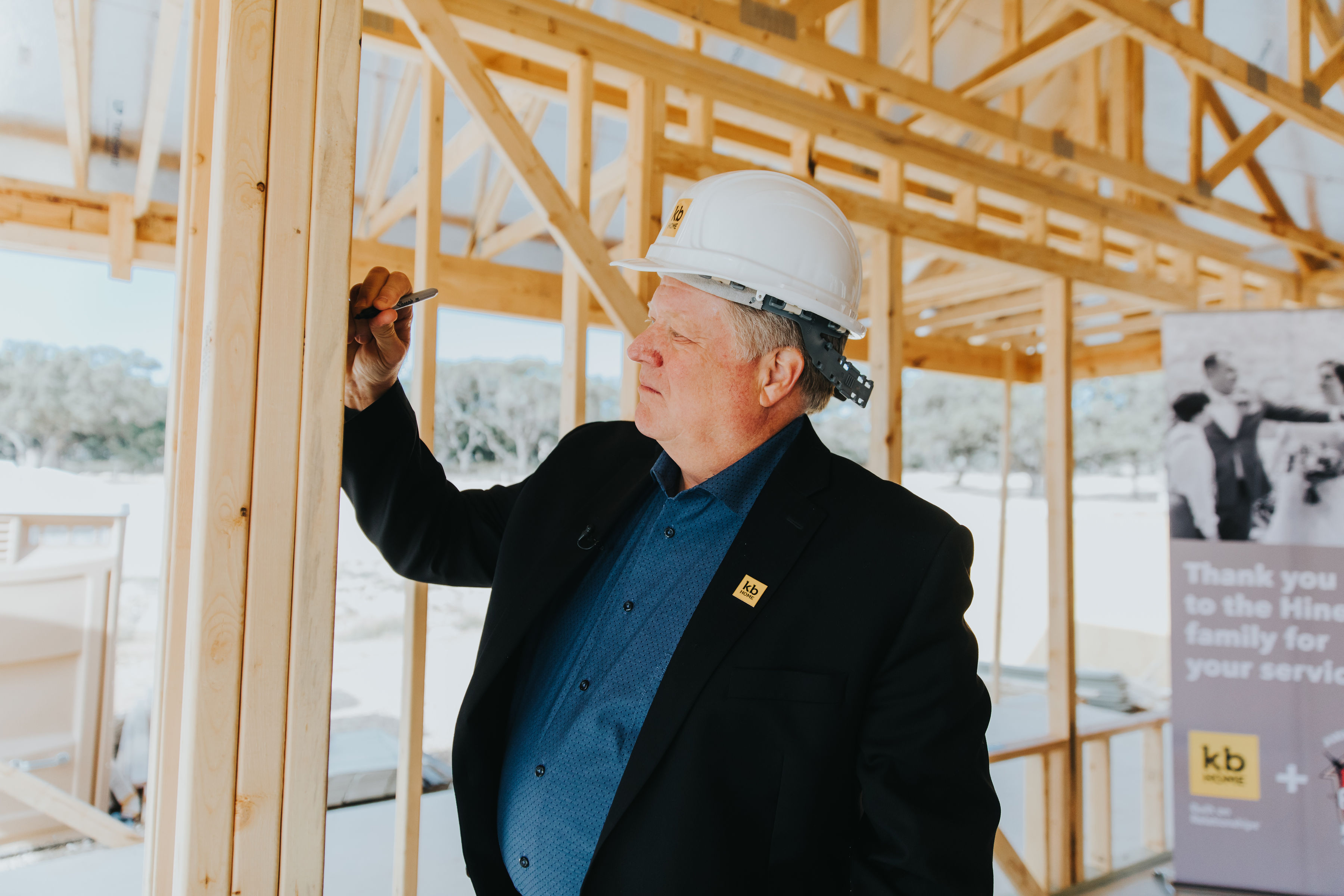
A more literal ceremony appears in a December 2019 photograph: Mezger in a hard hat, signing a timber in the frame of a future home for the Hines family. The project brought KB Home together with Jared Allen’s Homes for Wounded Warriors. In February 2020, the partners celebrated completion of the family’s personalized, mortgage-free house in the San Antonio area.
The bill that arrives after the mortgage
There is another customer decision tucked behind the purchase price: what the home will cost to run. Under Mezger, KB Home made energy and water efficiency part of its affordability argument. That connects the building specification with the household budget long after closing. A utility bill has little interest in how persuasive the original brochure was.
The company’s 2024 sustainability report recorded a national average Home Energy Rating System Index score of 45. Its 2025 report put the figure at 43 and cumulative ENERGY STAR-certified home deliveries above 217,000. These are company-wide measures. They describe the output of a building organization, rather than a personal scorecard for its chairman.
A smaller energy number
KB Home national average HERS Index. Lower scores indicate greater energy efficiency. Bars use a 0-50 scale; these are ratings, not utility savings.
A more experimental version took shape in Menifee, California. In 2022, KB announced two residential microgrid communities, Oak Shade and Durango, combining all-electric homes with solar generation and battery storage. Partners included the U.S. Department of Energy, SunPower, UC Irvine, Southern California Edison, Schneider Electric, and Kia. The plan included research comparing the connected communities with conventional residential solar communities.
In 2023, the work helped earn KB Home a place on Fortune’s Change the World list. The useful detail is the research component. A neighborhood can become a place to test how energy systems work together, with the findings tied to buildings people actually occupy. For Mezger’s affordability argument, the relevant destination remains the owner’s recurring bill.
The part the board could not overlook
His public record also includes a failure of conduct. In September 2017, a recording captured Mezger directing sexist and homophobic insults at his neighbor, comedian Kathy Griffin, after a noise complaint. KB Home’s board reduced his annual bonus award by 25 percent and warned that a similar incident would result in dismissal.
The episode belongs in an account of his leadership. A company that sells homes through relationships also depends on the behavior of the people representing it. The board’s intervention made the connection explicit: personal conduct had consequences inside the business. The operating achievements do not remove that entry from the record.
Making room for the next builder
Beyond KB, Mezger became founding chairman of Leading Builders of America and participated in university housing-policy circles. His affiliations have included Harvard’s Joint Center for Housing Studies, Berkeley’s Fisher Center, and USC’s Lusk Center. They place his career at the intersection of the local work of building and wider discussions about housing supply and real estate.
The 2026 succession brought that long operating career into a new arrangement. Robert McGibney, who joined KB Home in 2000 and advanced through its management ranks, became president and CEO. Mezger’s executive-chairman responsibilities include overseeing high-level strategy and supporting the transition. The job changed without ending his involvement.
The through-line is a series of decisions made at different scales: a child’s tree house, a division’s operations, a buyer’s selections, a neighborhood’s energy system, a board’s succession. Houses give those decisions somewhere to land. For the buyer, the final test is wonderfully unceremonious: opening the door and finding the home they expected.
Conversations & further reading
- KB Home · official website
- Jeffrey Mezger · LinkedIn
- The 2026 leadership transition
- His first days at KB Home · 2007 interview
- Customer service with Shep Hyken · 2022
- Housing and affordability · 2024 interview
- The 2017 board decision · Forbes
- KB Home · 2024 sustainability report
- KB Home · 2025 sustainability report
- How the HERS energy rating works