Before David Viger ran a homebuilding company, he needed somebody to let him build a home. He had graduated from the United States Naval Academy, served in the Navy and signed with the New York Jets. In a job interview, these were excellent conversation starters. In Las Vegas, where builders needed people who could deliver houses immediately, they were less useful qualifications.
He remembers approaching about nine public homebuilders. The first eight turned him down. At Richmond American, the final stop, his pitch had become a request for a chance. He would start wherever they could use him. He left with an offer to become an assistant superintendent on a construction site.
That was 2004. His later career would include purchasing, division leadership, regional operations and the chief executive’s office. But the entry point matters. The future CEO first had to persuade an employer that he was worth training. A football résumé could get him into the conversation; it could not finish a house.
A turnover in Honolulu
There is a much earlier moment when Viger helped change an outcome without being the person who got to score. On Christmas Day 1996, Navy was playing California in the Aloha Bowl in Honolulu. California had led 38-28 entering the fourth quarter. Navy quarterback Ben Fay brought his team within three points, but another possession was needed.
Viger, then a junior defensive tackle, stripped California quarterback Pat Barnes of the ball. Jerome Dixon recovered it. Fay took Navy down the field again, and the Midshipmen won 42-38. The final touchdown belonged to the quarterback. The opportunity to make it had come from the defense.
It is a useful scene to keep beside an executive biography. A turnaround can depend on somebody doing a particular job at a particular instant. Credit travels unevenly. The person moving the ball into the end zone is easier to see than the person who made the next drive possible.
Viger forced a fumble before Navy’s winning drive.
The résumé had a waiting room
Viger graduated from the Naval Academy in 1998. His connection with the Jets brought another lesson in the distance between having an opportunity and being allowed to use it. By August 1999, the club had him on its military reserve list. His Navy duties and football ambitions were sharing an unusually awkward calendar.
He was working at a Navy recruiting center in New York. Under the reserve arrangement, he could neither practice with the Jets nor sign with another team. Other clubs had expressed interest, but interest did not produce an open door. He was a defensive lineman who also handled long snapping, waiting for the terms of his next step to become clear.
That episode complicates the tidy version of an athlete’s second career. A team affiliation is a line on a résumé. Living through it can involve long stretches when the next decision belongs to somebody else. Viger eventually left military service with the rank of lieutenant. Homebuilding offered a different place to put his effort.
A career with several sets of keys
Construction was familiar territory in his family: his father had worked in the industry. Viger’s own route began in Las Vegas and soon crossed both geography and job descriptions. In 2006, he moved to purchasing in Southern California. By the end of that year, he was division president in Southern Colorado. Utah followed a year later.
In 2009, he took responsibility for Richmond American’s consolidated Colorado Front Range division. He later joined Harmony Homes as a regional president and helped establish satellite divisions in Southern California and Dallas. In April 2012, he returned to Richmond American to lead its Arizona operation in Phoenix.
The sequence gives substance to the word operations. Buying materials, setting up a division and managing an existing market ask different things of a leader. Each move put him closer to another group of people whose work would eventually sit beneath his signature. A title can be granted in a meeting. Familiarity with the work takes longer to acquire.
- 2004Las Vegas construction site
- 2006Purchasing, then division leadership
- 2012Back to Richmond American in Phoenix
- 2020Chief operating officer
- 2025President and chief executive officer
The umpire had heard worse
Asked in 2011 about his first job, Viger named Little League umpiring. His assessment was cheerfully unflattering: either he had been terrible, or the spectators had successfully convinced him he was. It is an early introduction to public accountability, with smaller players and remarkably committed critics.
His tastes in that interview were equally specific. He supported the Detroit Tigers, had family around Detroit and could rewatch The Natural. Before NFL games, he listened to Cat Stevens. The expected soundtrack for a large defensive lineman might involve a little more menace. His apparently did the job.
He also remembered his mother teaching him that a hug and a tackle required different techniques. The joke gives the football credentials a domestic scale. This was a person who could discuss objectives and work ethic, then admit that embracing his mother had once presented a practical problem.
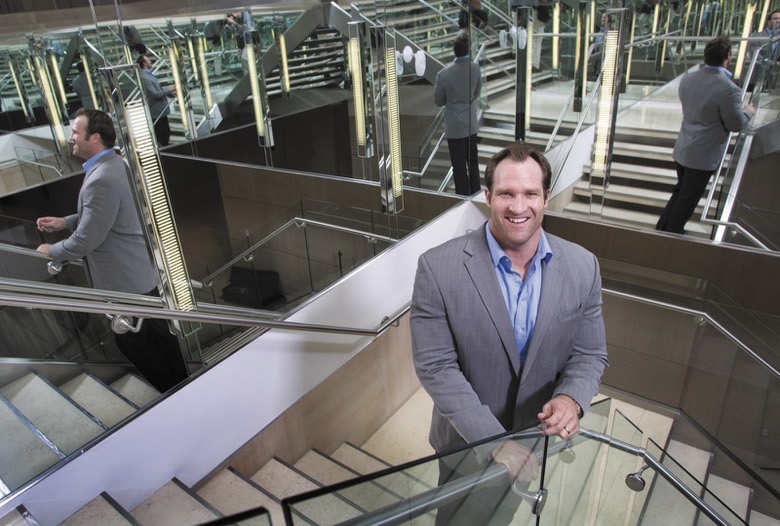
Those details belong to that period of his life. Together, they make the executive in the mirrored staircase photograph easier to recognize as a person: competitive, willing to laugh at himself and capable of choosing his own pregame music.
Florida is not California
By June 2020, Viger was overseeing Richmond American operations in Arizona, Utah and Northern California. His explanation of the business was blunt about the importance of local research. A buyer in Florida and a buyer in California could want different things. Following a trend without understanding the market could leave a builder reacting to somebody else’s customer.
“Details are important,” he said. The thought sounds modest until it reaches a floor plan, a price or a purchasing decision. A builder can repeat a process across the country. Repeating assumptions about the people buying the homes is a more expensive habit.
He pointed to the Seasons Collection as an attempt to address affordability while retaining features buyers valued, including generous ceiling heights, kitchen islands and sliding patio doors. The objective included giving people a house they could keep for longer. His hiring priorities were similarly direct: effort and attitude mattered. Neither appears in a model home, but both affect how it gets built.
“Details are important.”
David Viger · 2020
A new name over a familiar business
Viger served as Richmond American’s chief operating officer from 2020 through 2024. His appointment as president and chief executive officer took effect on January 1, 2025. He also joined the board. The superintendent who had entered the company two decades earlier was now responsible for decisions extending across the business.
The company around him was changing. Sekisui House had acquired M.D.C. Holdings in 2024. A subsequent reorganization brought its U.S. builders into a common structure, with M.D.C. taking the legal name Sekisui House U.S. The new arrangement began operating in January 2026. Established builder brands were to remain in place for the time being.
The distinction between an organization and a brand matters here. Customers could continue to encounter familiar names while decisions about the combined business moved into a shared structure. Integration has to work at both levels: people buying a home need continuity, while people running the business need to know who decides what.
A September 2025 operating plan set out six regions and separate leadership for conventional framing and SHAWOOD. It placed Viger above a business whose differences could not simply be tidied away. An organization chart can connect boxes with a line. The people inside those boxes still have to make the arrangement useful.
A shared organization has to carry different building methods and local markets.
What he brought back from Japan
In February 2025, Viger visited Sekisui House’s exhibition halls, factories and research facilities in Japan. He described the task ahead as combining the strengths of American builders with those of their Japanese parent. In his account, integration would require people to accept changes in how they worked and understand the value those changes were intended to create.
His ambition included making the combined organization a place people in the industry would want to work. That adds a human test to the corporate plan. Procedures have to travel between companies; confidence has to travel with them. A construction method is considerably easier to introduce when the team using it understands why it deserves their attention.
By April 2026, he was describing prototype homes and additional internal construction checks. He had expected superintendents to find the inspections frustrating. Instead, he reported enthusiasm and pride in the finished work. He also said the prototypes had taken less time to build. That was his account of those projects, rather than a promise about every future house.
“The jobsite is the business,” he said. It is an unusually short statement for a chief executive, and an exact description of where his own homebuilding education began.
“The jobsite is the business.”
David Viger · 2026
The house after the handover
By July 2026, Viger was discussing how construction practices associated with SHAWOOD could gradually reach other U.S. product lines. He acknowledged the constraint of cost. A method can attract attention in a model community and still need work before more buyers can afford it. His stated task was to extend access over time.
He also described an interest in Japan’s longer relationship between builder and customer. Bringing that philosophy to America would require adaptation to a different market. The practical question was how to build houses that create fewer maintenance demands as the years pass.
That is a fitting place for Viger’s career to arrive. He began by asking for the chance to learn how a home gets built. His responsibility now includes what happens after the keys change hands. The field job and the chief executive’s job meet there, in a house somebody else has to live in.