An empty lot is an awkward thing to put in a shop window. It offers neither a kitchen to admire nor a front door to unlock. During the housing crash, it could also represent a very expensive mistake. Patrick Zalupski looked at the same patch of ground and saw a chance to enter a business that had previously priced him out.
He formed Dream Finders Homes in December 2008. The timing deserves a moment. Starting a homebuilder then required finding customers in a market where the recent past had given almost everyone reasons to hesitate. The company closed 27 homes in Jacksonville in 2009. By the end of 2025, its cumulative total had passed 46,500.
Those numbers make a satisfying opening and a dangerous explanation. A small beginning followed by a large result can make the intervening years disappear. Zalupski's career becomes more interesting when you put the complications back: the early work in finance, a difficult property market, the dependence on other people's capital, and the problem of growing without allowing land to consume the business.
In October 2026, the scale changed again. Dream Finders completed its acquisition of Beazer Homes. Zalupski was already a principal owner of the Tampa Bay Rays. He now had two conspicuous places to test the proposition that had accompanied his building career: opportunity often arrives carrying a problem nobody particularly wants to inherit.
Before the subdivision, the spreadsheet
Zalupski grew up in Detroit and graduated from Stetson University in 2003 after studying finance. His early employer was FedEx, where he worked in internal audit in Memphis. It is an unglamorous entry on the résumé of a future sports owner, which is part of its appeal. Auditing gives numbers a cross-examination before anybody gets to celebrate them.
He subsequently moved into real estate sales and construction, serving as managing partner of Bay Street Condominiums from 2006 to 2008. That put his apprenticeship directly in the path of the housing downturn. The future founder had experience of a property venture under pressure before he had a large company to protect.
There was also a practical education in Jacksonville. His mother was a Realtor; her husband renovated foreclosures. Zalupski learned about buyers and renovation work, including tile and drywall. His early understanding of a house therefore came from both sides of the transaction: what a customer would pay, and what someone actually had to do to make the place habitable.
That combination helps explain why the later company cannot be understood purely as a collection of floor plans. A homebuilder must sell something intensely personal while managing something relentlessly numerical. The buyer imagines a life. The builder has to arrange the land, labor, materials and financing so that the imagined life has an address.
A builder who keeps an eye on the ground
Dream Finders describes its approach as asset-light. The term sounds peculiarly airy for an occupation involving concrete, but it concerns the land beneath the house. The company uses finished-lot options and land-bank arrangements to secure access to sites without funding every stage of land ownership and development itself.
A land-bank partner can buy and finance the development of property, then sell finished lots to the builder over time. Dream Finders commits capital through deposits and contractual arrangements. It still has costs and obligations; there is no architectural drawing that makes risk vanish. The aim is to keep more money available for building and selling homes.
The arrangement also makes relationships part of the machinery. Land developers, sellers and financial partners have to deliver. Local teams need to understand where buyers want to live. Corporate management has to judge the terms. Zalupski remains involved in the origination, underwriting and structuring of land investments, a responsibility that links the former auditor to the current chief executive.
Read this as an operating preference rather than a promise of immunity. The business still faces mortgage rates, construction costs and shifts in demand. Its choice is about where to place capital and which commitments to carry. In homebuilding, the balance sheet can determine how much freedom a manager has long before the first buyer arrives at the model home.
- Control the siteAgree on access to finished lots.
- Stage the capitalUse developer or land-bank arrangements.
- Build and sellBuy lots over time and deliver homes.
The company grows by joining other companies
Dream Finders went public in January 2021. A public listing brought a different audience to a business that had begun in one Florida market: shareholders who could check its progress quarter by quarter. Expansion increasingly involved buying operating businesses with existing teams, communities and customer orders.
In February 2024, Dream Finders acquired the core homebuilding assets of Crescent Homes. The deal opened Charleston and Greenville in South Carolina and Nashville in Tennessee. It included approximately 6,200 controlled lots and a backlog of about 460 homes. Geography arrived attached to people who already knew how to work there.
Liberty Communities followed in January 2025. That transaction brought Dream Finders into Atlanta and added to its Greenville operations. It also included offsite manufacturing and building-component businesses. An acquisition could therefore bring a new market and different ways to manage the cost of making the product.
This is where the founder's job changes. Opening another community is one kind of work. Bringing another organization into the company requires decisions about purchasing, construction, staffing and accountability. The announcement is brief; the integration has to survive an ordinary Tuesday.
More houses, harder arithmetic
Growth provides the obvious chart. Profit provides the less comfortable conversation. In 2025, Dream Finders closed 8,608 homes, compared with 8,583 a year earlier. Yet homebuilding revenue fell from about $4.40 billion to $4.15 billion. The average selling price declined, and income attributable to the company fell to roughly $217 million from $335 million.
The pattern continued into the second quarter of 2026. Closings reached 2,290, a company record for that quarter, while homebuilding gross margin was 14.2%, compared with 16.5% a year earlier. More transactions could coexist with weaker profitability. A headline about sales volume tells only part of the story.
Zalupski's response has included an emphasis on construction costs, inventory turns and affordability. These are connected problems. A buyer's monthly payment can limit demand even when the buyer wants the house. Lower costs can help create room to compete, but the company must still earn enough to justify the capital it uses.
His shareholder writing also argues that local approval processes constrain the supply of new communities and worsen affordability. That is his diagnosis, and it gives his public voice a sharper edge than a catalogue of attractive kitchens would suggest. He wants to build more homes; his argument extends to the rules governing where those homes can go.
A home office acquires a larger audience
The company began in an upstairs bonus room measuring about 400 square feet. Zalupski later described interviewing and hiring nearly every employee during its first decade. That detail has a human scale the revenue figures lack. For years, the growing company passed through the founder's own appointment book.
In 2013, buying out his partner required finding financing. He has said he remained close friends with the lender who helped complete the transaction. The anecdote supplies an antidote to the idea of the solitary entrepreneur: ownership itself depended on someone else's willingness to back him.
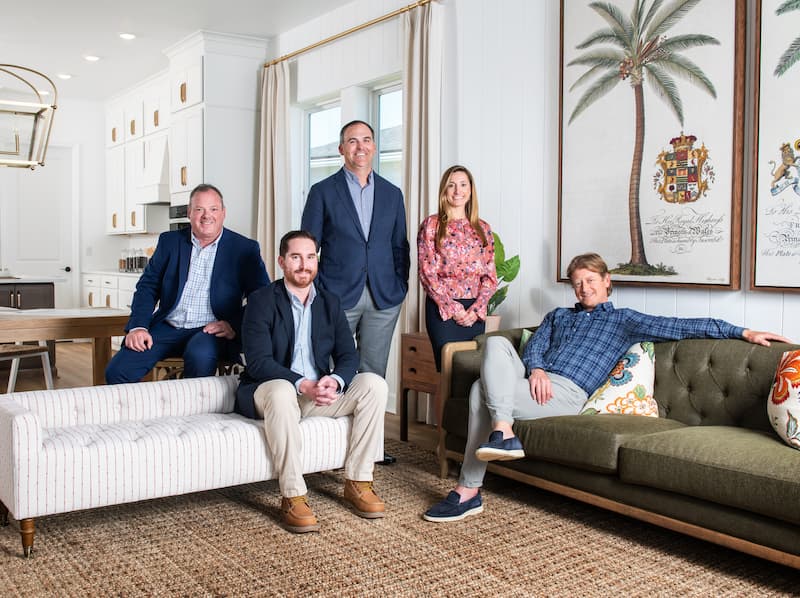
The photograph of the leadership team offers a later version of that dependence. Zalupski stands among colleagues responsible for operations, law, finance and land. A comfortable room makes a pleasant setting; the divisions of responsibility matter more. The company has grown beyond anything one person could interview, inspect or negotiate alone.
His educational connections have grown too. Appointed to the University of Florida's board of trustees in 2023, he has a term scheduled to end in January 2028. Dream Finders committed $2.5 million toward UF's downtown Jacksonville campus and supported Stetson's annual giving program. Stetson named him a Distinguished Alumni Award recipient in 2025.
Then came a different kind of home field
On September 30, 2025, an investor group led by Zalupski completed its purchase of the Tampa Bay Rays. Bill Cosgrove became co-chair alongside him, and Ken Babby became chief executive. The deal also brought the Tampa Bay Rowdies soccer club into the new ownership arrangement.
A baseball team makes the responsibilities of ownership unusually visible. Customers become fans, and fans have memories longer than a quarterly reporting cycle. The new group inherited a ballpark question as well as a roster. Buying the franchise did not finish the work of giving it a durable home.
Zalupski called the owners “stewards” when the sale closed. It is a useful word for a team whose identity belongs emotionally to thousands of people who hold no equity. It also creates a standard against which the owners' decisions can be judged. Affection for the game has to meet the practical work of running the organization.
By October 19, 2026, he was giving an interview about the Rays advancing to the World Series. For an owner a little over a year into the role, that was a striking change of setting. The responsibilities at Dream Finders, meanwhile, were about to grow again.
“My mindset is: 'What do we do tomorrow?'”
Patrick Zalupski
The next acquisition is already here
One day later, Dream Finders announced that its Beazer acquisition had closed, at an enterprise value of approximately $2.2 billion. The transaction was its ninth acquisition since the IPO and its largest. It expanded the footprint into California, Nevada, Indiana and Delaware.
“Today, Beazer’s teams officially join ours, and the real work begins,” Zalupski said. His stated priorities included adapting floor plans to buyers' budgets, reducing construction costs and shortening build times. Those are plans to execute, rather than results already earned.
The two October events make a neat juxtaposition: a World Series interview and a major corporate closing. They also expose the limits of a neat success story. Baseball has its own management team. Homebuilding has its own difficult market. The owner's attention is finite even when his ambitions keep expanding.
The empty lot at the beginning is still a useful place to end. It asks questions a celebratory headline can evade. Who will want to live here? What will they be able to pay? Who finances the wait? Zalupski has spent his career arranging answers. Every new community gives him another opportunity to discover whether the numbers work once somebody turns the key.
Keep reading. Press play.
The company, the conversations and the next chapter.
- Dream Finders Homes
- Patrick Zalupski on LinkedIn
- Patrick Zalupski on X
- Dream Finders on Instagram
- Dream Finders on Facebook
- Dream Finders on YouTube
- The Window: company blog
- Read the 2020 career interview
- Read the 2025 company feature
- Read the Beazer closing announcement
- Watch: new Rays owners meet the press (YouTube)
- Watch: Zalupski on the World Series, October 2026
- Watch: fan engagement and leadership