An office in Asia was in trouble. People were summoned, flights were taken, and the work continued for weeks. In the account Allan Melgaard and Jørgen Jessen later gave of that 2005 crisis, the tasks ran from warehouse forklifts to freight bookings. Decisions were made where the problems were. Jessen recalled keeping every customer and supplier. It is a revealing episode to keep in the company scrapbook: ownership had brought them closer to the loading bay.
Melgaard had invested in Mahé with Jessen the previous year. They were joint chief executives, with all the authority that title suggests. Yet the episode they chose to remember involved a group of colleagues arriving to help an operation recover. The attraction of the story is its scale. Before the international acquisitions and financial announcements, there was work that needed doing, and people willing to do it.
Today, as co-founder and Global CEO of Scan Global Logistics, Melgaard faces the same question in a much larger setting: how much freedom can a company give its people while still making the whole enterprise work? Freight has a habit of making this question practical. A container has little interest in an organisational chart.
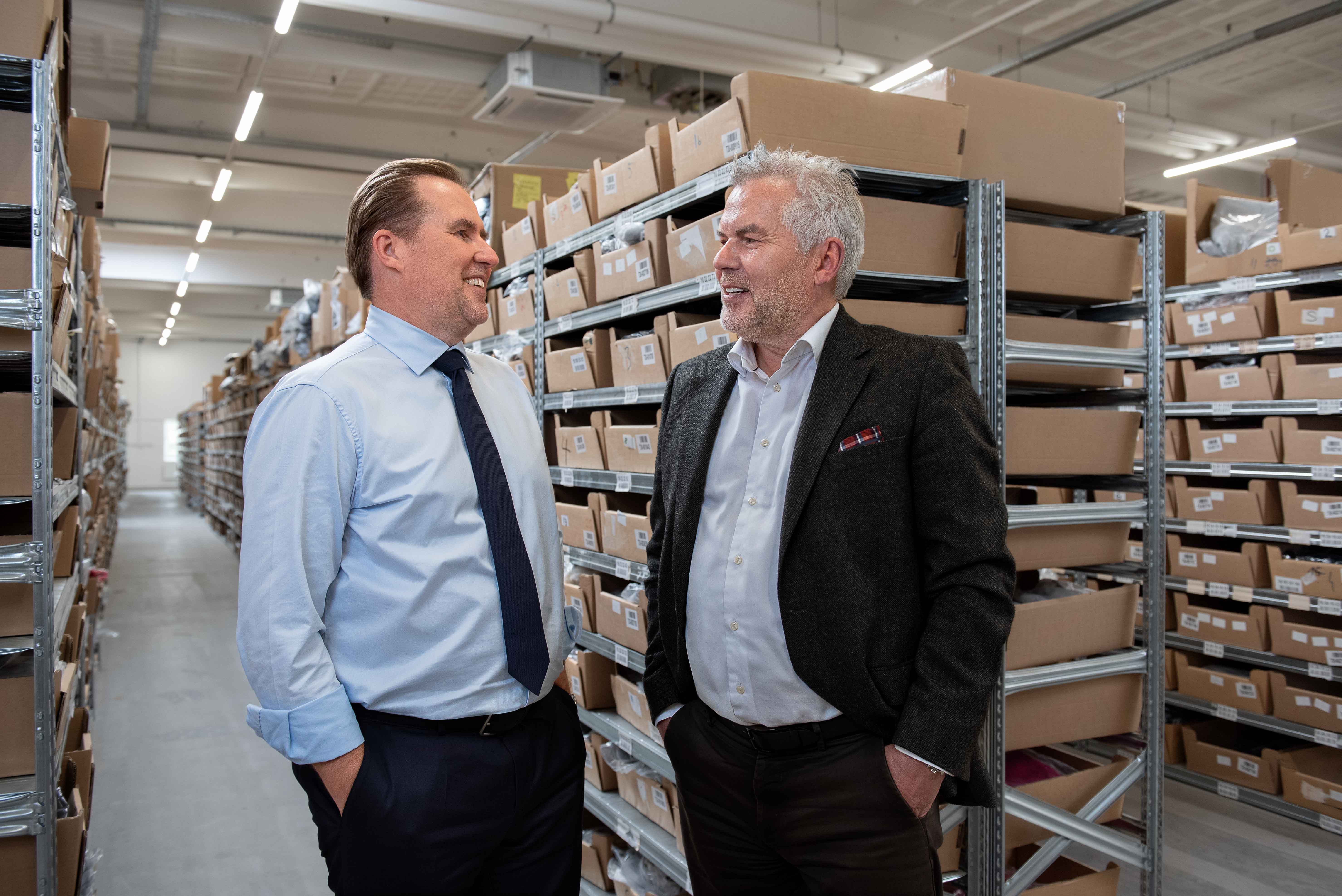
A salesman buys into the business
Born in 1970, Melgaard built his career inside freight forwarding. He began at Samson Transport before joining Mahé in the early 1990s. His work there included sales, followed by sales management and the sales director role. The route matters. Selling freight means making promises about something other people must help deliver. Relationships with customers and operating colleagues are part of the same job.
In 2004, he and Jessen became investors and joint CEOs of Mahé. That is the useful starting point for understanding the co-founder title he carries today. Mahé already existed; its history reached back to 1975. Melgaard's founding role belongs to the business that developed through investment, merger and expansion, rather than to the original creation of that predecessor.
The Scan Global Logistics name arrived in 2007, when Mahé and ScanAm combined. The pairing brought together airfreight and ocean-freight backgrounds. Melgaard became chief commercial officer. For someone whose earlier responsibilities had centred on sales, the position kept him close to the relationship between what a customer needed and what the network could arrange.
His appointment as Group CEO took effect on 20 November 2017. At the time, he retained the commercial role alongside it. Chairman and outgoing CEO Henrik von Sydow pointed to his entrepreneurship and understanding of customer expectations. Melgaard's stated priority was continuity: tailored transport solutions, customer attention and the ability to move quickly. After years inside the business, he was taking responsibility for its next stage.
One name, many local relationships
The expansion required partners with capital as well as colleagues with forwarding experience. AEA invested in 2016. The North American business TransGroup became part of the same ownership structure, adding a substantial presence across the Atlantic. In May 2021, the two businesses announced that they would operate together under the Scan Global Logistics name.
There was a concrete organisation behind that branding exercise: TransGroup brought 525 full-time employees and 43 offices in the United States and Canada into the SGL identity. Melgaard led the global executive team with the CFO. His explanation linked integration to simpler processes for customers and a wider network, while maintaining local relationships. The shared name was meant to make those different operations easier to use together.
It is easy to draw a larger network. Getting people inside it to work together takes longer. For Melgaard, growth has repeatedly involved joining an established local business to an international system. The customer may want the extra reach while still wanting to call the person who knows the shipment. Both wishes are reasonable. Satisfying them simultaneously is the job he has chosen.
The 2023 agreement to acquire Germany's ETS illustrates the approach. ETS had a base in Bremen, a Hamburg branch and two fulfilment warehouses. Melgaard emphasised its customer relationships and service philosophy alongside the ocean-freight capacity it added. Customers were promised access to SGL's network while keeping their local contacts. That last detail gives the corporate language a recognisable human consequence: the telephone number need not become a mystery.
“Our people are our most valuable asset.”
Allan Melgaard, on the CVC partnership, 2023
Capital arrives with expectations
In February 2023, CVC Fund VIII agreed to buy a majority shareholding from the AEA-led investor group. AEA and management would invest alongside the new owner. The announcement described a business with more than 150 locations in 45 countries and over 3,300 logistics professionals. It also recorded more than 30 acquisitions since 2017. The purchase programme had become a central part of Melgaard's working life.
His ambition at that point extended beyond revenue. He wanted SGL to attract talent by offering work with a clear purpose. The company's four declared virtues include respect, integrity, entrepreneurship and fun. The last is an unusually cheerful item to place beside the paperwork of global transport. It also raises a fair question for any growing employer: will the daily experience resemble the language used to recruit people?
Melgaard has discussed the problem of preserving a company's character with Morten Albæk, the philosopher and founder of Voluntās. Their public conversation about organisational identity during growth gives the subject room beyond an acquisition announcement. In a business assembled across countries, explaining how colleagues should treat each other has operational consequences. A network depends on people answering one another.
Another connection brought a different sort of experience. Nils Smedegaard Andersen, formerly chief executive of Maersk and Carlsberg, became chairman in 2023. Melgaard welcomed the industry knowledge behind that appointment. His own career had developed largely within the company and its predecessor; the board now included someone who had led businesses of a different size and shape. Expansion was changing the company around him, too.
India, after the wait
India offers a useful test of Melgaard's professed patience about people. At the September 2025 launch, he explained that direct operations there had been a long-standing objective. SGL had used partners and agents, and had examined acquisition opportunities without proceeding. He said cultural fit had influenced those decisions. The eventual entry began with Mumbai, Chennai and Delhi under India CEO Vikash Agarwal.
“Culture is essential for us,” Melgaard said. The phrase can sound comfortable until it delays a deal. Here, he described having stepped away from possible acquisitions while looking for the right team. The launch therefore supplied an example of what his recurring emphasis on people could mean for an investment decision, rather than merely for an internal presentation.
The announced plans were substantial: eight Indian locations by the end of 2025, followed by a nationwide network of 15 to 20 offices within three years. Those were plans, with the uncertainty that word deserves. Melgaard identified larger small and medium-sized businesses seeking international support as customers worth pursuing. His argument was that competing only on price left too little room to build the service those customers needed.
He also gave the growth ambition some flexibility. The Vision 2027 discussion included a €5 billion revenue goal, but he placed more emphasis on setting direction than on whether it arrived in 2027 or 2028. A deadline can focus an organisation. It can also become a very expensive reason to hurry. His remarks left room for judgement about the route.
The bigger business has a harder exam
The financial picture brings necessary friction to this story. For 2025, SGL reported revenue of €2.526 billion and EBITDA before special items of €219 million, alongside a net loss of €91 million. Financing and refinancing expenses, restructuring and other special items weighed on the result. Melgaard defended the underlying operations while acknowledging that building the network carried financial costs.
Three different measures. EBITDA before special items does not represent the final profit or loss.
By August 2026, the challenge was sharper. Second-quarter air and ocean volumes had each risen 17% from a year earlier. Revenue reached €710 million, yet gross profit was almost unchanged at €144 million. EBITDA before special items was €50 million, compared with €51 million a year earlier. More freight was passing through the network without producing an equivalent improvement in earnings.
Melgaard's response combined commercial discipline, services around the main transport leg and a larger SME customer base. He also described automation, artificial intelligence and standardised processes as ways to improve productivity and cash generation. These priorities put a practical boundary around the freedom he advocates. Local initiative has to produce results that the whole company can sustain. Busy warehouses alone cannot settle that account.
The brief thank-you
A small personal detail offers a quieter ending. In a public LinkedIn post thanking people for birthday greetings and colleagues for a virtual celebration, Melgaard opened by saying he rarely posted. The note was brief, affectionate and signed off in the comments with a Danish thank-you. It was a glimpse of the relationships behind his frequent public references to colleagues.
His story now stretches from sales work to ownership, through a merger, successive investors and an international organisation. The next chapter depends on how well that organisation earns from the reach it has built. Melgaard continues to argue for responsibility close to the customer. The old warehouse episode remains a useful measure of the argument: when something goes wrong, someone has to be able to act.