A weather website is an unlikely place to look for the beginnings of an advertising software company. People arrive with admirably modest ambitions: should they pack a coat, carry an umbrella, postpone the picnic? Alexey Boltivets found another question waiting behind the forecast. What could a business do with the audience once it had arrived?
His internet career began in 1999. Website development led to Meteoprog, then the travel portal Turistua. Encounters with advertising networks while expanding Meteoprog abroad suggested a larger opportunity. The websites became Admixer’s first publishers; development began in late 2008, with an operating launch in March 2009.
There is a pleasing economy to that beginning. A founder running websites meets the business of selling their advertising, then starts supplying the machinery. The experience travels from one side of the transaction to the other. Eventually, people who have never checked his weather forecast have a reason to become his customers.

The business behind the rectangle
Advertising technology can make an ordinary activity sound like a diplomatic negotiation between acronyms. A DSP buys advertising. An SSP helps sell it. An ad server manages delivery. The vocabulary becomes easier when someone has a page to fill and somebody else has a message to put on it.
Boltivets’s company has built products on both sides. Admixer’s history dates its SSP to 2016 and its DSP to 2018. It also records an Agency Tech Stack in 2019 and an In-House AdTech Stack in 2020. The sequence describes an expanding set of customers who want more of the operation under their own control.
These are company milestones, involving teams of engineers and commercial staff. Their relevance to the founder is the direction they reveal: repeatedly turning an advertising activity into software that another organization can operate. Selling an advertisement solves one transaction. Providing the system creates a reason for the customer to return tomorrow.
Tools for the transaction become a business of their own.
A demonstration still needs a person
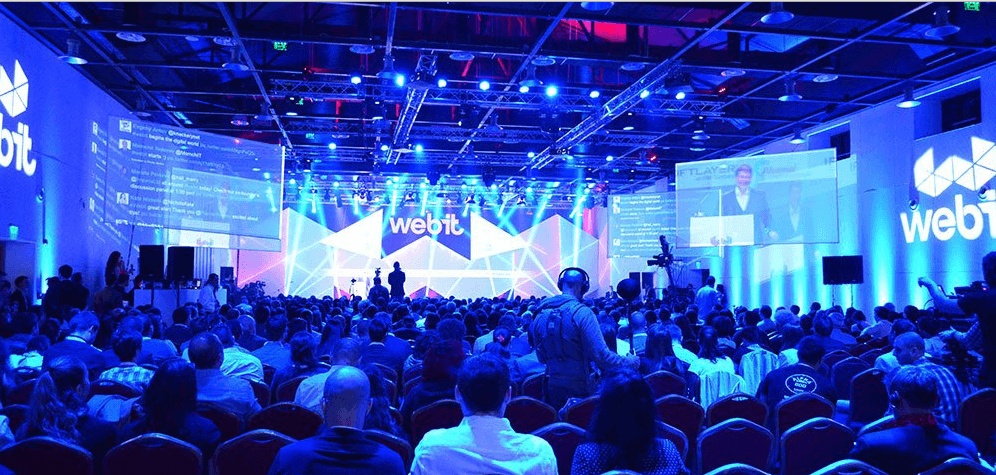
In April 2016, Boltivets and Admixer’s chief marketing officer, Anna Yatel, were at WEBIT in Sofia demonstrating the company’s Creatives product. The event mixed advertising people with founders, policy makers and technology businesses. For a company selling the apparatus behind advertising, a demonstration offered something a catalogue could only describe.
The gathering also produced a small piece of advertising industry comedy. The festival’s founders competition chose the ad blocking company AdGuard as its winner. Admixer’s account of the event registered its surprise: advertising had helped promote the conference, and an opening speech had discussed the damage from ad blocking. Even an industry gathering can have an awkward guest of honour.
That irony belongs to the setting in which Boltivets works. Advertising technology must make sense to the people paying for messages, the people publishing them and the people who would rather see fewer. A product demonstration takes place in the middle of those competing interests.
By May 2019, the subject in Berlin was audience data. Admixer listed Boltivets among the executives available for meetings at DigiTech Day, alongside Ivan Fedorov, Elena Podshuvejt and Tetiana Sichko. Fedorov was to speak about using first and second party data. That means, broadly, information held through a business’s own audience relationships or shared through another business’s relationships.
These meetings also made the division of labour visible. A founder could attend with the people responsible for data products, product strategy and business development. The software needed explanations at several levels, from how it worked to what a customer could do with it.
The advertised discussion concerned practical uses: understanding audiences, allocating budgets and improving campaigns. The customers needed both a product and an explanation of the choices behind it. Boltivets’s appearance on the meeting list places him in that commercial work, among colleagues with distinct product responsibilities. International expansion also involves a succession of fairly specific conversations.
More than a pin on the map
That same month, Admixer announced an office in Chișinău, Moldova. Sergiu Cocieru would lead the local business. Boltivets described the opening as part of the company’s continuing expansion in Central and Eastern Europe. The announcement combined a software business with a regional sales presence, putting people near the agencies and brands it wanted to serve.
There is a distinction between making software available somewhere and developing a business there. The former can begin with a website. The latter brings local customers, relationships and commercial responsibilities. Cocieru’s appointment gave the expansion a person responsible for the market.
For Boltivets, the announcement marked another outward step from the Ukrainian publishing businesses where this story began. By then, the question was how an advertising technology company could distribute its products across several markets. A map shows the offices. The harder part, invisible on a map, is giving each office a useful role.
“A logical step in our business growth strategy.”
Alexey Boltivets on the Moldova office opening, 2019
A company needs a market
Boltivets’s career also leads outside the company. In 2018, he became president of the newly established IAB Ukraine. The organization’s stated work includes education, digital advertising standards and development of the local market. Those subjects sound less lively than a product launch, but a trading industry depends on them.
Standards let participants agree on what they mean. Education helps people use the tools they buy. A market organization gives businesses a place to discuss problems they share, even while they compete for customers. For a founder selling advertising infrastructure, that surrounding competence matters.
His participation continued at an international level. In February 2020, he attended the IAB Annual Leadership Meeting in Palm Desert, California, with Admixer’s CTO, Volodymyr Zakrevskyi, and programmatic director Yaroslav Kholod. The agenda included privacy and alternatives to third party cookies, the browser identifiers used across websites.
At the time, the industry was debating how advertising could adapt to changes in identification. The meeting put Boltivets among people considering questions that reached beyond any individual product: what information could be used, how participants might recognize an audience and what smaller publishers would need. Those were live discussions in 2020, with proposals and objections rather than a settled destination.
- 1999Website development begins
- 2008 / 09Admixer development and operating launch
- 2022Retail Media Machine starts within Admixer
Admixer’s 2021 work makes that discussion more tangible. The company introduced Admixer ID, developed tools for working with customers’ own audience data and released a white label RTB Stack. White label means the customer can operate technology under its own brand. RTB is the bidding process used to trade advertising in real time.
Those products address different tasks, but each concerns a customer’s ability to operate a business. Identity tools help connect audience information. Trading software gives an operator a way to organize transactions. The founder’s early experience as a publisher provides a useful way into understanding the appeal: an audience owner has commercial decisions to make after the visitors arrive.
The same year’s work also included header bidding, which lets publishers receive bids from multiple buyers simultaneously. To an audience owner, the appeal is practical: more of the selling process can be managed through a system. It is another example of the detail hidden behind the rectangle. A reader sees an advertisement. The publisher has to organize the process that gets it there.
When the network carried another message
There is another documented use of the advertising network. In March 2014, Boltivets publicly described Admixer’s antiwar banner campaigns. They targeted Russia, southeastern Ukraine and Ukraine more broadly with information and messages of unity. Partner sales houses Digi Media and TAKiTAK also joined the initiative.
The activity used the same practical capabilities as a commercial campaign: participating websites, advertising formats, geographic targeting and links to material people could read. Boltivets said none of Admixer’s partner sites had refused to take part.
The participating network included sites such as Liga.net, Prom.ua, Sinoptik.ua and Hotline.ua. The banners linked to information and public statements, including material by musician Andrey Makarevich. Different placements could carry different messages to different audiences. Familiar advertising techniques acquired a public purpose, using the reach that the network and its publishing partners had already built.
It is a concrete episode in a career otherwise described largely through software and market expansion. Advertising infrastructure distributes messages; the purpose of those messages can change. Here, Boltivets explained a public position through an action his company could carry out. The available machinery was the machinery of his working life.
The shop becomes a publisher
The newer chapter brings him to Retail Media Machine, which identifies Boltivets as its founder and CEO of Admixer Group. RMM began inside Admixer in 2022. Its focus is advertising infrastructure for retailers and marketplaces, organizations that already have audiences through the business of selling things.
That audience relationship gives the story a familiar shape. A retailer can have digital space and customers whom advertisers want to reach. Operating an advertising business then requires tools for managing placements, campaigns and data. RMM offers a modular platform for bringing that technology into the retailer’s operation.
The company names Rodion Pryntsevsky and Ivan Fedorov alongside Boltivets in its leadership team. Familiar colleagues, a different customer setting. The move carries years of advertising work into a narrower commercial problem, with retailers taking the place once occupied by website publishers.
There is a long distance between a weather forecast and a retail media platform. Boltivets’s career supplies the connecting steps. First, run a business with an audience. Then learn what serving advertisers requires. Build tools that other operators can use. The banner on the page is small. Behind it sits enough work for a founder to keep finding another business.