Seven months is a long time to live inside a question. Alex Xiao and his co-founder Stella Qin spent that long traveling by RV across the United States before they began building Evotrex. They did not go merely to admire a national fondness for folding chairs. They went to watch where the extension cords ended.
The people they met were changing. Campers were younger, more connected and intent on going farther than the familiar plug-and-stay campground. They wanted to ski, hunt, fish, work remotely and remain in the wild for four or five days. They also wanted their gadgets, their climate control and, one suspects, coffee made without a lecture from the battery meter. Traditional RV life did not comfortably support that combination.
For Xiao, the problem arrived in a familiar language: power, product and the user. He had spent more than a decade at Anker, joining as its first product manager and rising through a succession of product leadership roles. The objects there could fit in a hand. His next one would measure nearly 29 feet and contain a kitchen, two queen beds, a dry bath and enough interdependent systems to make a pocket charger look like a pleasant afternoon.
“The first thing is you need to find the real customer demand. The second is you need to deliver a really good product, and third is: The customer will say the story for you.” Alex Xiao
The research tripSeven months before the first bolt
There is an old temptation in technology to treat expertise as permission to skip observation. Xiao seems to have drawn the opposite conclusion from his Anker years. Experience supplied a method, not an answer. He and Qin went into the field before they chose the machine.
Their conclusion was that off-grid travel had an energy problem disguised as a lifestyle choice. A large battery offered quiet, clean power but eventually needed a charger. A conventional generator offered endurance but brought noise, inefficiency and the usual ritual of running a separate appliance to support the appliances. Electric tow vehicles faced an additional indignity: hauling a trailer could consume the very range needed to reach a remote campsite.
Evotrex, founded in 2024, proposed to combine the parts. Its PG5 stores electricity in a 43 kWh lithium iron phosphate battery, gathers it from 1.5 kW of rooftop solar and recovers some energy while being towed. An integrated gas-powered Horizon generator can recharge the system when sunlight and braking are not enough. An electric drivetrain can assist the tow vehicle rather than remaining dead weight. The company says the combined system can provide more than 270 kWh of usable energy in one cycle.
The trailer as an energy loop
Three inputs, one managed battery system, several jobs beyond camping.
The point, in Xiao’s telling, is not simply to keep the air conditioner humming in a picturesque nowhere. Vehicle-to-vehicle charging can support an electric tow car. Vehicle-to-home capability can turn the trailer into backup power during an outage. Parked at home, it can be a guest room, an office or an extra room that happens to have all-terrain tires. The rarely used RV, traditionally a depreciating object in storage, is invited to find a second occupation.
The operator's inheritanceFrom the pocket to the hitch
Anker is the obvious prehistory. Xiao joined in 2011, shortly after university, and became its first product manager. Over more than a decade he helped develop products that reached tens of millions of users. The company taught a generation of travelers to carry their own small reserve of electricity. Evotrex enlarges that proposition until one can sleep inside it.
The similarity is not just electrical. Xiao describes a durable hardware company as a coordination problem. Product definition, research and development, supply chain, distribution and service must all work together. None is decorative. A trailer that contains propulsion assistance, energy management, water, climate and domestic fittings is a small republic of failure modes. Each department gets a vote.
The team around him reads like an answer to that complexity. Qin brought Anker brand experience and first-hand van life. Chief technology officer Bruce Yang came from automotive research and development at Geely. Chief operating officer Jack Zhan carried more than two decades of manufacturing, procurement and quality work across IBM, Lenovo and Anker. Marketing chief Ivan Wang arrived with experience at Xiaomi, Faraday Future and Pebble, plus years as an early Tesla and Rivian owner. Xiao’s own contribution sits at the junction: the consumer-product habits of charging electronics, the impatience of a gearhead and the unusual willingness to spend seven months watching before deciding what to build.
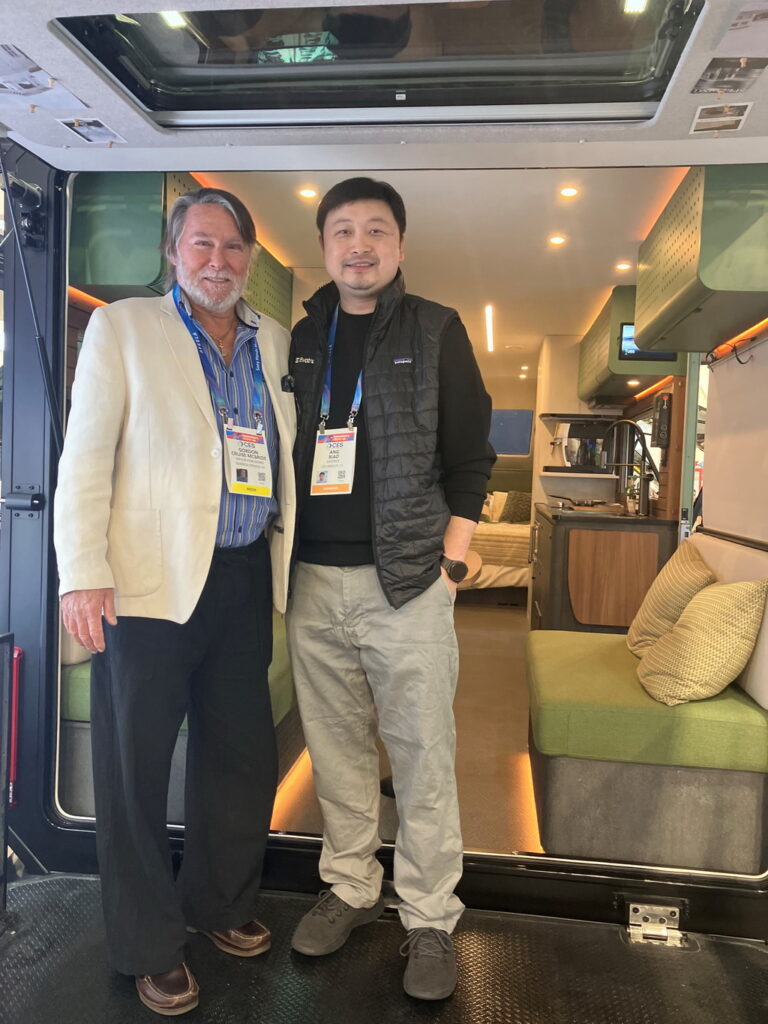
The PG5’s public doorway opened at CES in January 2026, after Evotrex emerged from stealth the previous November with $16 million in Pre-A funding. Xiao walked visitors through the prototype, explaining how the generator, solar array, battery and tow assistance behaved as one system. Prices opened at $119,990, with a fully equipped version listed at $159,990. By June, the company said roughly 90 percent of its order book was for the higher-priced trim.
- Joins Anker as its first product manager.
- Founds Evotrex after seven months of RV market research.
- Emerges from stealth with $16 million in Pre-A funding.
- Debuts the PG5 at CES in Las Vegas.
- Raises a $30 million Series A for testing and production readiness.
A revealing hireService arrived before sales
One detail cuts through the theatrical fog that often surrounds new vehicles. Evotrex hired its first service employee roughly six months before its first salesperson. Xiao offered the sequence as evidence that the company was preparing to support owners before accelerating the order book. It is not glamorous. It may be the reassuring sentence investors forget to ask for.
Durability remains the immediate test. By June 2026, Evotrex had validated a functional PG5 but expected another 10 to 12 months of extensive work. The announced program includes towing and range tests, energy management evaluation, braking and lateral stability assessment, structural durability, rain exposure, water fording and regulatory compliance. First customer deliveries are now planned for 2027.
That schedule describes the difficult middle of physical innovation. The concept has escaped the sketchbook, but the product has not yet accumulated years of owner stories. Xiao wants those stories to carry the marketing. The machine must earn them first, one owner and one rough road at a time.
The company plans to manufacture in China and complete final assembly in California. Los Angeles offers access to customers and, conveniently, an anthology of testing climates nearby. The international plan also exposes Evotrex to trade policy and supply-chain complexity. Xiao is under no illusion about the elegance of the task. Building an RV company, he has said, is complicated because excellence must occur in many places at once.
The competitive instinctA race car driver who wants a crowded track
Xiao is a licensed race car driver, an appealing biographical detail for an automotive founder. Yet his public attitude toward business competition is notably collective. “We are not afraid of competition, competition is a good thing,” he has said. “We educate the market together, we grow the market together.”
The remark is more strategic than sporting. Electric and hybrid trailers remain an emerging category. Lightship and Pebble are pursuing all-electric approaches; Evotrex has chosen a range-extended system with an onboard engine. Every credible product teaches consumers that a trailer can participate in towing, manage energy intelligently and operate beyond a hookup. In a young market, attention is infrastructure.
Still, the approaches embody different compromises. Evotrex keeps gasoline in the equation so that owners can replenish energy where chargers do not exist. It is a practical bridge rather than a purity test. Xiao’s aim is not to eliminate every compromise on a specification sheet. It is to remove the compromise his seven-month trip revealed: the choice between going farther and bringing modern life along.
“We are not afraid of competition, competition is a good thing. We educate the market together, we grow the market together.” Alex Xiao
The second actThe customer gets the final line
Evotrex’s June 2026 Series A added $30 million, bringing total disclosed funding to $46 million. The money is assigned to final product development, automotive-standard validation and production preparation. The company has spoken of reaching roughly 1,000 units a year. Investors can fund the route. They cannot flatten it.
Xiao’s career now spans two scales of portable power. At Anker, the promise was reassurance in a pocket. At Evotrex, it is reassurance on a hitch. The new object is larger, costlier and more complicated, but his three-part rule remains almost suspiciously simple: locate real demand, deliver a good product and let the customer speak.
That last step is still ahead. For now, there are prototypes, preorders, financing and a long validation list. There is also the founder’s seven-month question, answered not with a slogan but with a machine still being tested. The road is an unforgiving editor. Xiao appears content to let it have the next draft.