Breaking
XANDER wins CES 2024 Innovation Award - Accessibility & Aging Tech VUZIX begins supplying custom Shield AR glasses to Xander REORDER Xander places its largest-ever order to meet demand ~$2.8M raised to caption the world MISSION 1.5 billion people live with hearing loss
Co-Founder & CEO, Xander

Alex
Westner

He spent eighteen years teaching machines to hear. Now he is building glasses that help people read what was said.

MIT Media Lab AR captioning Audio engineer Founder
Alex Westner, co-founder and CEO of Xander

The keytarist who grew up to chase a single voice across a noisy room. // CEO, Xander

The Pitch

Subtitles, but for real life

Put on a pair of Xander's glasses and the room starts to write itself. Whatever the person across the table says appears as text, floating in the lower edge of your vision, a half-second behind the words. No phone in your hand. No app to open. No conversation routed through a server farm. Just an on switch, an off switch, and the sentence you would otherwise have missed.

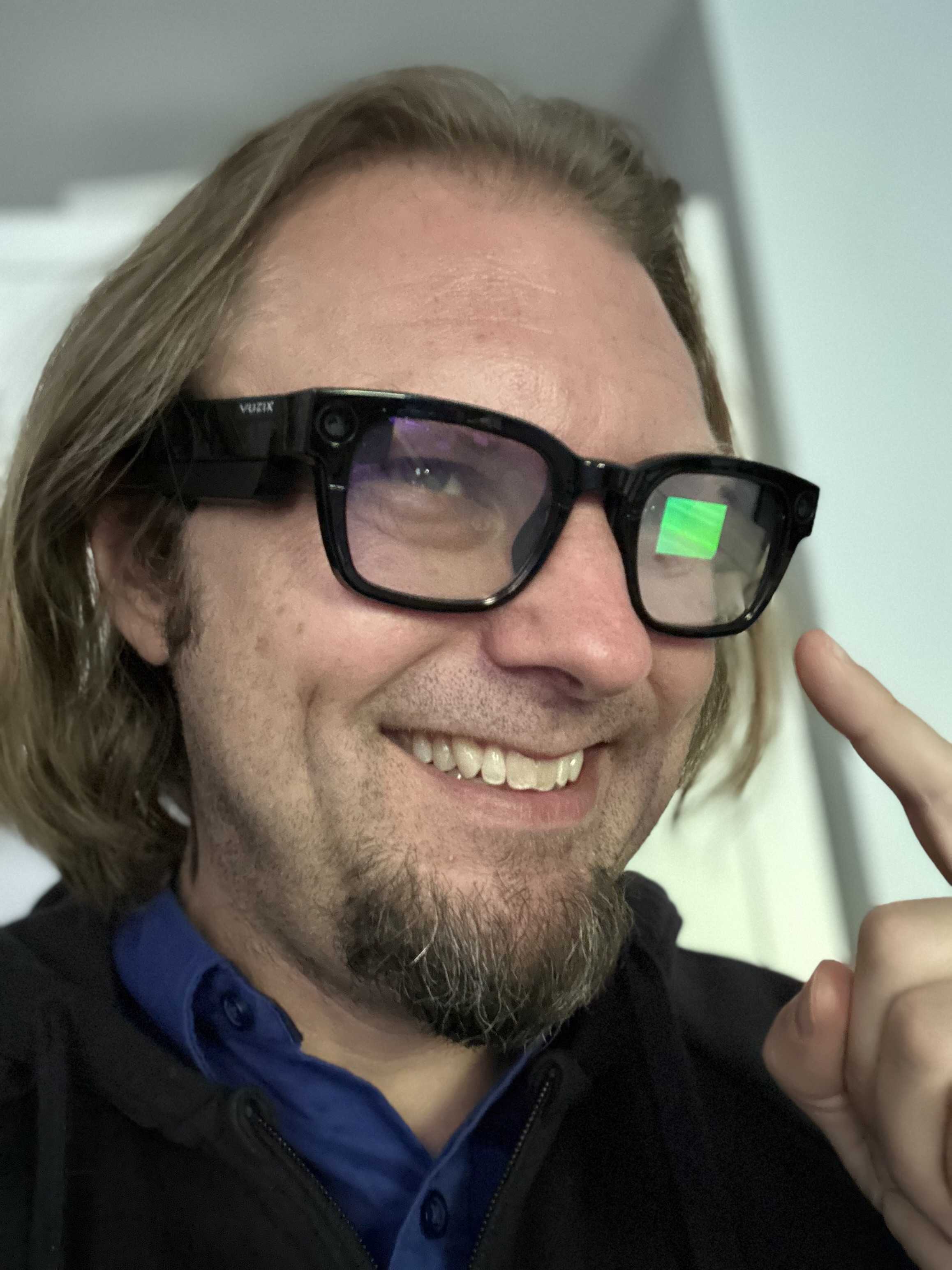
That is the product Alex Westner has spent the better part of a decade refusing to compromise on. Xander, the Raleigh-based company he co-founded in February 2020, builds live-captioning augmented reality smart glasses for people who have trouble following speech. The hardware runs on Vuzix Shield frames; the intelligence runs entirely on-device. Westner treats the offline, private, self-contained design as the whole point, not a footnote.

It is a strangely specific obsession, and it did not arrive out of nowhere. Westner has been circling the same engineering puzzle for roughly twenty-five years: how do you pull one voice out of a sea of noise, and what do you do with it once you have caught it?
By The Numbers
2020
Xander founded
~$2.8M
Total funding
18 yrs
In audio tech
1
Engineering Emmy touched
Hearing loss, global
1.5B people
Hearing loss, US
48M people
Xander team
~23 people
Caption the world. - Xander's mission, stated without hedging
Origins

The cocktail party problem

At the MIT Media Lab in the late 1990s, Westner studied something engineers call the cocktail party problem: the everyday miracle of a human picking one conversation out of a crowded, clattering room, and the maddening difficulty of getting a computer to do the same. He worked on microphone arrays and on training machines to separate individual voices from the surrounding din.

Before any of that, he was an electropunk keytarist. He calls it a blend of music and business, and it is not a throwaway line. The same instinct that wants to know how a sound is built and how a crowd responds to it runs straight through his later work. He earned an electrical engineering degree at Rutgers, then the master's at MIT, and the question stuck.

What is unusual is the through-line. Most people change the subject. Westner kept the same subject for a quarter century and just kept changing the tools. Microphone arrays became audio software became, eventually, a pair of glasses. The voice he wanted to isolate stopped being an academic abstraction and became the voice of the person sitting across from someone who could not quite hear it.

The leap from separating sound to displaying it is bigger than it looks. It meant accepting that the most useful thing you can do with a captured voice is not always to play it back louder. Sometimes it is to write it down.

The Audio Years

The Photoshop for Sound

For eighteen years, Westner was a product leader at audio and music technology companies - the kind of person who decides what software should do, then convinces the rest of the world to want it.

He joined iZotope in 2010 as a business-development manager, launching the company's technology-licensing program and running B2B sales. He climbed through director roles in business development, product management, and product strategy, closing licensing deals across markets and building teams. The product the work is best remembered for is iZotope RX, an audio-repair tool so capable that the industry took to calling it the Photoshop for Sound. RX earned an Engineering Emmy Award and became a standard fixture in studios and editing suites.

His resume reads like a tour of places that take sound seriously: Cakewalk, iZotope, Gibson, and a stint as president of Spark23 from 2016 to 2020. Then a swerve - in 2018 he joined Fidelity Investments, rising to vice president of product management. By every conventional measure he had arrived. Which is usually the moment people stop. Westner started a company instead.

// SIGNATURE WORK

iZotope RX

The audio-repair suite nicknamed the Photoshop for Sound. Engineering Emmy winner, studio standard, and proof that Westner ships tools people actually keep.

// THE PIVOT

Side hustle, 2020

Xander began as a side project in February 2020. It outgrew the side and became the whole thing.

The Arc

From microphones to midair text

1996 - 1998
Researches microphone arrays and the cocktail party problem at the MIT Media Lab.
2010
Joins iZotope; later directs product management and strategy. Works on RX, the Emmy-winning Photoshop for Sound.
2016 - 2020
President of Spark23.
2018
Joins Fidelity Investments, rising to VP of Product Management.
Feb 2020
Launches Xander as a side project to caption real conversations.
2023
XanderGlasses, powered by the Vuzix Blade, debut at CES. Co-founder Marilyn Morgan Westner joins officially.
2024
Named a CES Innovation Award Honoree in Accessibility & Aging Tech.
2024 - 2025
Vuzix supplies custom Shield AR glasses; Xander places repeat and record reorders to meet demand.
The Object

What the glasses actually do

The design choices are the argument. Westner could have shipped something that leaned on a phone in your pocket and a model in the cloud. He didn't.

// 01

On. Off.

Two states. The glasses are meant to be used by anyone, including people who have no interest in pairing a device or learning an app. Simplicity is the feature.

// 02

No cloud, no phone

The captioning runs on-device. Nothing about your conversation gets shipped off to a server, which is both a privacy stance and a reliability one.

// 03

Captions in your sightline

Real-time speech appears in the wearer's field of view on Vuzix Shield frames, so eye contact and the conversation can coexist.

// 04

Built for the room

Designed for in-person talk - the dinner table, the meeting, the doctor's office - rather than for media you are already watching with subtitles.

// 05

Veterans first

Xander entered the U.S. Department of Veterans Affairs innovation program, putting captioning glasses in front of the people who need them most.

// 06

Next: translation

Westner has hinted the same pipeline could move from speech-to-text to speech-to-text translation, captioning not just the deaf room but the foreign one.

1.5 billion people around the world struggle with the effects of hearing loss. - The number Westner builds against
Receipts

Trophies and reorders

Awards are nice. Repeat purchase orders are better. Xander has both. The glasses were named a CES 2024 Innovation Award Honoree in Accessibility & Aging Tech and won the CTA Foundation's Eureka Park Accessibility Contest - the recognition lane for hardware that takes accessibility seriously.

The more telling signal is commercial. Xander's hardware partner, Vuzix, has publicly announced supplying custom Shield AR glasses and has noted Xander placing repeat and record-setting reorders to keep up with demand. A startup that keeps reordering is a startup whose product is leaving the building.

// AWARDCES 2024 Innovation Award Honoree, Accessibility & Aging Tech.
// AWARDWinner, CTA Foundation Eureka Park Accessibility Contest.
// PARTNERVuzix Shield frames power the glasses; reorders keep growing.
The Person

Curiosities, on the record

// BEFORE THE BOARDROOMHe played electropunk keytar. The stage instinct never fully left.
// THE LONG GAMEHe has spent roughly 25 years on one question: how do you separate one voice from the noise?
// READING LISTHe points to The Three-Body Problem and The Obstacle Is the Way as influences on his thinking.
// THE CO-FOUNDERMarilyn Morgan Westner, who holds a PhD in history, co-founded Xander and leads content.
// OFFLINE BY DESIGNIn an industry sprinting to the cloud, his flagship choice was to stay off it.
// FROM RX TO ARHe went from repairing recorded sound to displaying live sound - same obsession, new medium.
Where It's Going

A world that captions itself

The aspiration is not subtle, and Westner does not pretend it is. Make speech visible. Keep it private. Keep it simple enough that anyone can wear it. Then point the same technology at language barriers and let the glasses translate as easily as they transcribe. The plan is to caption the world - and then to do it in every language the world speaks.

The Rolodex

Find Alex Westner

Spread The Word