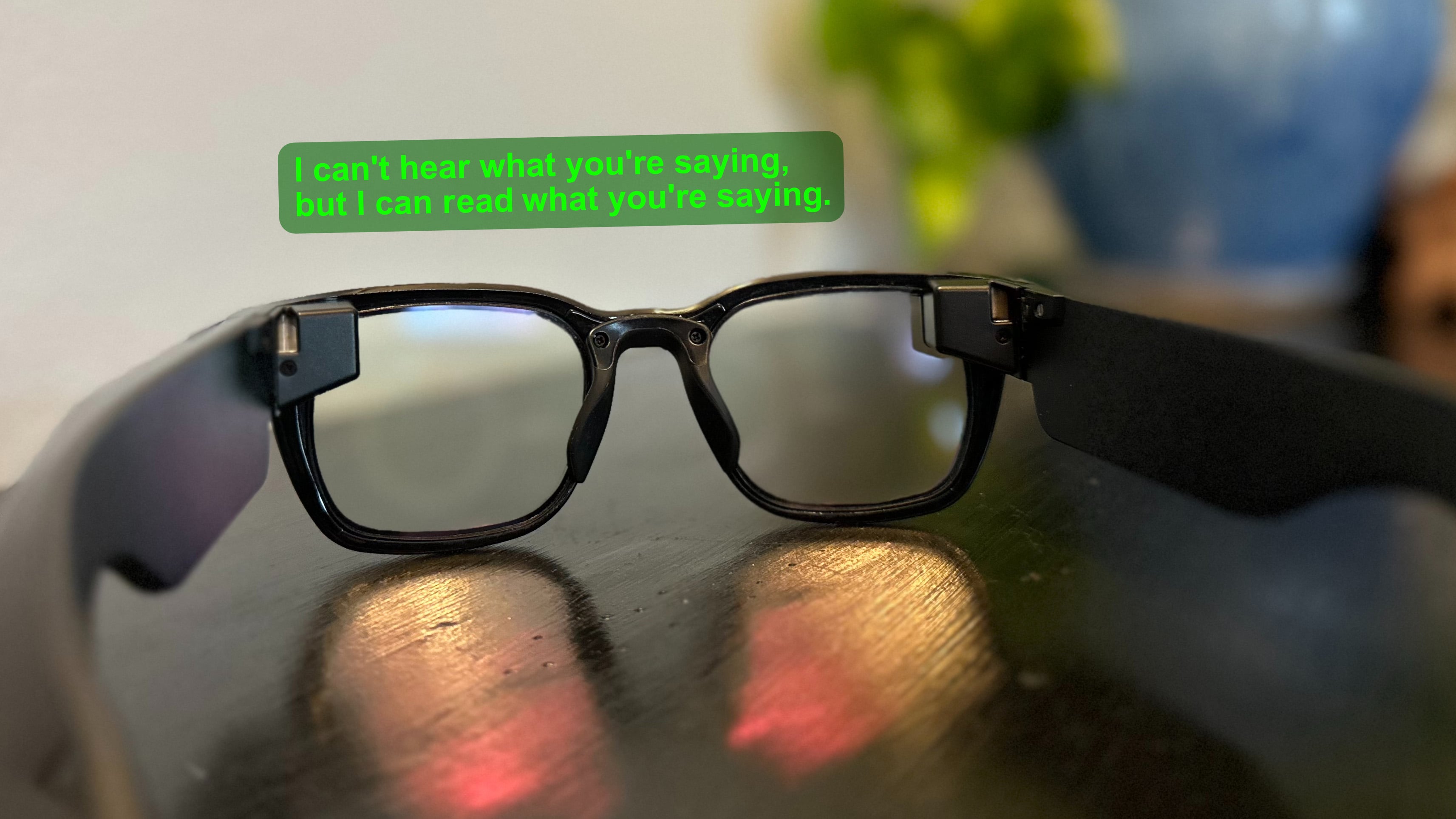
Picture a dinner table. Six people, three conversations, one clatter of forks. For roughly 48 million Americans with hearing loss, that scene is not a party - it's a wall. The words are there; they just don't arrive. Xander's answer is disarmingly literal: if you can't hear the sentence, read it.
XanderGlasses look like a chunky pair of sport frames. Behind the lenses, multiple noise-canceling microphones pick up whoever is speaking nearby, and the words appear as captions on both lenses - live, in your line of sight, while you keep looking at the person's face. No phone to fish out. No app to babysit. No awkward "sorry, one more time."
The trick that separates Xander from a smartphone captioning app is where the thinking happens. The speech-to-text runs on the glasses, offline. That means captions in a basement, on a plane, or in a doctor's office with no signal. It also means the most private thing you own - your conversations - never leaves your face for a server somewhere.
Xander is an MIT Media Lab spinout, and it shows in the pedigree. Co-founder and CEO Alex Westner earned his master's at the Media Lab for acoustics and audio processing, then spent two decades in professional audio at iZotope, Gibson, and Fidelity. He started Xander as a side project in February 2020 after time at Massachusetts Eye and Ear got him thinking about sensory substitution - using one sense to stand in for another.
His co-founder is his wife, Marilyn Morgan Westner, a historian with a PhD and twenty years at Harvard, Harvard Business School, and UMass Boston. She joined officially in 2023 after years of user testing and research shaped the product. The couple traces their motivation to a line from Stephen Hawking: build technology that helps others.
The name of the mission came from an audiologist. When Alex described what he wanted to do, the specialist told him to "caption the world." He took it literally, and it's stayed the company's north star ever since.