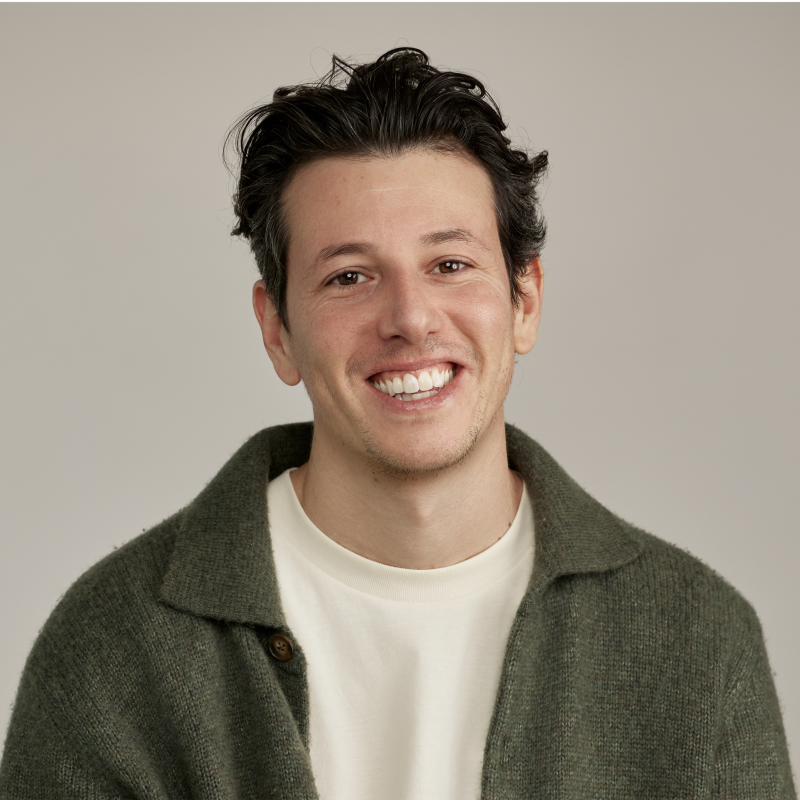
The phone buzzed in the middle of a lecture. Tomer Aharoni let it go - and then sat with a question most people never ask: if you couldn't hear it ring, or speak into it, how would you ever take the call? That stray thought, in a Columbia classroom, is the whole origin of Nagish.
Nagish is an app that lets Deaf and hard-of-hearing people place and receive phone calls by typing and reading. You dial a number, type what you want to say, and the AI speaks it aloud to the person on the other end. They talk back, and Nagish captions it on your screen in real time. No human operator. No interpreter scheduled three days in advance. No brother making the call for you. The name is Hebrew for "accessible," and Aharoni means it as a spec, not a slogan.
Today he is co-founder and CEO of a company that is FCC-certified, offered free to users through US government subsidies, and backed by $16 million. But the more interesting fact about Tomer Aharoni is that he was kicked out of high school in the 10th grade. "I failed basically every single class," he says. The boy with severe ADHD who couldn't survive an Israeli classroom would later publish natural-language and Internet-of-Things research at Columbia, get offered a PhD, and turn it down. He keeps the failure in the story on purpose. It is the proof that the system, not the person, is what usually needs fixing - which happens to be the entire thesis of his company.
"Communication should be accessible and private."
- Tomer Aharoni, Co-founder & CEO, Nagish
A two-week trip that never ended
Aharoni grew up in Israel and served as a technological intelligence analyst in the Israel Defense Forces before flying to New York to visit a friend for two weeks. He stayed. A decade later he is still there. He enrolled at Columbia, started in psychology, switched to computer science, and kept psychology as a minor - a tell, maybe, for someone whose product is less about audio engineering than about how people actually want to be spoken to.
The idea didn't arrive as a business plan. It arrived as discomfort. After the phone rang in class, he and co-founder Alon Ezer went and asked Deaf people a blunt question: how do you use the phone? The answers landed hard. "I just hang up when someone calls me." "I don't use the phone." "I ask my brother to call for me." A summer internship at Bloomberg sharpened it further - a Deaf colleague needed two interpreters for every meeting, and interpreters fluent in technical jargon were nearly impossible to find. The gap wasn't a niche. It was a wall millions of people had quietly learned to live behind.
Born at a hackathon
The first version of Nagish was a proof-of-concept built on Facebook Messenger during a Columbia hackathon. Rough, scrappy, real.
Google came knocking
The hack caught Google's eye - it became a case study and earned the founders a speaking slot at Google Cloud Next.
Then the world went remote
When COVID-19 hit in 2020, the phone stopped being optional for anyone. Demand for a captioned-calling tool spiked, and Aharoni and Ezer left their jobs to make Nagish a real company. The grind that followed was regulatory, not glamorous: Nagish earned FCC certification in January 2024, then a second certification in December 2024 that lets it provide service at no cost to users by drawing on the same federal relay subsidies that fund traditional human-operator services. In July 2024 the company announced $16 million in funding, including an $11 million Series A led by Canaan Partners, with backers ranging from K5 Global to the founders of Datadog and Looker.
Along the way it picked up the Zero Project's "Innovative Solution 2024" award - the certificate he is holding, slightly bemused, in the photo above. For the high-school dropout, it is a funny kind of report card.
"Everything we build from day 1 is built with the Deaf community."
- on why the first employee, Matt, is Deaf and runs community
Built with, not for
There is a difference between building for a community and building with one, and Aharoni treats it as load-bearing. Nagish's first hire, Matt, is Deaf and serves as head of community. The product was shaped in close work with Deaf individuals from the first iteration, and the company has kept hiring Deaf employees since. It's the opposite of the standard accessibility afterthought - the ramp added once the building is finished.
He's careful about the AI story, too. The point isn't to replace the interpreters and stenographers people rely on. "What we're building isn't meant to replace interpreters," he says, "but to complement their work and make accessibility more scalable." Privacy sits at the center of the pitch: with no operator listening, a call about your bank balance or your doctor stays yours. Users keep their own phone numbers, save transcripts, and even build a personal dictionary so the AI spells the names and jargon that matter to them.
His most quietly devastating statistic isn't about funding. It's about delay: it takes people, he notes, "between seven to nine years to take an action once they start losing their hearing." Nine years of hanging up, of asking a sibling, of pretending the phone didn't ring. The whole company is an argument for shrinking that number toward zero.
Type to talk, read to listen
Dial inside the app. Type your words; the AI voices them to the caller. Their reply lands on your screen as live captions. Your own number stays yours.
A dictionary of you
A personal dictionary lets users index unusual names and words, so the AI stops mangling the people and jargon that actually matter to them.
The subsidy that makes it free
The "$0 to the user" line isn't a launch promo - it's the regulatory architecture. In the United States, telecommunications relay services for people with hearing loss are funded through a federal program, and the FCC certifies providers to draw on it. That's why the two certifications matter so much: the first, in January 2024, put Nagish on the map; the second, in December 2024, is what lets an AI-driven service - not just the traditional human-operator kind - reach users without charging them. Aharoni effectively argued that software could do, at scale, what the old model did one interpreter at a time. The government agreed.
That scale is the quiet radical part. A human relay operator can handle one call at a time. Software doesn't tire, doesn't need a calendar, and doesn't need to be booked days ahead with a specialist who happens to know your industry's vocabulary. For Aharoni, the Bloomberg memory - a colleague needing two interpreters, neither fluent in the tech being discussed - is the exact bottleneck the AI is meant to dissolve. Not by firing the interpreters, but by handling the everyday calls that never should have required one.
It helps that he and Alon Ezer are engineers first. Aharoni built things at Bloomberg; he published NLP and IoT research at Columbia. The pair didn't approach accessibility as outsiders with a feel-good mission bolted onto a generic app - they approached a hard speech-and-language problem with the unglamorous patience it demands. The mission and the math point the same direction.
What's next: teaching machines to sign
Captioning calls was chapter one. Nagish has acquired Sign.mt to push into AI-powered sign-language translation, with a team led by Dr. Amit Moryosef, starting with American Sign Language. Aharoni frames the work with characteristic patience: "We're prioritizing progress over perfection, which takes time - but our end goal is perfection." Ask him what success looks like and he'll skip the valuations. "If, ten years from now, we've built a platform that helps millions communicate freely in their own language, and that was shaped hand-in-hand with the Deaf community, then I'd say we've succeeded."
It's a long way from a phone he didn't answer in class. Then again, the not-answering was the point.