The CEO of AcuityMD spent his Bain years staring at commercial strategy decks for medical device makers and noticing something a little odd: the people who built pacemakers and orthopedic screws were selling with tools their biopharma neighbors would have thrown out a decade earlier. He is now selling them the replacement.
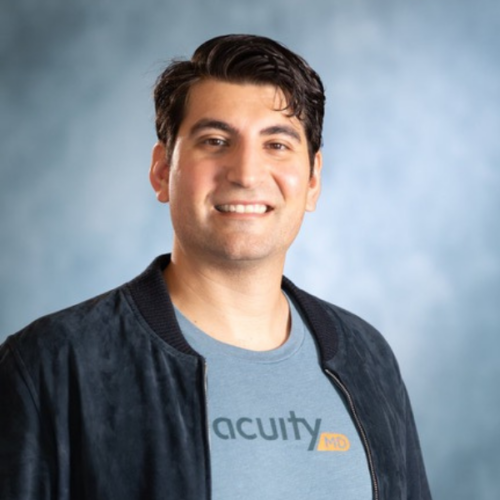
MONOVOUKAS, seated for a speaker portrait ahead of DeviceTalks Boston. A consultant's calm, a salesman's eye, the wardrobe of a founder who has stopped bothering with a tie.
Michael Monovoukas runs AcuityMD, a Boston software company that sells commercial intelligence to the medical device industry, which is a category-of-one description that only becomes interesting when you learn what medtech commercial teams were doing before. They were, mostly, using Salesforce and spreadsheets to keep track of surgeons the way a college friend might keep track of birthdays. This turned out to be a $163 million business opportunity.
AcuityMD closed an $80 million Series C in April 2026, led by StepStone Group, with Benchmark, Redpoint Ventures, ICONIQ and Atreides Management stacked in behind. The round put the company at a reported $955 million valuation, which is the sort of number that would have amused Monovoukas in 2015, when he was shutting down his first startup, an optical pen called the WoundStylus that he built with his brother Demetri to measure the perimeter and area of wounds. That company, Monolysis Medical, lasted about a year. Monovoukas says it taught him how to sell to clinicians, which is a polite way of saying it taught him that clinicians do not answer their phones.
The AcuityMD pitch is that a field rep for, say, a spine device manufacturer has roughly the same job as a very well-informed matchmaker. They need to know which surgeon does which procedures, at which hospital, referred by which primary care doctor, using which competitor's implant, and whether that surgeon is likely to say yes to a lunch meeting on Thursday. This information exists. It exists in claims data, in referral networks, in procedure codes, in the loose weather of physician gossip. AcuityMD's product is essentially: stop making the rep assemble it in their head.
Monovoukas is a Princeton graduate with an MBA from Harvard Business School, which is the résumé the pattern-matching part of a venture investor's brain likes. But the operator résumé under it is more interesting. Before AcuityMD he worked at PatientPing, a Boston healthcare data company where he handled business development and finance and helped raise over $40 million, mostly in the un-glamorous work of negotiating channel partnerships with electronic medical record vendors. Before that, Bain. Before that, Princeton. The consulting-to-operator arc is common in Boston. The version of it that ends in a nearly billion-dollar SaaS company is less so.
The three co-founders are Monovoukas, Robert Coe as CTO (previously at Yext) and Lee Smith as head of commercial development (previously at Medtronic, which matters, because Medtronic sells the things AcuityMD's customers are trying to compete with). They founded the company in 2019 and moved patiently, or at least in a way that looked patient from outside: a $31 million Series A in 2022, a $45 million Series B in 2023, and the Series C in April of this year.
What Monovoukas has said about the Series C is that medtech AI does not work the way general-purpose AI works. "AI systems need deep workflow context tied directly to how MedTech organizations operate day to day," he told reporters at the time, which reads like a founder's line and is also, if you have ever watched a surgical rep try to use enterprise software between cases, plainly correct. AcuityMD is trying to be the shared intelligence layer under the field team - the thing the territory planner, the product launch lead and the rep in the parking lot of a Louisville hospital all look at.
He has been reasonably public about the fundraising philosophy that produced these outcomes. On the 20MinuteVC-adjacent podcast circuit he has talked about raising from a "position of strength" - the idea, roughly, that milestones and metrics compound faster than valuation multiples do, and that founders who chase the multiple end up trading it back at the next round. It is not an original observation. It is a well-executed one.
Management consultant at Bain & Company, working on commercial strategy for medical device and biopharma clients. This is where the AcuityMD thesis quietly assembles itself: medical device makers, he later says, were "truly underserved" by software.
Co-founds Monolysis Medical with his brother Demetri. Product: the WoundStylus, an optical pen that measures wound perimeter and area. It is the kind of small, physical product that gets a founder used to hospital procurement calendars.
Monolysis winds down. Monovoukas calls the experience the reason he knows how to sell to clinicians.
Business development and finance at PatientPing, the Boston-based care-coordination data startup. Helps raise more than $40M and closes channel deals with EMR vendors.
Co-founds AcuityMD with Robert Coe (CTO) and Lee Smith (head of commercial development).
Series A of $31M. Podcast circuit, HBS case-study level metrics.
Series B of $45M to expand the commercial intelligence platform beyond early adopters.
Series C of $80M led by StepStone Group. Total funding tops $163M. Valuation reported near $955M. AcuityMD says it will use the money to scale agentic AI features and expand the underlying data model.
Medical device makers were truly underserved.
AI systems need deep workflow context tied directly to how MedTech organizations operate day to day.
They spend their days in their office logging notes into a CRM.
The medical device industry is one of the largest, oldest, and most fragmented parts of American healthcare. Devices are sold by manufacturers with names like Stryker and Medtronic and Zimmer Biomet, and by hundreds of smaller companies that make one very specific thing extremely well. The commercial team of any of these companies has the same essential problem: figure out which physician is likely to use their product, and then talk to that physician before someone else does.
For most of the 21st century this was solved by rented lists, salesforce automation of the least imaginative kind, and reps who had been in the same territory long enough to know who ran which OR. Real-world claims data existed, but ingesting it, cleaning it, tying it to individual physicians and procedures, and putting it in front of a rep in a way they would actually use - this was not a solved problem. It was a decision matrix inside a founder's head at Bain, waiting for the founder to leave Bain.
AcuityMD's bet is that if you make that decision matrix into a piece of software, you can sell it to hundreds of medtech companies at very high retention, because the medtech commercial job is not going away and the alternative is spreadsheets. The Series C is validation that this bet is working. The company now serves more than 400 medtech businesses, from pre-commercial startups to enterprise manufacturers.
It is a very Boston story: healthcare data, HBS operators, Benchmark and Redpoint on the cap table, a founder who has been building around the edges of this industry since he was 23. The interesting part is not the size of the round. It is that Monovoukas seems to have been playing the same slow game since about 2014 and has finally been given the size of check that matches the size of the opportunity.
The brother company. His first startup was co-founded with his brother Demetri. There is a version of the medtech world where the Monovoukas brothers are still building an optical wound-measurement pen; there is a version of Silicon Valley where nobody has ever heard of AcuityMD. Both companies had a lot of the same DNA - clinical workflow, sales into physicians, patience with hospital procurement.
The NYSE bell. AcuityMD's co-founders have appeared on the NYSE "Floor Talk" video series, which is a milestone somewhere between an appearance on CNBC and a wedding photo.
The Medtronic hire. Bringing on Lee Smith from Medtronic as head of commercial development was a distribution decision as much as a product one. The customer set for AcuityMD is, in large part, the competitive set for Smith's previous employer.
The CRM problem. Monovoukas is unusually specific about what he does not want reps to be doing: "spending their days in their office logging notes into a CRM." Founders often talk about workflow. He talks about it in a way that suggests he has watched a rep do it, and winced.
He is the CEO and co-founder of AcuityMD, a Boston-based commercial intelligence platform for the medical device industry.
2019. Co-founders are Robert Coe (CTO) and Lee Smith (head of commercial development).
More than $163M in total, including an $80M Series C led by StepStone Group announced in April 2026.
Princeton, followed by Harvard Business School.
Bain & Company, PatientPing, and a first startup called Monolysis Medical that built the WoundStylus optical pen.