Alex Patterson sells an hour in which sensible people put on protective suits, dodge lasers, argue with computer screens and try to prevent a paint bomb from going off. Success earns them bragging rights. Failure earns them a photograph. It is an unusually forgiving business proposition: the customers can lose the game and still get the ending they came for.
For Patterson, founder and CEO of BEAT THE BOMB, the explosion is the visible part of a quieter obsession. What happens when a game requires people to rely on one another? A roomful of clever individuals can be remarkably bad at becoming a team. His answer gives them a clock, a shared task and an incentive to listen before everybody changes color.
The career behind this proposition has its own improbable sequence. Patterson grew up in Brooklyn, graduated from Harvard College and attended the University of Virginia School of Law. He worked in tax at Davis Polk, moved into the young obstacle-course company Tough Mudder, and eventually began designing an entertainment business of his own. The résumé becomes easier to follow if you pay attention to the rules.
The lawyer who wanted a microphone
After two years practicing tax law, Patterson decided he could not see himself doing it for the rest of his career. He talked with mentors at the firm before leaving. A friend who had done a mud run with him sent an article about Tough Mudder. Patterson contacted its founders and persuaded them to make a lawyer one of their early full-time hires.
The legal work was substantial: contracts, insurance, waivers and corporate structure. He also took on marketing, initially by getting involved and eventually asking for the formal job. By 2011, he was both in-house counsel and chief marketing officer. He served as a start-line emcee too. The person considering the liability waiver was also the person getting the crowd ready to go.
That combination is revealing. Entertainment needs someone to imagine the occasion and someone to make it operate. Patterson was getting practice at both. A photograph from a January 2011 event in Texas shows him announcing at the start line; the law graduate had acquired a public-facing role with rather more outdoor shouting.
He could also make fun of the professional world he had left. Asked whether law school or Tough Mudder was tougher, he chose law school: an obstacle event could be finished in a day, while a demanding professor lasted a semester. It was a joke with a useful observation inside it. A challenge becomes more inviting when people know where the finish line is.
“The best obstacles were the ones that made people work together.”
Alex Patterson, 2023
A penalty worth paying for
At Tough Mudder, Patterson progressed from legal work through marketing to creative leadership and obstacle design. He worked there from 2010 to 2015. When he began developing his own concept in 2016, he drew on two interests from childhood: sports and video games. He wanted the group activity of one and the programmable possibilities of the other.
He studied escape rooms, television game shows, arcades, haunted houses, immersive theater and action movies. His complaint about escape rooms was their ending. Fail to escape a supposedly locked room and, eventually, somebody opens the door. The fiction politely withdraws. Patterson wanted a consequence that would complete the story while remaining part of the fun.
He began with a small prototype space, about 500 square feet, where he worked out how to blast people with paint and clean up afterward in minutes. That last detail deserves attention. A spectacular finale is only a business if the next customers can have one too. The unglamorous reset belongs in the same design conversation as the explosion.
He hired programmers and a technology specialist to build games using projectors, sensors and RFID wristbands. The rooms could change their games without being rebuilt. Cameras captured the finale in slow motion, giving players something to share immediately. An action-movie moment had been translated into a repeatable appointment.
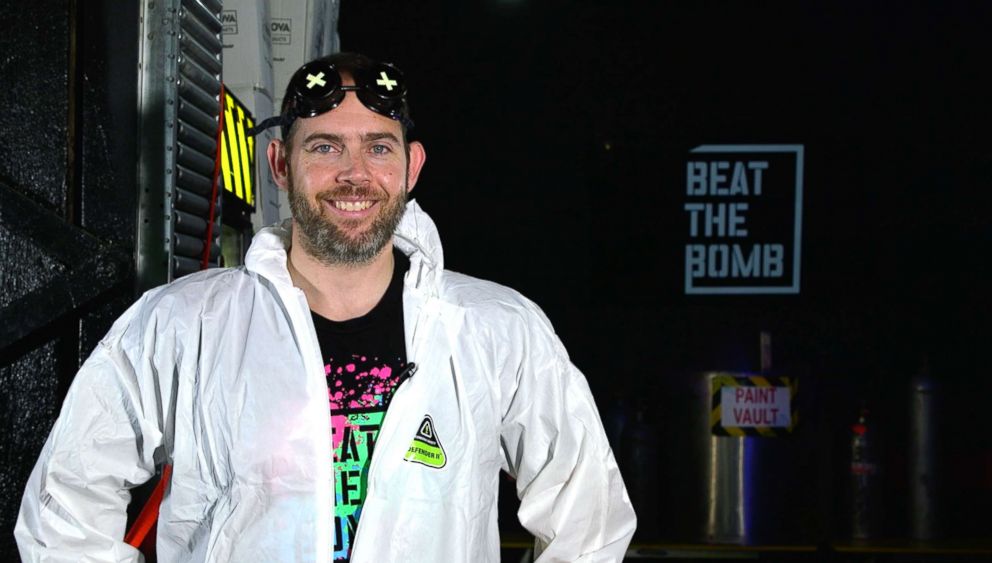
There is a dry joke in the engineering. The suits make the situation look serious; the paint makes it ridiculous. Players accept the costume before they know how the story ends. The photo afterward is proof that the group did something together, even if the evidence is mostly splattered across their sleeves.
Five rooms, one shared clock
The first public venue opened in Dumbo in December 2017. In January 2018, its first full month, it drew 1,000 paying players. The original space was about 2,000 square feet. Patterson and his team had moved from testing a finale to running an entire visit, with a sequence of games that fed time into the last room.
In the early format, teams had ten minutes in each of four rooms to score points. Better performance bought more time to defuse the paint bomb in the fifth. Patterson put the purpose plainly in 2018: “Beat The Bomb was made to be about teamwork, communication and coordination.” The countdown connected those abstractions to something everyone could see.
One team's performance follows it all the way to the finale.
A digital game can distribute information as well as points. In Hack Attack, each player sees a different screen and has to work out who needs the information they possess. The structure makes the communication problem tangible. Being quick with your own controls cannot compensate for failing to tell a teammate what they need to know.
Patterson has described Cyberbot in similar terms: players have different controls over a robot navigating a digital labyrinth. The challenge depends on coordinating those controls. It is easy to see why corporate groups would recognize the situation. Everyone has a responsibility; nobody gets to act as though the rest of the room is decorative.
He has kept returning to that idea in his public writing. A laser maze becomes a way to think about a team's hidden tripwires: awkward handoffs, assumptions and processes nobody questions. The metaphor is amusing because the game makes the invisible visible. A workplace rarely supplies an illuminated obstacle when a conversation goes wrong.

Rules, penalties and old friends
Patterson's legal background occasionally follows him into the bomb room. In 2019, his law-school classmate Patrick Ashby brought 28 Linklaters attorneys from New York and Washington for a team outing. When people ask about Patterson's transition from law to games, he points to their shared ingredients: invented systems, rules and penalties. The paint is a more photogenic enforcement mechanism.
That anecdote also gives the career a pleasing circularity. He left a law firm, built a different kind of workplace, and found lawyers arriving as customers. The old training still gave him a way to explain the new project. His interests had changed the setting in which he used it.
As the company grew, his circle included people whose support extended beyond a financing transaction. At the Houston opening, he publicly thanked investor Russell Shepard for years of encouragement and celebrated getting slimed with Shepard and his family. The acknowledgment was specific: messages, confidence and a shared opening-weekend experience.
For a founder selling teamwork, those details carry more weight than a slogan. The company requires programmers, venue managers, operations staff and investors to coordinate long before customers arrive. Patterson's public posts often name the people doing that work. The founder may explain the concept, but somebody else has to have the room ready at the booked time.
Paint travels. Buildings cost money.
The company announced a $7 million Series A in 2022, backed by Conversion Venture Capital and Otium Capital. A $15 million Series B followed in 2023. Those rounds helped turn a Brooklyn attraction into a network of venues. Atlanta opened in October 2022 and Washington followed in February 2023; Philadelphia, Charlotte and Houston joined later.
Denver's April 2025 debut made it seven locations. As of October 2026, the company's booking site lists those seven U.S. cities. The growth changed the operating problem. A game can be reprogrammed; a building still needs a lease, construction and people to run it. Patterson's ambition has to fit both the software and the floor plan.
A financing case study describes his approach between equity rounds: use lending to improve locations and add technology talent without selling more ownership. President Jesse Bull found the lender, Wayflyer. The company used that financing for retrofits and arcade game bays, offering a shorter, more casual way to play alongside food and drinks.
The bigger aspiration is a connected gaming platform, with teams in different cities eventually competing in real time. Patterson has spoken about Brooklyn and Tokyo in that future. It remains an ambition. The practical steps are closer to home: improve the existing venues, develop the games and make a customer want another visit.
The next reason to come back
By October 2026, the menu of experiences includes Paint, Foam and Slime missions. Completing all three unlocks access to Cash Bomb, with a shot at $1,000. An October-only Haunted Mission adds five themed games and a red-slime ending. The format lets the company give familiar rooms a fresh reason to be played.
That is where Patterson's original interests meet most neatly. Sports supply the pleasure of getting better together. Video games supply new levels, changing challenges and another attempt. The venue supplies a place to gather. A team can leave with a shared failure and still have unfinished business with the clock.
And the penalty continues to do a peculiar job. It gives the visit an ending that people can recall without explaining a score. Patterson began by wondering why failure in an escape room felt so uneventful. He built a business in which the answer arrives on your suit. The rules are complicated enough to require a team; the souvenir is wonderfully easy to understand.