A PowerPoint presentation has many talents. It can make a modest idea look expensive, give a meeting something to stare at, and persuade everyone that the next slide will contain the answer. Alberto E. Porciani's early proposal did something more useful: it persuaded 45 customers to pay before there was a product. In his account of building Top Doctors, that number supplies the opening scene. The software would follow. First came people willing to put money behind the proposition.
There is an appealing temptation to stop the story there. A founder spots an opening, finds believers, and sets off. Yet the more interesting part of Porciani's career comes after the first yes. He had to leave the habits of a large employer, build alongside his wife, work across borders, and decide how much of a growing business he was willing to exchange for capital. An early sale answers one question. Running the resulting company produces a fresh batch every morning.
Today he is CEO and co-founder of Top Doctors Group, based in Barcelona. His path runs through Italy, Spain, international sales and management, and a business that has expanded beyond its original online platform. The thread connecting those stages is a practical question: what do you keep when the company you are building starts to change?
A student trip that became a life
Porciani left Italy for Spain on an Erasmus programme and stayed. The departure belongs to a familiar European story: a student crosses a border for an exchange and discovers that the return journey has become negotiable. Spain became the setting for his adult working life. Barcelona later became the place where he and Lorena Bassas would build their company together.
That geography matters. An Italian founder starting in Spain could easily be described as an international entrepreneur from the outset. Porciani's explanation was more concrete. He and Bassas already lived in Barcelona and knew the Spanish market better than the Italian one. Their choice of starting point followed familiarity. The address preceded the strategy.
His education supplied another part of the preparation. He studied economics at the University of Turin and completed an Executive MBA at IE Business School in Madrid in 2004. Further training took him to INSEAD and IESE. Taken together, those experiences place him among founders who arrive with a management education and a substantial working history, rather than learning every operational lesson inside their own first venture.
A business school qualification does not promise commercial judgement. Porciani's account of his MBA is nevertheless revealing: he emphasises prioritising work, understanding different functions, managing projects, and developing a business. Those are unglamorous abilities until their absence becomes expensive. A company can survive an uninspired presentation. It has a harder time surviving a manager who cannot decide what needs doing first.
Before the startup, the sales job
Johnson & Johnson was a substantial part of his earlier career. His roles included Commercial Director for Italy and Director of Key Accounts for EMA. He subsequently served as Director of Corporate Accounts at Allergan. The titles suggest the kind of apprenticeship that rarely features in the romantic version of entrepreneurship: customers, account relationships, responsibility across markets, and the machinery of a large organisation.
That background gives the 45 early customers a useful context. Porciani came to company building with experience in selling and managing commercial relationships. A proposal put in front of a prospective buyer belongs to that world. The ability to describe a future product matters, but so does listening closely enough to discover whether the buyer sees a reason to pay.
The transition from corporate employment also changes the meaning of responsibility. Inside an established organisation, a commercial director inherits systems as well as targets. A founder has to arrange both. There must be something to sell, someone to build it, a means of delivering it, and enough money to keep the promises made during the sale. Porciani's earlier positions help explain the skills he brought to that transition, without making the transition sound automatic.
“To have a clear goal and stick to it.”
Alberto E. Porciani, on the best advice he had received, 2016
His stated advice allows room for a changed route. That distinction between an objective and the method of reaching it becomes useful when looking at the business he subsequently built. The original proposition gave the company a starting point. It did not settle every decision about its eventual size, products, or ownership.
Two founders, one household
Bassas is central to this story. She and Porciani co-founded Top Doctors; the group's current leadership page identifies her as Sales Director Spain and co-founder. They are also married. A photograph of the pair in the office catches something that a lone-founder portrait would leave out: this is a business built by two people whose partnership extends beyond work.
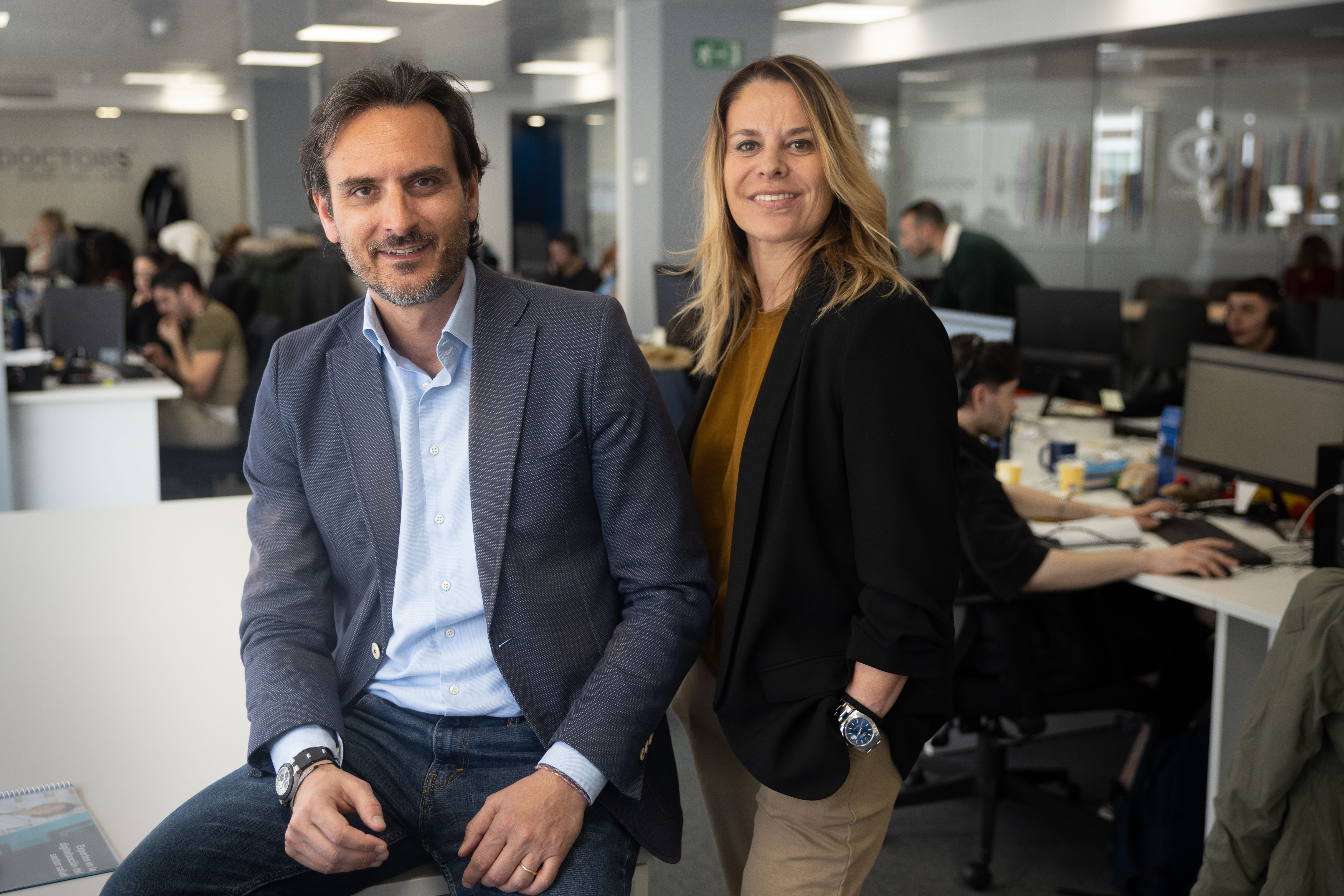
Calling them a husband-and-wife team is accurate, but it should not swallow their professional identities. The company gives each a distinct title. Bassas's continuing commercial role is a reminder that founding a business together involves the ongoing work of running it, long after the founding anecdote has been retold.
There is a small personal detail that makes the pair easier to picture outside those titles. Porciani has described skiing as a passion he shares with his wife and their three children. It is a pleasingly ordinary family enthusiasm beside the public language of expansion and financing. The executive who talks about allocating resources also has a life involving a family and a mountain. Neither requires an invented story about what happens on the chairlift.
The map grew a country at a time
The company's early expansion followed a sequence of market entries. Operations began in Mexico in 2014, Italy in 2015, and the United Kingdom, Colombia and Chile in 2016. The dates show how quickly the founders moved beyond their Spanish starting point. They also make clear that international growth consisted of particular decisions in particular places.
Colombia · Chile
A map can conceal as much as it reveals. Once a country is coloured in, the hard work underneath disappears: commercial relationships, local staff, language, and the question of whether a proposition travels. Porciani's earlier international roles form relevant preparation for that work. They do not remove the need to do it again inside a much smaller organisation.
By 2021, his next stated priority was to deepen the company's position in existing markets. That is an instructive turn in the story. Entering another country offers an easy announcement. Getting more out of a country where a business already operates demands a different sort of patience. The map may stay the same while the actual company becomes more substantial.
Capital has a price beyond the cheque
In October 2021, Top Doctors raised €11.2 million, also reported as $13 million, in a round led by Impact Partners with participation from ICF Venture Tech II. These were two currency descriptions of the same transaction. For Porciani, the funding supplied resources to accelerate the business; it also brought further investors into its ownership.
Two years later, the group arranged access to up to €8 million in non-dilutive financing from Mars Growth Capital and Liquidity Group. The distinction matters. Equity financing sells a stake. Non-dilutive financing preserves that stake, while bringing its own financial obligations. A founder's financing choices influence the room available for later choices about the business.
2021 equity round
Impact Partners + ICF
2023 non-dilutive financing
Mars Growth + Liquidity
Porciani connected the later funding to complementary acquisitions and improvements to the group's offering. The ambition was becoming more specific: assemble capabilities, add businesses that fit, and finance that work. Buying another company brings people, products and relationships into the group. It also creates an integration job that the funding announcement cannot perform.
Keeping the goal, changing the company
In July 2026, the group acquired Ireland's Manitex. Porciani described the company as active in looking for further transactions, with particular interest in Italy and the United Kingdom. The group had become an acquisition-minded software business as well as the owner of its original platform.
At that point, Porciani said the business was profitable and cash-flow positive. He was also preparing a capital restructuring to allow some longstanding investors to leave. That detail introduces another stage of founder responsibility. The people who financed an earlier chapter do not necessarily want to remain for every later one. A company's continuity and an investor's timetable are related, but they are separate considerations.
The group now presents a collection of brands that includes Top Doctors, Top Health Tech, Ofimedic, iWantGreatCare, Manitex and Top Farma. The name on the original proposition has become the name of a group. Expansion through acquisition asks a founder to keep an account of the whole while recognising the useful differences among its parts.
Porciani's career therefore offers a less tidy ending than the early PowerPoint story suggests. There was a first proposition and an encouraging response. Then came the continuing work of building, financing, employing and buying. The 45 customers make a good opening because they made the idea answerable to somebody outside the founding team. Every subsequent stage has added more people to whom it is answerable. That is where the presentation ends and the founder's job continues.