In October 2019, Al Villarreal invited a group of bank presidents to lunch in Brownsville. Several had school uniforms. These were the leaders of student banks in local Minitropolis programs, where children practiced earning, saving, and spending inside miniature school economies. Villarreal, then president and CEO of IBC Bank-Brownsville, was introducing a mentoring initiative. The photograph has the agreeable incongruity of a business meeting whose participants still have homework.
It is a useful image of his working life. A bank executive stands beside students who have been given a small version of his responsibilities. His own route to the top had involved a much longer apprenticeship. He joined IBC in 1993. Twenty-three years later, he succeeded the executive who had hired him, Fred W. Rusteberg. The relationship between those two episodes gives his career a particular shape: learning the work, taking responsibility, then making room for someone younger to ask questions.
Twenty-three years before the handover
Villarreal began working in banking in 1988. A Harlingen native, he worked at MBank Dallas and Bank One San Antonio before joining IBC as a commercial bank officer. His education includes a business administration degree with honors from the University of Texas at Austin and graduation from the banking school at Southern Methodist University. The credentials placed him within an established profession. The 1993 move gave that profession a lasting local address.
Rusteberg had established IBC’s Cameron County operation in 1984. By the time his retirement was announced in 2016, he had spent 32 years leading it. Villarreal was a senior executive vice president and bank director as the succession approached. He had been working inside the institution for most of its existence. Taking over meant assuming responsibility for an organization whose habits and people he already knew.
The transition was announced months before Rusteberg’s departure at the end of August. Villarreal became president and CEO in September 2016. That interval matters to the story. This was an arranged handover between colleagues with a long shared history. Rusteberg had been his mentor as well as his employer. The promotion put Villarreal in charge of the business where that relationship had developed.
His territory included Brownsville, Harlingen, Port Isabel, and South Padre Island. He also retained responsibility for the Cameron County sales and retail group. The job joined executive oversight to the everyday business of branches. Four communities sat within the same management brief, keeping the scale of his work identifiable on a county map.
A classroom with a cash drawer
Villarreal had taught finance as an adjunct instructor at the University of Texas at Brownsville and Texas Southmost College. That experience adds a concrete educational connection to his biography. His professional knowledge had already been something to explain to students, as well as something to apply at work. Later, his public activities repeatedly brought banking and education into the same room.
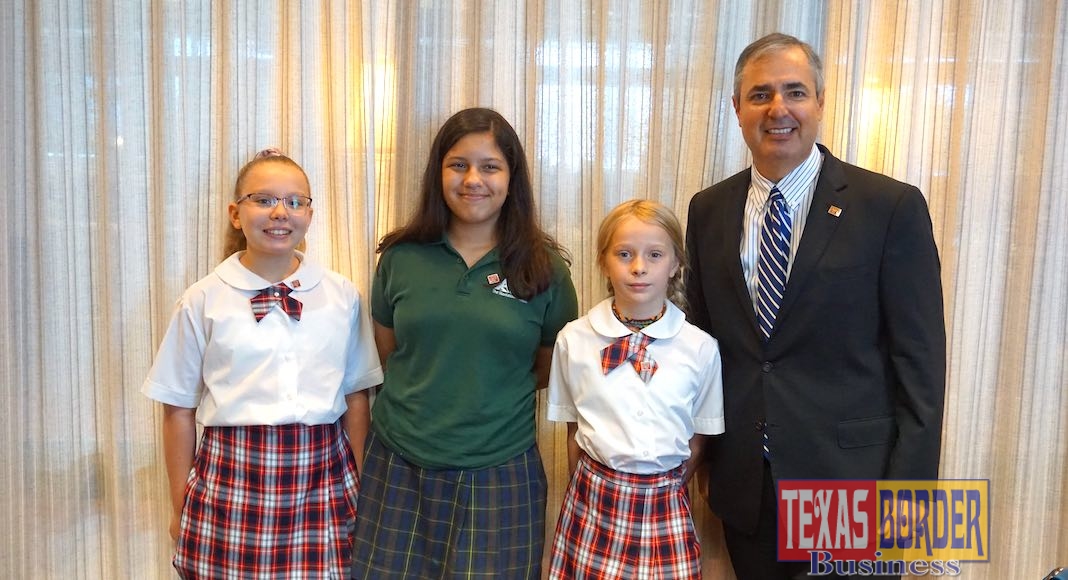
The October luncheon brought together representatives of four school programs. Minitropolis used token money and student businesses to give children practice with financial decisions and responsibility. The new mentoring arrangement let students meet bank officials for guidance. It made a direct connection between a school role and an adult workplace. For the children, the bank president was someone they could actually meet.
There was another educational gathering on Villarreal’s calendar in 2017. UT Austin scheduled its Brownsville student send-off at IBC, with Villarreal on the program alongside university president Gregory Fenves, alumni representatives, a professor, and a current student. The university expected to welcome 415 new students and their parents across its two Valley events. Villarreal appeared as both a local bank president and an alumnus.
The send-offs gave families a chance to talk about campus life before students left the Valley. The format had begun in 1993, the same year Villarreal joined IBC. By 2017, it had been adopted elsewhere in Texas. In Brownsville, a bank building provided the meeting place for a conversation about going away to college. The local institution helped make the distant one more familiar.
Scholarships supplied a different form of assistance. In 2019, IBC Bank-Brownsville awarded a combined $12,000 to students from 12 area high schools through the A.R. Sanchez Sr. Memorial and Fred W. Rusteberg programs. The awards considered financial need and a commitment to service. Villarreal publicly connected the students’ prospects with the community’s future.
Institutional scholarship support, not a personal donation.
The following year’s awards totaled $10,000 for ten graduates. By then, the Brownsville program, begun in 1985, had distributed more than $280,000. Those figures describe the bank’s work, rather than Villarreal’s personal giving. They also show the machinery behind the ceremonial photograph: an established program, recurring awards, and another group of students preparing for college.
The people who move up beside you
A long career inside one bank also means watching colleagues advance. In 2018, IBC promoted area sales managers Claudia Vianney Celvera and Leticia Esther Benavidez. Celvera had started as an accounting clerk in 1999. Benavidez had joined as a teller in 2004. Their work covered the Brownsville operation’s Cameron County branches. Villarreal praised their leadership and the value they brought to customers.
These were two separate routes through the organization, beginning in jobs far removed from an executive title. Their promotions offer a glimpse of the workplace around Villarreal. Institutional continuity involved other employees’ careers, too. The accounting clerk and teller had accumulated responsibilities of their own over years of work.
In January 2020, Villarreal’s next promotion was announced at the bank’s annual bonus presentation: he became chairman. Lee Reed moved from executive vice president to president. Reed had worked in accounting, operations, and credit, and had returned to IBC after a period away. The announcement paired two leadership changes within a team of experienced bankers.
Another round of promotions followed in 2021. Richard Eric Abete, who had joined IBC in 2003, advanced to senior vice president in commercial lending. Villarreal’s comments linked recognition with customer service, banking knowledge, and involvement in the community. The examples were local and specific. Progress was being marked through people whose work the institution had observed for years.
The county outside the bank
Villarreal’s public responsibilities extend into the systems that keep Cameron County functioning. The regional mobility authority lists him as treasurer. Its board meets to review projects and consider initiatives, with meetings open to the public. The Brownsville Public Utilities Board identifies him as vice-chair. These roles put him within collective decisions about local infrastructure, alongside his banking work.
His earlier civic positions included chairing United Way of Southern Cameron County and serving as vice-chair of the Brownsville Community Improvement Corporation. He also served on the Greater Brownsville Incentives Corporation board. Education appears again through affiliations with Guadalupe Regional Middle School, Saint Mary’s School, and Brownsville school district committees. Together, those appointments describe a career repeatedly intersecting with local institutions.
In July 2020, he and IBC-McAllen executive Adrian Villarreal made a public argument for business support of census participation. Their case connected an accurate count with public funding and representation. They urged employers to encourage responses and offer practical access to devices or internet connections. It was a civic task expressed as something a workplace could help accomplish.
The argument is revealing because its proposed actions were modest. An employer could make a resource available or help answer a question. The larger process belonged to the country; participation happened person by person. In that piece, Villarreal treated the community around a business as part of the business leader’s responsibilities.
His geographic focus also reaches across the border. In July 2026, he led a binational business dialogue at IBC in Brownsville during the México en Decisión forum organized by COPARMEX Matamoros. Participants discussed competitiveness and the United States-Mexico trade relationship. The setting connected his local banking base with the commercial conversations taking place between neighboring communities in two countries.
What gets passed on
In January 2022, Villarreal spoke at a gathering honoring Rusteberg. IBC named its main Brownsville office the Fred W. Rusteberg Building and unveiled a wall recording his life. Colleagues, relatives, and community leaders attended. Villarreal emphasized his predecessor’s efforts to make higher education accessible. The tribute returned to a subject that runs through his own public work.
“He led by example from the frontline.”Al Villarreal, remembering Fred W. Rusteberg
The occasion included a $20,000 IBC donation to Episcopal Day School for a leadership and service program bearing Rusteberg’s name. A building dedication thus came with an educational commitment. The memorial looked backward while the program concerned students still learning what responsibility might ask of them.
That brings the story back to the younger presidents at lunch. Villarreal had inherited an executive job from a mentor. At the school event, he was helping connect students with adults who could explain their work. The distances were different: decades inside a bank, an afternoon visiting one. Both belonged to a career in which staying in Brownsville has created repeated opportunities to welcome someone else in.
Continue the conversation
Career records, event coverage, and related profiles. IBC social channels below belong to the bank.