The furniture came with the office. Whoever had rented the space before Katie Harvey left behind some wicker, and the new proprietor gave it a coat of paint. There are more elaborate ways to announce the birth of a communications agency. This one had the advantage of being affordable. In 1994, Harvey was 24, had $2,000 to put toward her business, and was willing to begin.
She asked her boss whether she could continue working for her through a company of her own. The boss agreed and became the first client. It was an unusually direct route from employee to founder: a conversation, a customer, a room. The waiting-room decor could be improved later. So could almost everything else.
More than thirty years on, Harvey still runs the agency, now called K Harvey Brand Partners, with offices in San Antonio and Houston. The intervening years have supplied plenty of conventional milestones. Yet her personal story has another line running through it: an energetic founder learning that a business can grow beyond the habits that helped her start it.
A chair, a client, a start
Both of Harvey’s parents were entrepreneurs. Her father worked in the Arabian horse business; her mother ran a small business while raising Harvey and her brother. Independence was familiar long before incorporation papers entered the picture. The family gave her confidence to take risks, an inheritance that does not appear on a balance sheet.
Her early career included working on football camps for Earl Campbell while she was in college. She attended Texas State University and moved to San Antonio after college in 1992. The agency followed two years later. Those dates make the decision look tidy. A young person choosing a city and finding work inside it generally experiences rather more loose ends.
The company’s first years also contained gaps in the schedule. Harvey remembers forwarding the phones with her first employee, Elizabeth, and spending quiet stretches by the pool. It is a pleasingly unpolished detail. Founding stories tend to acquire an air of relentless destiny; a forwarded phone admits that even destiny occasionally has a slow afternoon.
When the city became part of the brief
A 2000 San Antonio bond-proposition assignment helped move the firm into public affairs. The change matters because public-facing work introduces a different kind of audience. Residents arrive with interests of their own. A campaign must find language that makes sense beyond the meeting in which it was commissioned.
Harvey’s civic involvement eventually brought her to the Greater San Antonio Chamber of Commerce board chairmanship in 2023. At the gala introducing her leadership year, she spoke about a business community whose members could compete and remain friends. That observation sounds simple until a difficult shared decision puts it to work.
Her priorities included the state legislative session, a stronger executive board, and developing the relationship between San Antonio and Austin as a super region. The scale had changed considerably from the first waiting room. A founder who once needed one client was now helping bring different businesses into a common conversation.
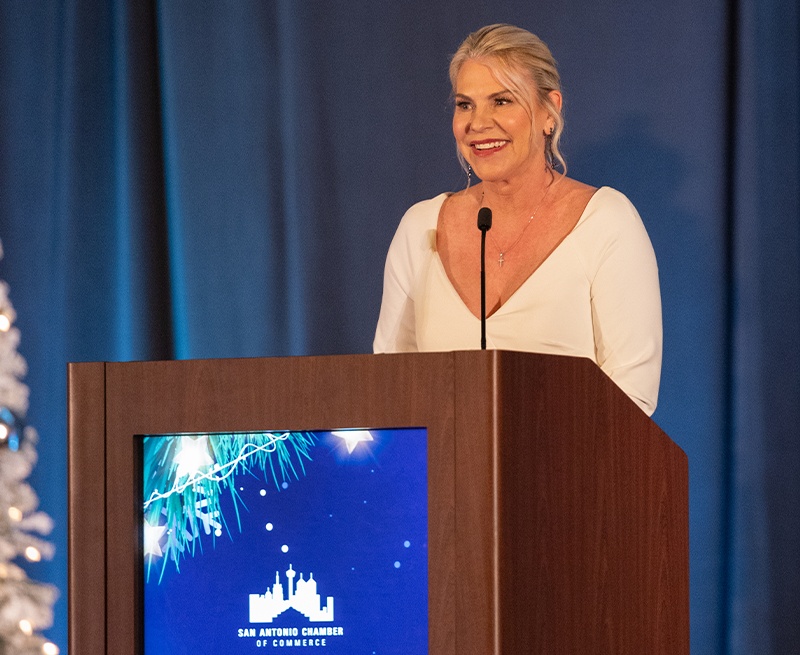
In May 2026, the Chamber recognized her with the Brenda Vickrey Johnson Award for Small Business. The award placed her alongside honorees from other parts of the region’s business and civic life. Such occasions put a date on work that otherwise accumulates gradually, across assignments, introductions, and years of showing up.
By September, she was chairing the Chamber’s second Executive Connections: San Antonio cohort. The program helps newly relocated or recently promoted senior executives understand the region and build relationships. It gives a practical shape to her interest in connection: help people find their bearings, then help them find where they can contribute.
Five more names at the table
Harvey’s agency grew from a PR practice into a business spanning advertising, public affairs, brand design, and other communications disciplines. Its current leadership includes Elizabeth Marshall Black, Jonathan Gurwitz, Jessica Serna, Edith Ramirez, and Ron Landreth. Each is listed as a partner. The title has a concrete history.
In 2022, Harvey brought five members of her executive leadership team into ownership. She described her trust in them and their investment in the work they did together. A founder can praise a team indefinitely. Sharing ownership changes the terms of that relationship, making the company’s next chapter a shared undertaking.
Ownership does not remove disagreements or settle every decision in advance. It does make responsibility more tangible. People who have helped build a business gain a stake in what comes next. For the founder, the adjustment includes accepting that the company’s future will carry other people’s judgment as well as her own.
The public name caught up in December 2024. At its thirty-year milestone, KGBTexas Communications became K Harvey Brand Partners. The surname preserved a connection to the beginning. The final word acknowledged the people helping determine where the business would go. An anniversary can produce a party; this one also produced a more explicit introduction.
- One clientA former boss backs the new agency.
- Shared ownershipFive executive leaders become partners in 2022.
- Shared nameK Harvey Brand Partners arrives in December 2024.
The founder who has to pause
Harvey has been candid about the less flattering side of determination. In her 2020 essay “Giving Up,” she recalled leading employees who were older than she was, and described an early mix of competitiveness, impatience, motivation, and inexperience. She struggled when others did not share her level of drive. The candor gives the origin story some welcome friction.
In “Planning on Faith,” published later that year, she described learning to support colleagues who approached a problem differently. She valued watching her leadership team grow, and acknowledged that listening could reveal issues she had not understood. The practical challenge is familiar: being open to a good idea that arrives in someone else’s handwriting.
Her Christian faith is central to the way she explains that change. She writes about servant leadership, surrender, and the difficulty of trusting a plan she cannot control. These are personal convictions, expressed in her own language. They give context to the patience she is trying to practice in business.
“I have a hard time letting go.”
Katie Harvey, “Trusting The Outcome”
In a later reflection, “Trusting The Outcome,” she admitted that her instinct when something goes sideways is to intervene quickly. She also acknowledged the effect that instinct has sometimes had on other people. It is an admission with practical consequences for anyone working beside a determined leader. Speed carries a cost when colleagues become obstacles in the hurry.
Her writing does not present patience as a completed acquisition. It treats it as something that needs attention. That distinction makes her a more recognizable person: experienced enough to identify a habit, still capable of falling back into it. Leadership develops in the ordinary moment when the impulse to interrupt meets the decision to keep listening.
A front porch with room for disagreement
Harvey’s interest in conversation extends beyond the agency. In 2020, after talking with Roy Spence on thePoint, she wrote about the front porch as a place where people could debate and challenge one another without abandoning civility. The image has an appealing scale. A porch has room for disagreement and usually very little room for a podium.
She wanted to have difficult conversations about problems that felt overwhelming. Her argument connected entrepreneurship with finding solutions, rather than treating it solely as starting a company. That definition gives a founder something to do after the founding is finished. A business becomes one setting in which to practice a broader habit of asking useful questions.
The agency’s thePoint series offers a public home for that curiosity. Its episode list brings together Texas leaders from business and civic life. Episode 35 features Harvey with Phil Green, her predecessor as Chamber chair and the chairman and CEO of Frost Bank. The conversation puts successive leadership years in the same room.
Outside the office, Arabian horses remain part of her life. She grew up around them and rides competitively. Her official biography also mentions her husband and two sons. Another companion has appeared in her working life: Pepper, the dog reported accompanying her to the office in 2023. Even a communications firm benefits from someone unconcerned with the wording.
A week without the pitch
In a 2026 reflection, Harvey described setting aside a week to sit down individually with people at K Harvey Brand Partners. She listened to what was working and what was difficult, and asked for feedback on how she could lead better. The detail brings her larger themes down to the scale of an appointment in a calendar.
Listening is easy to admire and harder to budget for. A week of conversations occupies time that could have gone to decisions, presentations, or the familiar business of keeping a company moving. Choosing it gives attention a visible place in the work. Colleagues get to answer in their own words.
The repainted wicker belongs to the first version of Harvey’s business. The shared ownership and the employee conversations belong to later ones. Across those versions, the question has widened: from whether she could start a company to how the people around her could help shape it. She still has the founder’s seat. She is making more room at the table.
Continue the conversation
- Katie Harvey’s official biography
- Katie’s LinkedIn profile and leadership writing
- K Harvey Brand Partners · Agency Instagram · Agency Facebook · Agency X
- Watch thePoint, including episode 35 with Phil Green and Katie Harvey · Agency YouTube channel
- The first-office years: Katie’s Q&A · Her approach to communications
- Planning on Faith · Front-Porch Conversations Welcome
- Executive Connections: the September 2026 cohort