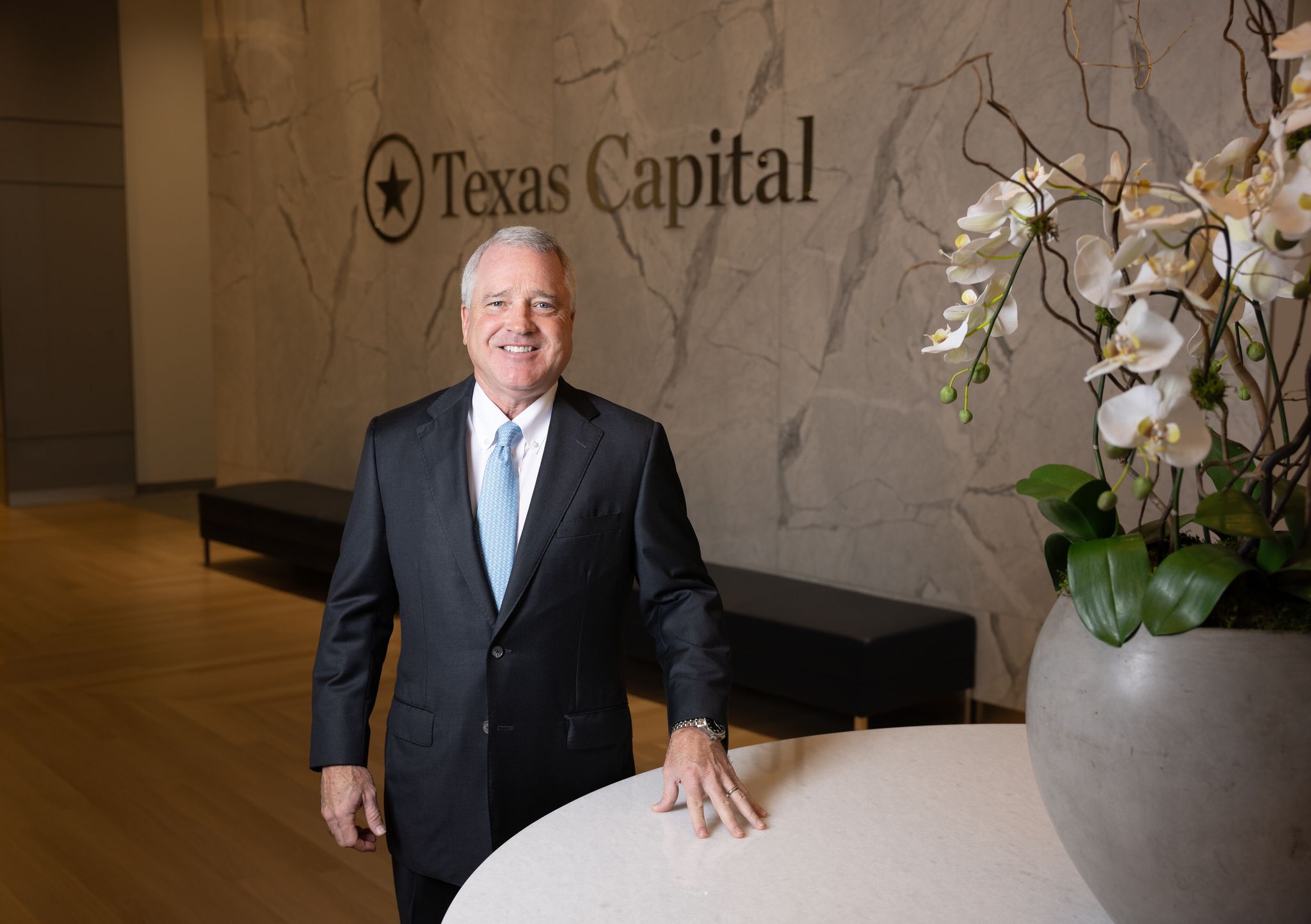
Rob Holmes spent 25 years commuting to New York. That is an unusually elaborate way of remaining a Texan. Across a 31-year career at JPMorgan Chase, his work became international while his attachment to home stayed stubbornly local. When the opportunity came to run Texas Capital, the geography was familiar. The assignment would require him to reconsider almost everything inside the bank.
He arrived in January 2021 with experience running a global business and a mandate to work out what a Dallas financial institution ought to become. There is an appealing simplicity to the phrase coming home. It suggests a return to things already understood. Holmes had accepted something more complicated: responsibility for changing an institution in the place where his own name, family history and professional relationships already meant something.
Texas Capital had been founded in 1998 to serve businesses with local decision-making. By the time Holmes took over, it needed a fresh direction. A proposed merger had fallen apart. He would have to give employees and clients a reason to believe in the bank as an independent enterprise, then equip it to justify that belief. Sentiment might bring someone home. It would do very little for the balance sheet.
The family business was bigger than groceries
Holmes was born in Dallas. His grandfather Robert Cullum and great-uncle Charles Cullum were associated with Tom Thumb, the grocery business woven into the city’s commercial history. Both were inducted into the Texas Business Hall of Fame in 1994. That family connection gives his talk about local enterprise a particular texture. The businesses were real; so were the obligations attached to them.
When asked what he learned from the two men, Holmes emphasized demanding standards, modesty and a duty to contribute to the community. “Humility is incredibly important,” he said. He described civic engagement as part of the price of being able to do business. In that account, giving back belongs in the operating philosophy, alongside service and performance. It cannot wait until the congratulatory dinner.
His own first job was bagging groceries. Later came an economics degree at the University of Texas at Austin and an MBA at Southern Methodist University. The progression from a grocery store to corporate finance sounds like a considerable change of subject. Both involve learning what somebody needs, earning repeat business and discovering how quickly a customer notices when the service goes wrong.
“Humility is incredibly important.”
Rob C. Holmes, on the lessons of his grandfather and great-uncle
Seven months before the announcement
On September 1, 2021, Holmes presented Texas Capital’s updated strategy. It followed more than seven months of examination: individual businesses, spending, the operating model and the bank’s overall direction. The ambition was to build a financial institution with a wider set of services and deeper relevance to its clients. The preparation was less glamorous than the ambition, which is often how useful strategies begin.
The choices he outlined included conservative capitalization, stronger funding from core deposits, investment in employees and concentration on businesses where the bank could distinguish itself. He also wanted a broader mix of earnings. For readers who do not spend their mornings with bank presentations, the practical issue is straightforward: a company that needs a loan today might need advice, payment services or access to investors tomorrow.
A lender can watch that customer take the next piece of business elsewhere. Holmes wanted Texas Capital to have more reasons to stay in the conversation. The plan required spending before the benefits were fully visible. It also required choosing where to direct attention. A bank’s strategy eventually appears in ordinary decisions: which specialist gets hired, which system gets replaced, which opportunity gets a polite refusal.
- JAN 2021Take the jobHolmes joins Texas Capital.
- SEP 2021Set the directionA revised strategy follows seven months of review.
- JAN 2022Broaden the offerTexas Capital Securities launches.
- APR 2025Add the chairmanshipHolmes becomes board chairman.
A bank with more answers
Texas Capital Securities launched in January 2022. It added a broker-dealer to the organization, extending its ability to help with capital raising, securities underwriting and mergers and acquisitions. Those services changed the kinds of questions clients could bring to the firm. An owner considering a sale or an expansion could have a different conversation with the same institution.
Holmes’s previous roles help explain the design. At JPMorgan he had led Corporate Client Banking and Specialized Industries, with responsibility spanning lending, treasury management and investment banking across multiple markets. Earlier assignments included retail industry investment banking and leadership in the southern United States. He understood how those capabilities could fit together. Texas Capital offered the chance to build that relationship on a different scale.
The interesting part is the combination of breadth and proximity. Bigger companies need sophisticated finance, but decisions still have to be made by particular people. Holmes was betting that a Texas headquarters could matter alongside the product list. The promise would have to survive a practical test: could the firm handle a client’s next problem without making the client start over somewhere else?
The useful art of selling something
Building also involved subtraction. On November 1, 2022, Texas Capital completed the sale of BankDirect, its insurance premium finance subsidiary, to a Truist subsidiary. The transaction brought approximately $3.4 billion in cash proceeds. The associated loan portfolio was about $3.1 billion at the end of September. These were different numbers measuring different things, a distinction worth keeping when a deal starts acquiring a life of its own.
The sale redirected resources toward the bank’s Texas commercial strategy and strengthened its capital position. It also illustrated a point often lost in corporate accounts of expansion: owning more businesses does not automatically make an institution more coherent. Sometimes the chief executive’s job is to decide that a perfectly substantial operation belongs elsewhere.
For Holmes, the sale and the investment bank belonged to the same argument about priorities. One released resources; the other expanded the ways the firm could serve clients. The two moves look contradictory only if growth is measured by how many things a company owns. Measured by what it is trying to accomplish, they have a clear relationship.
Approximate cash proceeds received by Texas Capital.
The associated loan portfolio was approximately $3.1bn as of September 30, 2022. Sale proceeds and portfolio size measure different things.
An early reputation, revised
Holmes can be candid about the distance between an executive’s polished biography and a junior employee’s actual education. Early in his career, he recalled earning a reputation for being good with clients while falling short on details. The lesson stayed with him. He now brings that experience into conversations with younger bankers about how quickly a professional reputation can form.
That is a useful admission from someone overseeing a business in which small errors can have expensive consequences. It makes his emphasis on development more credible than a general statement about valuing people. A junior colleague needs encouragement, but also somebody willing to notice the mistake and insist that it gets fixed.
He has described the importance of candor, transparent communication and accountability. The challenge is making those habits work together. High expectations can become exhausting when nobody explains the purpose. Friendliness can become evasive when nobody says what needs improving. His approach asks employees to take both the work and one another seriously. That is an everyday management problem, even when the organization is attempting a substantial rebuild.
The city gets a seat at the table
The Texas Capital Foundation launched in late 2022. In 2024, foundation grants and corporate giving together exceeded $4.1 million, reaching more than 100 organizations. Employees contributed more than 6,200 volunteer hours. Their work included restocking food pantries, repairing homes, building playgrounds and teaching children to code. These are institutional efforts involving many people, rather than a personal accomplishment to attach to the chief executive alone.
They do, however, give concrete form to Holmes’s description of business and civic responsibility. His public commitments include the Dallas Citizens Council and the Salesmanship Club of Dallas, as well as educational advisory work. He is also a founding member and treasurer of the Economic Club of Dallas. The recurring theme is participation in institutions that will outlast an individual transaction.
In April 2025, he added the chairmanship of Texas Capital’s board to his responsibilities as president and chief executive. Bob Stallings became lead independent director. The appointment placed more of the institution’s direction in Holmes’s hands. A strategy that began with a new arrival now had continuity at the top, along with a longer list of results for which he would be accountable.
Now he asks the questions
Holmes has also stepped into the interviewer’s chair. His Taking Share: Lessons From Leaders podcast opened with Condoleezza Rice. Another conversation brought in ARK Invest founder Cathie Wood to discuss conviction, transparency and decisions made under scrutiny. It is an appropriate sideline for a banker: listening closely, asking how somebody reached a judgment, then finding the question underneath the first answer.
Away from work, he has named fly fishing and quail hunting among his interests. He has also admitted asking Charlyn, now his wife, seven times for a second date. Corporate persistence has its uses. The detail is a reminder that even a banker accustomed to complicated negotiations may find the important answer takes a while.
His connection to SMU gained a particularly visible expression in autumn 2026. Texas Capital became an end-zone sponsor at Ford Stadium in September. An October 13 agreement extended the relationship to uniform patches across all 17 varsity programs. A financial services company had found a way to appear in rather more competitive environments than an earnings call.
Holmes’s MBA came from SMU, so the association links personal history with the firm’s public identity. It also returns the story to a question he has been working on since 2021: how much can proximity matter when the ambitions are large? He wants Texas Capital to be a client’s first call. To earn that place, the bank has to keep making itself useful.
Coming home gave Holmes a place to do the work. The work itself has consisted of choices: what to keep, what to sell, whom to bring in, how to widen the offer and where to show up. That is a less tidy story than a triumphant return. It is also a more interesting one. A hometown can supply the reason to begin. Running the bank means earning the next conversation.