A boarding pass is a peculiar document. It gets you onto a plane. After a bad flight, it can also help get you paid. Between those two uses lies a small mountain of work: finding the rule, proving the delay, sending the documents, answering the airline. AirHelp makes its living climbing that mountain for other people. The interesting question is how much of the money you would surrender to avoid the climb.
- AirHelp checks flight claims, negotiates with airlines and can pursue legal action.
- A standard €600 recovery leaves you €390; legal action can reduce that to €300.
- Its free app tracks flights. Paid AirHelp+ adds protection before disruption.
01 / Three thousand names. Three founders.
Henrik Zillmer started with his own delayed flights. He helped people he knew, then tried a landing page that collected flight details. In a 2015 interview, he recalled roughly 3,000 sign-ups in one week. For two months, three founders handled customer support while working out how to automate the repetitive parts. Demand had arrived ahead of the machinery.
Zillmer, Nicolas Michaelsen and Greg Roodt founded AirHelp in 2013. The company joined Y Combinator’s Winter 2014 batch. Its original application described a flight database connected to customer records and notifications. The ambition was to spot a qualifying disruption and offer to handle the claim. The original success fee was 25%.
“We took law, put it into code, and made it accessible for everyone in an app.”
HENRIK ZILLMER / 2015
That early workload suggests a useful business test. Start with a task someone wants finished. Do it yourself long enough to see which steps repeat. Then build the machinery around those steps. AirHelp’s expertise now combines flight data, legal specialists and automation. Software can organize the evidence; an airline dispute may still require people who know what the evidence means.
02 / The €210 question
The customer supplies flight details and supporting documents. AirHelp checks eligibility, pursues the airline and, where necessary, escalates through legal channels. It handles delays, cancellations and denied boarding, alongside other disruption services. The passenger is buying relief from administration, negotiation and the possibility of a legal fight. Checking eligibility is free.
The bill makes the bargain unusually easy to inspect. AirHelp’s standard compensation fee is 35%, including VAT. On €600 recovered, that is €210 for AirHelp and €390 for the passenger. If legal action is required, another 15% applies: the passenger keeps €300. If the service recovers no compensation, it charges no compensation-service fee. Brazilian claims have separate pricing.
The price of handing it over.
You can approach the airline yourself. That free alternative keeps AirHelp honest as a proposition: convenience must be worth something. Commercial competitors include Flightright and AirAdvisor. AirAdvisor advertises a 30% standard flight-compensation fee, with different terms for legal action. AirHelp’s pitch combines claim handling with flight tracking, pre-flight protection and travel-partner distribution. Price alone does not explain the whole offer.
A standard €600 claim is therefore a choice about time as well as money. Someone comfortable with the airline’s process may keep the fee by filing directly. Someone who has stalled, or wants another party to manage the case, may prefer a smaller payment to another unfinished task. AirHelp monetizes that preference.
03 / Arrive before the delay
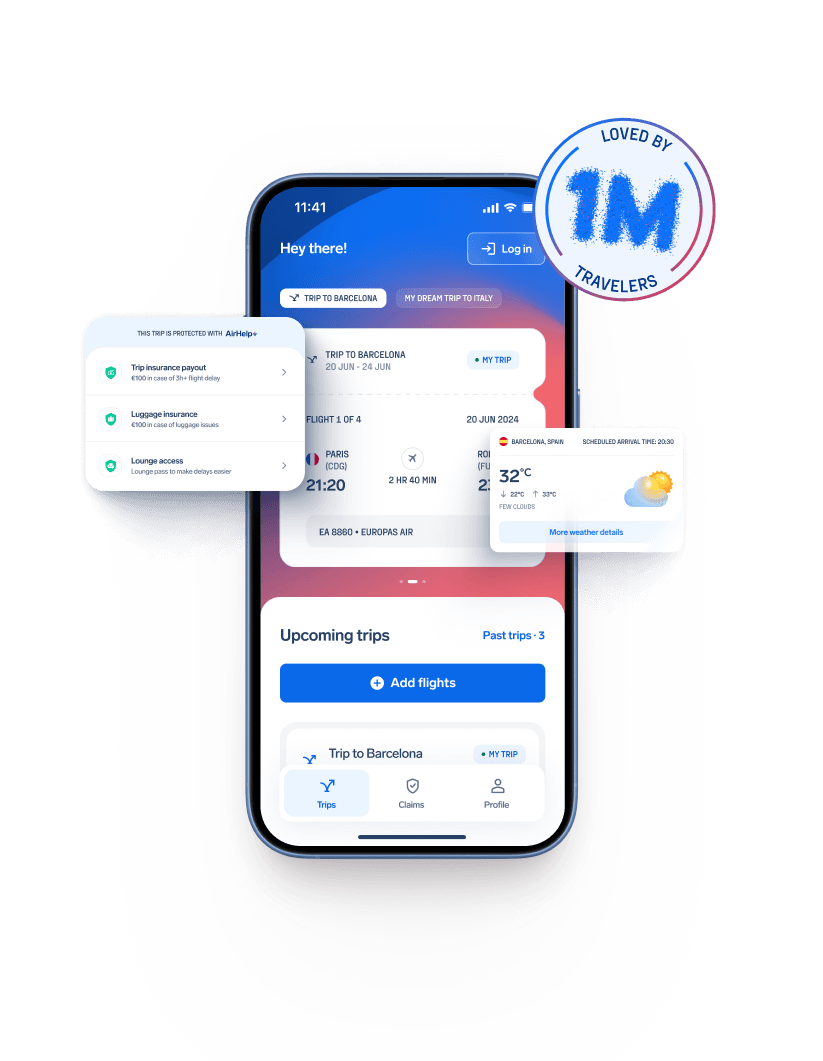
The newer business reaches travelers earlier. AirHelp announced its renewed Flight and Claim Tracker in 2025. The free app gathers itineraries, follows flight status and sends disruption alerts. It also connects those alerts to compensation checks and claim submission. A gate change is useful information; a possible claim gives the notification a financial consequence.
Another to the paperwork.
AirHelp+ makes a different trade. Customers pay before disruption for covered claims without success-fee deductions, plus insurance and lounge benefits according to their plan. At research time, the US-facing site listed protection from $179.99 a year for six trips. Certain benefits require flights to be registered at least 48 hours before departure. Buying after trouble starts cannot undo that deadline.
Insurance payouts and airline compensation run on different clocks and rules. A plan’s payout can arrive sooner; recovering statutory compensation depends on the airline and the case. Keeping those two products distinct matters. A lounge pass helps during the wait. A compensation claim settles an obligation afterward.
Distribution is part of the design. AirHelp works with travel sellers, insurers and platforms that can integrate its services into their own customer journeys. eSky is a publicly named partner. The company reports more than 140 travel-brand partnerships. Customers can encounter help where they booked, rather than discovering a claims company only after something goes wrong.

04 / A right still needs a route
AirHelp reports more than 3.3 million passengers paid compensation. In March 2025, Abry Partners bought a minority stake through a secondary investment, giving existing shareholders liquidity. The announcement disclosed no price. Pawliszyn said the company had been profitable for several years. It was a shareholder transaction with a growth agenda, rather than a disclosed new funding round.
The boundaries remain practical. European compensation depends on the route, operating carrier, delay and cause. Extraordinary circumstances can exclude cash compensation while leaving care obligations intact. A late plane does not automatically produce a claim, and an accepted claim does not promise immediate payment. Flight data can help establish what happened; it cannot create an entitlement the law does not supply.
AirHelp keeps looking for another route to the customer. In August 2026 it announced a compensation checker inside ChatGPT and Claude, using its flight and regulatory data. The previous December, it acquired Dutch rail-claims company Trein Vertraging. Both moves extend the same proposition: make a valid claim easier to start and harder to abandon. Keep your boarding pass. Decide who should do the chasing.