Ahti Heinla learned to program on paper. His mother, a programmer herself, taught him Pascal when he was ten. There was no computer at home in Soviet Estonia. There were books, exercises and occasional visits to the machines at his parents’ workplace. A program had to spend some time as an idea before it could become a thing that ran.
It is an unusually appropriate beginning for someone whose later career would involve persuading computers to leave their desks. First came software that helped people talk across borders. Then came little wheeled machines whose professional obligations included finding the correct doorstep. Both required a useful idea to survive contact with ordinary human behaviour.
Heinla’s childhood had other uses for computing equipment. He built houses out of punch cards. Both his parents worked in software, so programming belonged to family life rather than some glamorous future profession. At school, his father kept his mathematics moving a year ahead of the classroom. Jaan Tallinn became his school desk mate. Several of the people around him would remain in the picture for decades.
The friends who kept building
Heinla finished Gustav Adolf Gymnasium in 1990 and studied physics at the University of Tartu in 1990-1991. By then, he and friends were already making computer games under the Bluemoon Interactive name. They found publishers abroad while Estonia was still part of the Soviet Union. Selling software internationally was an unfamiliar occupation in their immediate surroundings; there was no well-worn local route to follow.
The chronology matters because Skype can make everything before it disappear. Heinla’s working life already contained experiments, collaborators and products before internet calling became his calling card. The same circle worked on Kazaa and Joltid before Skype. Later, he would describe those ventures with a programmer’s economical accounting: one brought attention and users, another delivered neither, and Skype finally brought commercial success as well.
At Skype, launched in 2003, he was a founding engineer and chief technical architect. Janus Friis, Jaan Tallinn, Priit Kasesalu and Toivo Annus belong to this wider professional story. The connections lasted beyond the company itself. Heinla, Tallinn, Kasesalu and Annus also formed Ambient Sound Investments, putting capital into other businesses. A successful product had produced another resource: people who knew how one another worked.
A country-sized Saturday job
After Skype, Heinla’s interests extended well beyond another software company. In 2008, he helped organise Let’s Do It!, the Estonian cleanup that brought together 50,000 volunteers to remove illegally dumped rubbish. It was a practical problem on a scale that made vague goodwill insufficient. People needed to know where the waste was and where their efforts should go.
He led the volunteers developing the geographic software for the operation. The mapping system let people record waste using their phones. That detail is easy to overlook now, when a phone seems qualified to do almost anything except leave us alone. In 2008, using mobile mapping to coordinate a national cleanup was a specific piece of organisational engineering.
His civic work continued with Citizen OS, founded in 2015 with Margo Loor and the Let’s Do It! Foundation. The platform supports public discussion and collective decisions. The cleanup and the participation software sit comfortably beside his commercial work: each asks how a technical system might help a large number of people do something together. The desired result exists outside the code.
“It is fun to overcome obstacles.”
Ahti Heinla · Jazz Shapers, 2025
Mars was the rehearsal
Robotics began as a hobby. Heinla assembled a ten-person team for NASA’s Sample Return Robot Challenge, which asked a machine to locate and retrieve samples without the convenient assistance of GPS or communications. The prize fund was $1.5 million. It was an exacting way to spend one’s spare time, with rather more navigation than most hobbies require.
The team did not win. But a competition can yield something more useful than its advertised prize. In summer 2014, Heinla and Friis were discussing possible new businesses when they recognised an earthly application for autonomous movement: the last mile of delivery. The company followed within days. By the end of its first month, it employed more than ten people.
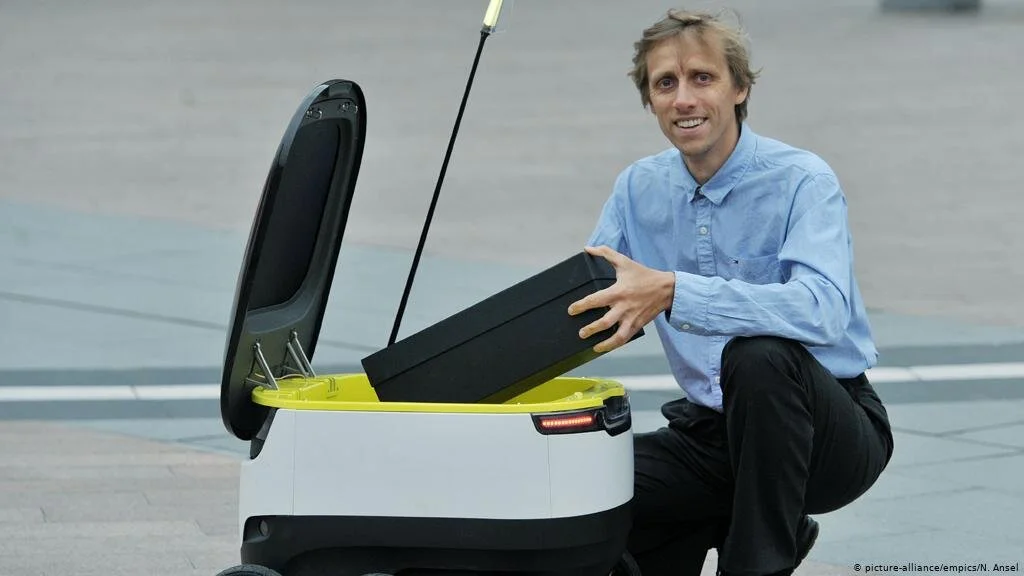
Starship was founded on July 3, 2014; a delivery prototype followed in August. Heinla’s reasoning was deliberately practical. Self-driving cars demanded enormous investment and long development schedules. Smaller robots on pavements offered a narrower problem, using technology already available or within reach. A machine could earn its place in the world by bringing someone dinner. Mars, for all its attractions, has a disappointing takeaway market.
The robot has to come back tomorrow
The early commercial map took shape gradually. Grocery service began in Milton Keynes in 2018. George Mason University became the starting point for commercial U.S. campus operations in 2019. Pedestrian campuses offered a useful setting for the machines, and students supplied something a laboratory could never manufacture: daily orders, changing habits and a reason to keep the service running.
Heinla has repeatedly drawn attention to the distance between a robot that works and a delivery operation that works. An impressive demonstration occupies a few minutes. A service must turn up again tomorrow, carrying something somebody has paid for. Weather, charging, maintenance, routing and the food’s temperature all join the engineering brief. The groceries are unmoved by a successful demonstration last Tuesday.
By April 2026, Starship announced ten million deliveries, more than 22 million kilometres of autonomous travel and a fleet exceeding 3,000 robots across eight countries. Those are company-reported totals, and their dates matter. They describe accumulated operating experience. Each street crossing adds another encounter with a world that does not arrange itself conveniently for a camera.
Describing the supporting operation, Heinla explained how much it had changed: robots could charge automatically outdoors, while maintenance was handled through a much smaller network of facilities. The machine’s independence depends on all that surrounding work. The little box on wheels is simply the part the customer gets to meet.
Deliveries, counted in millions
Winter is on the product team
Finland gives this philosophy a fairly stern examination. In December 2025, Starship and S Group marked one million grocery orders completed in just under three years. The service was available from more than 170 stores. Rovaniemi, in Lapland, appeared on the delivery map. The robots had acquired a customer base in a place unlikely to excuse poor preparation for snow.
The technical response included winter tyres, special motor control software, routing that accounts for snow and detection of snow piles. These are satisfyingly unromantic improvements. A robot cannot charm its way through a drift. Some machines in Rovaniemi were nevertheless dressed as reindeer and elves for Christmas, combining the requirements of traction with those of seasonal public relations.
That mixture of engineering and social acceptance keeps recurring. In February 2026, announcing the Just Eat partnership in Sunderland, Heinla emphasised that robots needed to fit into the community. He described politeness as part of that relationship. On a shared pavement, manners have technical consequences: a machine has to move among people who have their own destinations and no obligation to admire it.
Finnish stores offering S Group robot delivery by December 2025. A useful test of an idea: people ordering again, in winter.
An engineer learns to run the room
Heinla has been candid about management requiring a different kind of learning. As Starship grew from a small group into hundreds of employees, practices that suited ten people no longer suited three hundred. He had to change his own behaviour, hire different leaders and make everyday work more systematic. Solving the robot did not automatically solve the organisation building it.
There is a useful complication in his account of becoming a founder: he says he never began with a particular ambition to be an entrepreneur. He started as a software developer, accumulated experience, gathered teams and found himself leading things. The result looks coherent in retrospect. Living through it involved projects that stalled, experiments that ended and organisations that continued without his daily involvement.
His descriptions of life outside work are similarly resistant to the usual founder accessories. He values travel, music and encounters with other cultures, and has said that conspicuous possessions do little for him. He describes wanting to be useful. Recognition, in his telling, is a poor substitute for a worthwhile experience or a problem that still holds his attention.
The next turn is toward the grocery aisle
In June 2026, Starship announced a consequential change: it would wind down U.S. university campus operations and redirect more than 1,200 robots toward grocery retailers in Europe and the United States. Its announcement included transition arrangements through the 2026-2027 back-to-school period. The campuses had helped build the service; the company was now choosing where to concentrate it.
That decision belongs beside the delivery milestones. A founder’s job includes deciding which successful chapter to leave. The earlier campus strategy had given Starship operating experience in more controlled environments. Heinla’s argument for the move was that the system could now work in open urban settings, where grocery customers offered a different commercial opportunity.
The partnerships were already pointing outward. Uber Eats and Starship announced their collaboration in November 2025, beginning with a planned Leeds launch, followed by further European markets and a proposed U.S. expansion in 2027. Just Eat added another route into people’s existing ordering habits. These were announced plans and partnerships, rather than a promise that every town would soon have a robot.
For Heinla, the unfinished business remains the delivery itself. He has described wanting to reach the point where the change he set out to make is actually accomplished. There is a patient stubbornness in that ambition. The child who wrote programs before he could regularly run them now leads a company whose progress is measured in journeys completed. The destination is usually somebody’s front door.
Keep following the journey
More from Heinla, the people he builds with, and the streets his robots travel.
- Starship Technologies
- Ahti Heinla on LinkedIn
- Ahti Heinla on X
- Ahti Heinla on Facebook
- Heinla’s personal website
- Heinla on Medium
- Watch: The impossible equation · Talks with Petri
- Listen: Jazz Shapers
- Listen: Robot Talk, May 2026
- Citizen OS: giving citizens more decision-making power
- Starship’s June 2026 grocery announcement