The revealing number in Agora Data’s first crowdsourced auto securitization was $11,000. That was the size of one participating originator’s portfolio. At the other end were portfolios worth more than $20 million. On December 29, 2020, they entered the same transaction. A very small operator had found a way into a very large room.
- Pool smaller originators so their loans can reach capital markets.
- Use credit models and reporting to make those portfolios understandable.
- Let eligible dealers participate in profits as loans perform.
That is the useful starting point for understanding Agora, an Arlington fintech founded in 2017. The company serves auto dealers and finance companies working with non-prime borrowers. Its proposition is that a dealer’s size should not determine whether it can access sophisticated financing. The car lot supplies the contracts; Agora supplies much of the financial machinery around them.
Build the missing middle
A dealer offering buy-here-pay-here financing has two businesses sharing one address. One sells cars. The other waits for borrowers to make payments. Selling another vehicle requires cash today, while the money from the last sale may arrive over years. Access to funding therefore shapes how quickly the dealership can grow.
Agora’s answer combines loan analytics with structured financing. AgoraCapital connects originators with capital. AgoraInsights reports on portfolio value and cash flows. AgoraPortal provides loan-level information and origination guidance. Nuron, its proprietary modeling system, addresses credit risk, pricing and fraud. Together, these products help translate individual contracts into portfolios that capital providers can evaluate.
Capital returns to originators. Borrower payments support the portfolio.
The ambition required substantial spending. Agora says it spent more than $50 million assembling its team and models. It also reports training its technology on over $350 billion in loan principal data. That figure describes its data foundation, rather than loans Agora itself funded. The distinction matters: experience observing credit and dollars actually advanced measure different things.

The price of a second profit stream
The dealer-facing offer is now unusually concrete for a capital-markets story. As of October 2026, Agora advertises a $299 monthly subscription. It includes portfolio insights, portal access and no application fees. The published comparison also assumes an average $500 fee per funded contract. Three contracts produce an illustrative $1,799 monthly total.
Published fee illustration, not a complete financing quote. Actual terms apply.
Its OnRamp program precedes WealthBuilder, which offers participation in additional loan profit. Published entry conditions include $500,000 in funded contracts, six months in OnRamp and consistent performance in good standing. The waiting period makes operational sense: the relationship needs a track record before the dealer can enter the next stage.
This is Agora’s distinctive pitch against simply handing a contract to another lender: the dealer may earn beyond the initial payment. But the company’s own terms say additional profit and its timing are not guaranteed. A subscription cannot make a weak contract perform. Underwriting, collections, market conditions and the final agreement still govern the outcome.
Follow the capital, carefully
The financing history shows Agora adding different ways to keep that machinery supplied. In September 2022, it announced a $100 million revolving credit facility from Credit Suisse. In August 2023 came $160 million in private term financing. Waterfall Asset Management supplied up to $100 million in additional mezzanine capacity in September 2024.
These announcements describe different financial instruments. Treating them all as venture funding would muddle the story. The more revealing milestone arrived in June 2025: Agora announced its first rated asset-backed securitization, a $112 million transaction. It said the deal increased annual lending capacity beyond $1 billion. Capacity measures what a platform can support, rather than what it has already originated.
The method also traveled beyond passenger cars. Auto Finance News reported that Agora bought $12 million in powersports loans from Model Finance Company in 2025, followed by an evergreen forward-flow agreement. A bulk purchase addressed an existing portfolio; the continuing arrangement created a route for future loans. The underlying need remained familiar: turn receivables into money available for growth.
There is an investor-facing business here, too. AgoraTrade Auto Loan Trust, or ATALT, offers qualified financial institutions exposure to seasoned, performing auto loans through a Delaware Statutory Trust. Published portfolio sizes typically run from $5 million to $50 million or more. The attraction is an existing payment history, supported by reporting and servicing oversight. Banks and credit unions can examine cash-flow models and documentation before committing capital; their requirements help determine how portfolios are constructed.
Meet the dealer where the dealer works
Distribution provides another clue to Agora’s strategy. Its October 2025 DealerCenter integration offered more than 20,000 dealers the opportunity to enroll through software they already used. That number describes a potential channel. The practical attraction is less rekeying and a more connected application process, rather than asking a dealership to build a separate financing workflow.
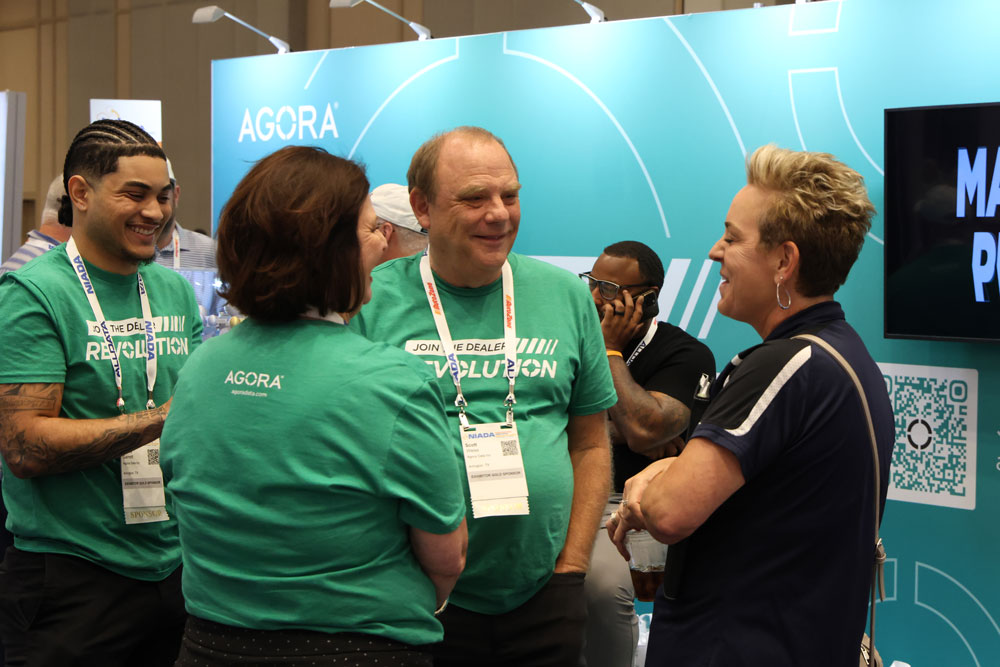
There is recognizable industry experience behind the software. Co-founder Steve Burke leads as CEO; co-founder Matt Burke is president and COO. Christopher Hawke, also identified as a founder, serves as chief legal officer. The company organizes its stated workplace values around GRIT: Growth, Responsibility, Integrity and Technology. The acronym fits a business combining credit judgment with software development.
“We effectively aligned numerous car dealers and finance companies into a single transaction.”
Chris Hawke · inaugural securitization announcement, January 2021
Customer examples supply a more everyday perspective. In an Agora-published testimonial, Autos of Forney says the program gives it flexibility to structure deals for different profit objectives. That is a dealer’s account, not a controlled comparison. Still, it identifies the decision Agora wants to influence: how a dealership earns from the contracts it originates.
The loan gets another address
In February 2026, Agora and Figure announced a partnership, including a strategic Figure equity investment. In March, Agora said its auto loans became available to qualified participants on Figure through ALTRUVO. The platform combines Agora’s underwriting and asset validation with Figure’s blockchain infrastructure. Figure does not fund dealers directly under the arrangement.
The technology changes the route to investors; borrowers still have to pay. For other businesses, the copyable lesson is the aggregation: identify infrastructure too expensive for small customers to build alone, then make it shareable. Agora’s wager began with portfolios of radically different sizes entering one transaction. The smallest participant remains the best explanation of the idea.