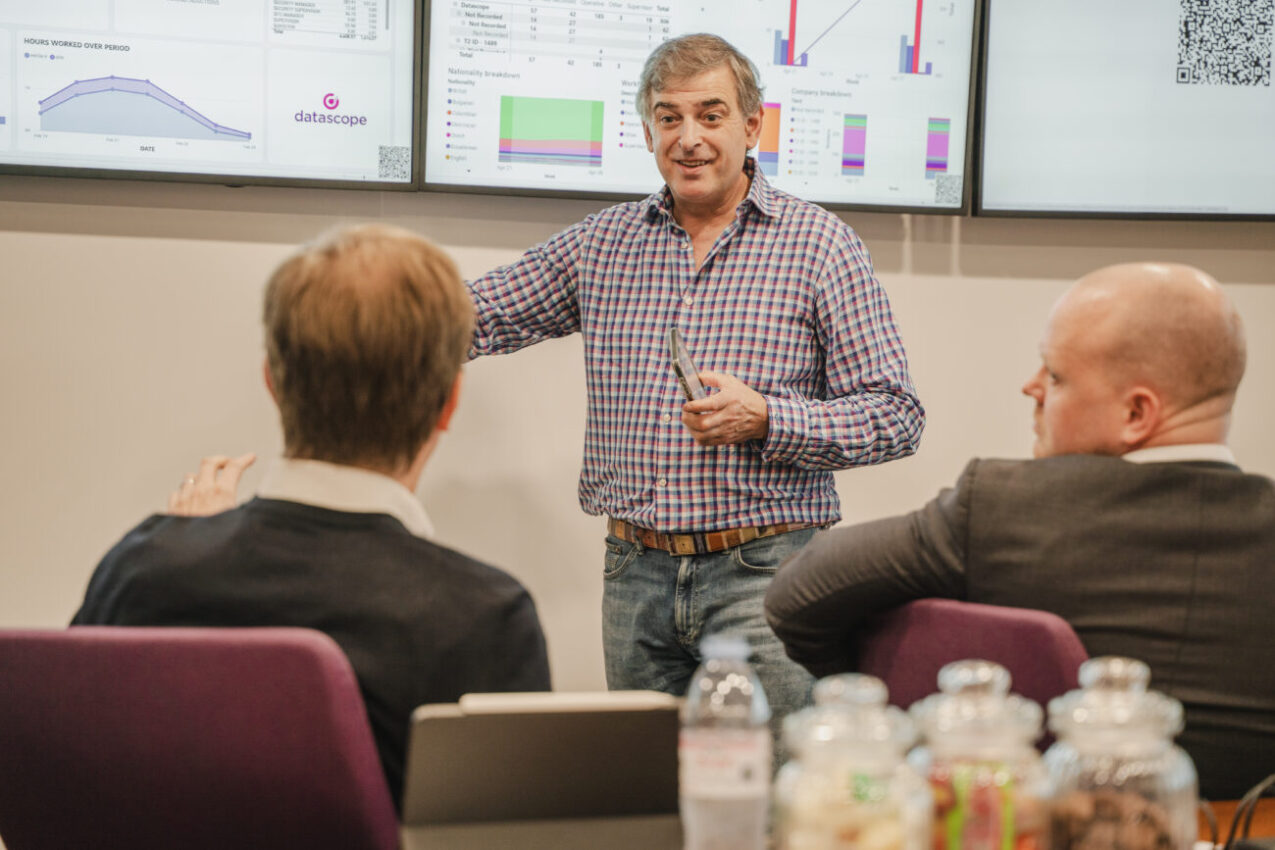
In the photograph, Adrian Butt is standing in front of a wall of charts, talking to customers. He wears a checked shirt. There are water bottles on the table and a collection of graphs behind him. It is DataScope Day, documented in June 2024, at the company’s Chester office. The founder is doing the demonstration himself.
Butt and sales director Richard Bailey opened the gathering with the company’s plans. In the new DataScope Lab, Butt then showed software that let people visualise and analyse information according to their particular roles. The room provides a useful place to begin his story: a business owner, his customers and the question of what they need to see.
There is something pleasingly direct about it. A chart can look impressive from a distance. Put the person who will use it in the room, and the conversation becomes more demanding. Which numbers matter? Which view helps someone make a decision? In construction, those questions have to survive contact with a working day.
The questions after arrival
Butt founded DataScope and remains its CEO. The company’s early work was construction site hardware; its later business brought attendance, logistics and planning into software. At first glance, that sounds like a change of medium. Look more closely and it is an expansion of the questions a site manager can ask.
Knowing that someone has arrived is a useful beginning. It leaves a substantial amount of the day unresolved. A project still needs to organise activities, coordinate contractors and understand where work will happen. The gate can register an entrance. It cannot, on its own, settle the afternoon’s competing claims on the same piece of ground.
Butt’s particular contribution has included research and development. He helped drive DataTouch, DataScope’s daily activity coordination system, and has more recently concentrated on collaborative planning. That gives his position an unusual breadth: responsibility for the whole company, alongside sustained involvement in products intended for the people organising its customers’ work.
DataTouch gives teams a shared view of activities and work areas. Its functions include identifying clashes between planned activities and recording commitments. The principle is straightforward enough to explain without a sales presentation: people planning separate jobs need to understand how their jobs meet. A building programme contains rather more neighbours than a tidy spreadsheet suggests.
- ArrivalWho is on site?
- CoordinationWhere will the work happen?
- PlanningWhat needs to happen next?
That is the thread connecting the hardware business to the software Butt helped develop. Information collected at one point becomes useful to someone making a decision elsewhere. Arrival, activity and planning are related, but they answer different questions. His company’s expansion across those questions gives the career a shape that a job title alone would miss.
A longer view of the work
Collaborative planning extends that concern further into the future. DataScope’s product uses shared digital boards, lookahead tools and task tracking. Teams can review upcoming work, see dependencies and update progress. The ambition is to make commitments visible while there is still time to organise the work around them.
The distinction between daily coordination and forward planning matters to Butt’s story. His attention has moved across both. One concerns the work being brought together now; the other asks whether future tasks are ready to proceed. Neither is a particularly glamorous subject for dinner. Both become absorbing when a project depends on the answer.
It would be easy to describe this as a founder’s instinct and leave it there. The more useful evidence is the work itself: DataTouch, collaborative planning and the lab demonstration. Together they show where Butt has spent his attention. The recurring problem is how to give different people a sufficiently clear picture of a shared job.
He also works within a leadership team. Rob Hinds, another founder member, is CTO and leads the technical and development team. Peter Hosker oversees finance, while Sam Jones coordinates commercial activity as COO. Butt’s role sits among those responsibilities. The company’s development has involved a collection of people doing distinct kinds of work.
“Our approach is to focus on what works”
Adrian Butt, on DataScope’s approach
Twenty years, then an investment partner
In September 2024, Butt described DataScope’s evolution over the preceding twenty years from hardware into a software business. That month, BGF announced a multi-million-pound investment. DataScope reported more than 120 employees and live projects in 25 countries across five continents. Outside investment arrived after the company had already acquired an international footprint.
The plans attached to it were quite specific. Butt wanted to expand in the United States, the Middle East, mainland Europe and the Far East. He also wanted continued investment in product development and greater sales capability. More territory was one part of the programme. Developing and selling the software remained central to it.
Investment announcements have a habit of making the future sound agreeably frictionless. The interesting detail here is the combination of commitments. International expansion, development and sales each require attention. Butt was proposing to advance all three, with a partner intended to support the business over the longer term. Capital was attached to an existing set of ambitions.
DataScope’s reported footprint at the time, rather than a current headcount or a measure of personal wealth.
Geoffrey Finlay joined the board as non-executive chair as part of the investment. His background included leading technology companies. For Butt, the next stage therefore involved a change in the people around the board table as well as resources for expansion. The founder continued as CEO while the company added another layer of experience.
The timing gives the Chester photograph another dimension. In June, Butt was demonstrating software to customers. In September, the business announced backing for its next stage. They are different scenes in the same year: the close view of a product being explained, and the wider view of an organisation preparing to travel further.
The division of responsibilities matters as well. A founder can remain involved in development while technical leadership, commercial coordination and finance sit with colleagues. DataScope’s published leadership structure makes those roles explicit. For a reader following Butt’s career, it provides a more concrete account of the organisation than treating every product and decision as the work of one individual.
A lunch with a useful agenda
A year earlier, the setting had been rather grander. In September 2023, DataScope brought customers to the Palace of Westminster after an invitation from local MP Mark Tami. There was a tour and a private lunch. Parliament supplied the architecture; the guests supplied their experiences of using construction technology.
Butt described the gathering as an opportunity to hear customers discuss industry challenges. He was interested in the different ways they used DataScope’s systems, including attendance, logistics and DataTouch. The discussion also looked towards the next generation of products. An existing system can acquire a different meaning when the customer explains what happens around it.
A private lunch at Westminster might seem a considerable distance from a site gate. The connection is the conversation. Butt was hearing how people used tools his business supplied. In Chester, he would show them further possibilities. The two events place customers inside the development story, rather than leaving them as an anonymous figure in a growth announcement.
They also give this profile its human scale. The public record offers specific moments of Butt presenting, listening and setting out plans. There is enough interest in those actions without decorating them with an invented revelation. The founder’s work is visible in the rooms he enters and the subjects he brings to the table.
The next booking
By his year-end review of 2025, Butt had further figures to report: a 13% increase in live sites and 20% growth in software revenues. He also recorded 2.8 million bookings through DataScope’s delivery management platform during the year. These measures describe different things. Each offers a separate view of how the business was being used and how it was growing.
A booking is a small unit with a substantial working life around it. Someone needs a delivery; a project needs to make room for its arrival. At that scale, the administrative detail becomes part of the company’s story. DataScope’s software was participating in repeated, ordinary decisions. The number is interesting because of the routine it measures.
Further developments followed in 2026. In July, DataScope appointed Sarah Beesley as Head of Product to lead its next phase of product strategy. In August, it announced an integration with Mission Zero that brought fleet accreditation into delivery booking. One development concerned responsibility for the product roadmap. The other extended what a particular workflow could check.
For Butt, these are recognisable continuations of the questions behind the lab demonstration. Which information belongs in front of which person? At what point will it help? A company can have an international plan and still depend on answering those modest questions carefully. Somewhere, a person needs to make a decision before the next job begins.
The shift in scale is easy to see across these episodes. The lab puts a founder and a customer in front of the same information. The investment announcement sets out ambitions across several regions. The delivery platform records millions of transactions. Each is a different distance from the working day, and the business has to operate across all three.
Return to the checked shirt and the charts in Chester. Butt is explaining software to the people expected to use it. The photograph catches a practical part of being a founder: making the work legible to someone else. Beyond the gate, there is an entire day to organise.