Adrian Aoun has a habit of looking beneath the thing he is supposed to be building. A news feed becomes a problem about the structure of information. A job at Google becomes a question about what else Google might become. A factory becomes an invitation to redesign the factory. Give him a component and he is liable to become interested in the surrounding institution. It is an engaging habit, although institutions seldom thank anyone for inspecting the foundations.
His career contains an acquisition, an influential patron, a company that closed, and new ventures with physical consequences. The sequence resists the usual founder biography, in which each chapter seems to have been arranged beforehand by a considerate publicist. Aoun’s story is more interesting with the awkward turns left in. The recurring ambition is visible. So are the occasions when ambition had to answer to events.
The boy who found computers more agreeable
He was born in Paris and grew up in Los Angeles. In his telling, the move brought an accent that made school difficult: the English words three, free and tree were troublesome companions. Computers offered a more predictable sort of company. At thirteen, he began a business building websites. It expanded into software and hosting, continued through college, and was sold when he was twenty-two.
There is a practical education in that progression. Someone asks for a website; making the site raises questions about the software behind it; running the software raises questions about hosting. Each answer exposes another layer of work. In retrospect, that early business offers a useful way to read the later career, without pretending a teenager had already mapped out his future. The appetite for building arrived before the impressive job titles.
Aoun attended the University of Southern California, studying computer science and psychology. That pairing has an appealing symmetry: one discipline considers how machines behave, the other how people manage to surprise them. His subsequent working life would involve plenty of both. Before Wavii, his employers included Microsoft and Fox Interactive Media. Employment gave him a view inside established organizations; founding gave him a chance to argue with their assumptions.
A news feed with an engine underneath
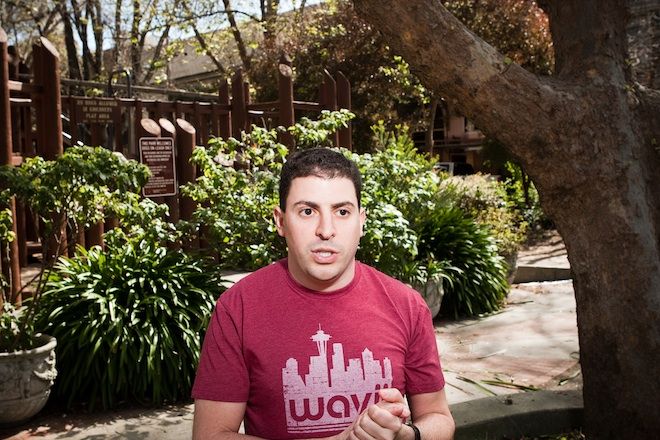
Wavii began in Seattle in the late 2000s and spent long enough developing its product to become a local mystery. In 2011, Aoun was still declining to explain much of what the company was doing. He even withheld the office address in an interview, citing security. For a business concerned with extracting information, it was unusually economical about supplying any.
“We are focused on tough technical challenges that really effect people’s lives, and a lot of that takes time.”
Adrian Aoun, 2011 interview
The public product arrived in 2012. Users could follow subjects and receive compact updates. Beneath that familiar feed sat an attempt to turn the unruly language of the web into information a machine could organize. Names, events and relationships had to emerge from prose. A useful summary required more than locating a few impressive words and arranging them with confidence, a temptation available to people as well as computers.
Early testing also exposed imperfect results and stale items. That detail matters. Wavii was a working attempt at a difficult task, with the unevenness that description implies. Today’s familiarity with generated text can make earlier language-processing products seem inevitable. They were experiments made under different constraints, with users encountering their mistakes in public.
A conceptual illustration of the product’s approach, not a technical architecture diagram.
Google acquired Wavii in 2013. The standalone service closed, and the team’s work moved inside a much larger organization. For Aoun, the sale created a new setting for an old interest: what could be done once a computer understood more of the information in front of it? An exit, in the financial vocabulary, had become an entrance.
Larry Page changes the job description
At Google, Aoun worked on artificial intelligence before moving into special projects for Larry Page. In 2014, he appeared ready to leave. Page persuaded him to stay with a different brief. By 2015, Sidewalk Labs had been announced, bringing technology into questions about cities. Aoun helped found it; Dan Doctoroff was its chief executive. The distinction matters in a career easily blurred by proximity to famous names.
The change of scale was considerable. A feed asks what a reader should see next. A city raises questions about movement, buildings, public space and the organizations responsible for them. Technical possibility must meet people who cannot simply refresh the page and start over. The appeal of starting from scratch becomes more complicated when the thing already contains everyone else’s day.
Aoun later described his special-projects work as looking at sectors and asking how they might be improved. It helps explain why his career does not stay politely within one product category. The object changes; the interest in how the pieces fit together persists. That continuity is an interpretation of the work, rather than proof that the same approach will succeed everywhere.
- 2012Wavii’s public product
Reading the web - 2013Google acquires Wavii
Working inside a larger system - 2015Sidewalk Labs launches
Thinking about cities - 2024Forward closes
An eight-year chapter ends - 2025–26Seneca and Foundational
New work in the physical world
Eight years, then an ending
Changing the system also changes what a builder must be accountable for. A narrow product can leave many decisions to somebody else. A broader undertaking brings those decisions inside the company, along with their costs. The freedom is real, but it arrives with obligations that a product demonstration can leave out. That trade-off is worth keeping in view through Aoun’s next chapter. It prevents the scale of the ambition from becoming the only measure by which the work is judged.
Forward became his next sustained undertaking. Aoun co-founded it, led it, and spent roughly eight years on the company. In November 2024, it closed. Later that month, he joined a public conversation about winding it down. The ending belongs beside the earlier acquisition. A biography that keeps only the flattering transaction becomes an advertisement with dates attached.
The closure puts a boundary around any easy reading of his ambition. A founder can be persuasive, technically experienced and well connected, and still lead a company that ends. Confidence does not relieve a business of the need to sustain itself. Nor does a promising new chapter cancel the cost of the previous one. People who supplied their time or money lived through that chapter too.
There is no need to turn the episode into a convenient lesson in perseverance. Stopping and continuing are different decisions, each requiring its own justification. The interesting question is what a person chooses to carry forward. Aoun’s subsequent activities suggest that the attraction of difficult systems remained. Whether that attraction produces a durable business has to be established again, separately, by each new venture.
A factory is harder to refresh
His newer work includes Foundational Industries, a partnership with Jonathan Winer. Aoun has described the project as building factories designed from the beginning for autonomous production. The company’s stated aim is a network of factories that can bring critical supply chains back to domestic production. It treats the production system itself as the object to redesign.
There is a recognizable family resemblance to the earlier work. The visible product sits on top of a deeper arrangement of information, equipment and decisions. Change that arrangement and different products may become possible. It remains a proposition to prove. Steel, schedules and manufacturing costs have a way of providing opinions without first being invited to a meeting.
Seneca adds another physical setting. Its October 2025 launch named Aoun among its founding partners and announced $60 million in financing. The company develops autonomous aerial systems for wildfire response. Stuart Landesberg is its chief executive. Here too, Aoun appears among a group of collaborators, rather than as the solitary inventor who materializes whenever a biography needs a convenient protagonist.
The financing is evidence of backing, not a measurement of success in the field. Keeping those categories separate makes the venture more intelligible. An aerial system has to function outside the presentation; a factory has to produce. Both offer clear reminders that the world beyond software has weight, weather and deadlines.
Chocolate, flight plans, and another question
His investments create a second map of his interests. His own site lists stakes in companies including Stripe, Airbnb, Anthropic and Anduril. That range puts consumer products, software and physical systems beside one another. It is a self-reported portfolio, rather than a scorecard of returns. Still, it shows another way he participates in the work: supporting people building their own companies, while pursuing projects of his own.
There are less institutional details. Aoun’s public professional profile lists aircraft and helicopter pilot credentials. His personal site places him in both San Francisco and Los Angeles. In a 2023 interview, chocolate emerged as a running joke among his friends and colleagues. A dessert menu, apparently, presents fewer strategic ambiguities than a company.
His professional relationships also extend beyond individual ventures. In a 2021 conversation, he singled out Marissa Mayer’s willingness to help others. That acknowledgment adds another dimension to a story often told through founders and their ideas. Careers also depend on introductions, advice and people who make time before anyone can promise them a result.
Wavii asked a computer to find structure in a torrent of language. Aoun’s later choices keep returning to the structure underneath an experience. There is ingenuity in looking there, and considerable risk in deciding to replace what one finds. His career holds both facts in view. The next chapter will have to earn its place alongside them, one working decision at a time.
Follow the threads
Conversations, company announcements, and places to follow his work.
- Aoun’s own site
- Twitter / X
- Foundational Industries
- Seneca’s launch announcement
- The Wavii years
- Wavii’s long development
- Wavii’s early product test
- Google and the special-projects turn
- The November 2024 business ending
- The #ANGELS conversation
- Watch: Aoun on his career with S³
- Watch: Creator Lab, the Google and cities discussion