A doctor’s office contains an astonishing amount of waiting. Waiting for the appointment, the test, the call back. Forward tried to turn that inconvenience into an engineering problem. Eventually, its answer was a silver box in which a patient could sit alone, follow instructions and collect health measurements. The box looked ready for the future. The company behind it closed in November 2024, a year after announcing the product.
- Forward sold preventive primary care through a monthly membership outside insurance.
- Its CarePods moved routine screening into self-service kiosks, with clinicians still involved.
- Hardware trouble, difficult deployment and financing pressure preceded the shutdown.
The appointment before the machine
The origin was personal. In his launch essay, founder Adrian Aoun described the phone call announcing a relative’s heart attack, followed by hospital hours and a crash course in unfamiliar medicine. He had encountered healthcare as a family member: frightened, researching, trying to make the pieces fit. Prevention became the organizing idea behind Forward.
Founded in 2016, the company opened its first public clinic in San Francisco in January 2017. The Associated Press described a converted clothing store with six exam rooms. Body scanners and large screens gave the place the vocabulary of consumer electronics. Behind the presentation was a recognizable wish: make it easier to understand your health and reach someone who knows your history. The first clinic made that proposition tangible.
Members could get primary care, baseline measurements, blood testing and ongoing support. An app connected them with the care team; home sensors extended monitoring beyond the visit. The intended customer was a person willing to pay regularly for easier access and preventive attention. The obstacle was familiar too: that person needed enough disposable income to buy another subscription.
Two prices. One missing insurance policy.
The clinic launched at $149 a month. Forward did not take insurance. That made the transaction unusually legible: a recurring payment for the specified care, rather than a fresh billing puzzle after every encounter. Its early model included medical scribes to let doctors spend more time with patients instead of entering records.
$1,788 / year vs. $1,188 / year
Annual equivalents at advertised monthly rates. Insurance separate.
But a primary care membership could not pay for every medical event. Hospitalization, surgery and outside specialist care still belonged to another system. As health-policy expert Paul Ginsburg pointed out in the AP’s launch coverage, a member would still need insurance. An easy front door did not remove the rooms behind it.
This also separated Forward from One Medical, which paired a membership with insurance billing. Forward positioned itself around direct payment and continuing prevention. In 2021, it offered programs addressing heart health, stress and weight, alongside genetic screening supplied by 23andMe. The bundle was broader than a video consultation, but breadth alone could not establish better outcomes or affordable delivery.
A clinic becomes a product
Forward’s next move followed its founder’s logic. If every new clinic required another team and another expensive location, expansion would keep running into physical limits. In November 2023, the company announced $100 million in financing and its CarePods: compact, guided screening stations intended for malls, gyms and offices.
“Our insight was actually healthcare should just be a product.”
Adrian Aoun · CarePod launch interview, 2023
A member would unlock the pod with a phone and choose a health app. Instructions guided measurements and tests; sensors supplied data. Aoun’s comparison was an ATM, with routine steps automated and people handling the harder decisions. Forward said clinicians reviewed the information and made care decisions. The “AI doctor’s office” still contained human medical judgment, even when the doctor was elsewhere.
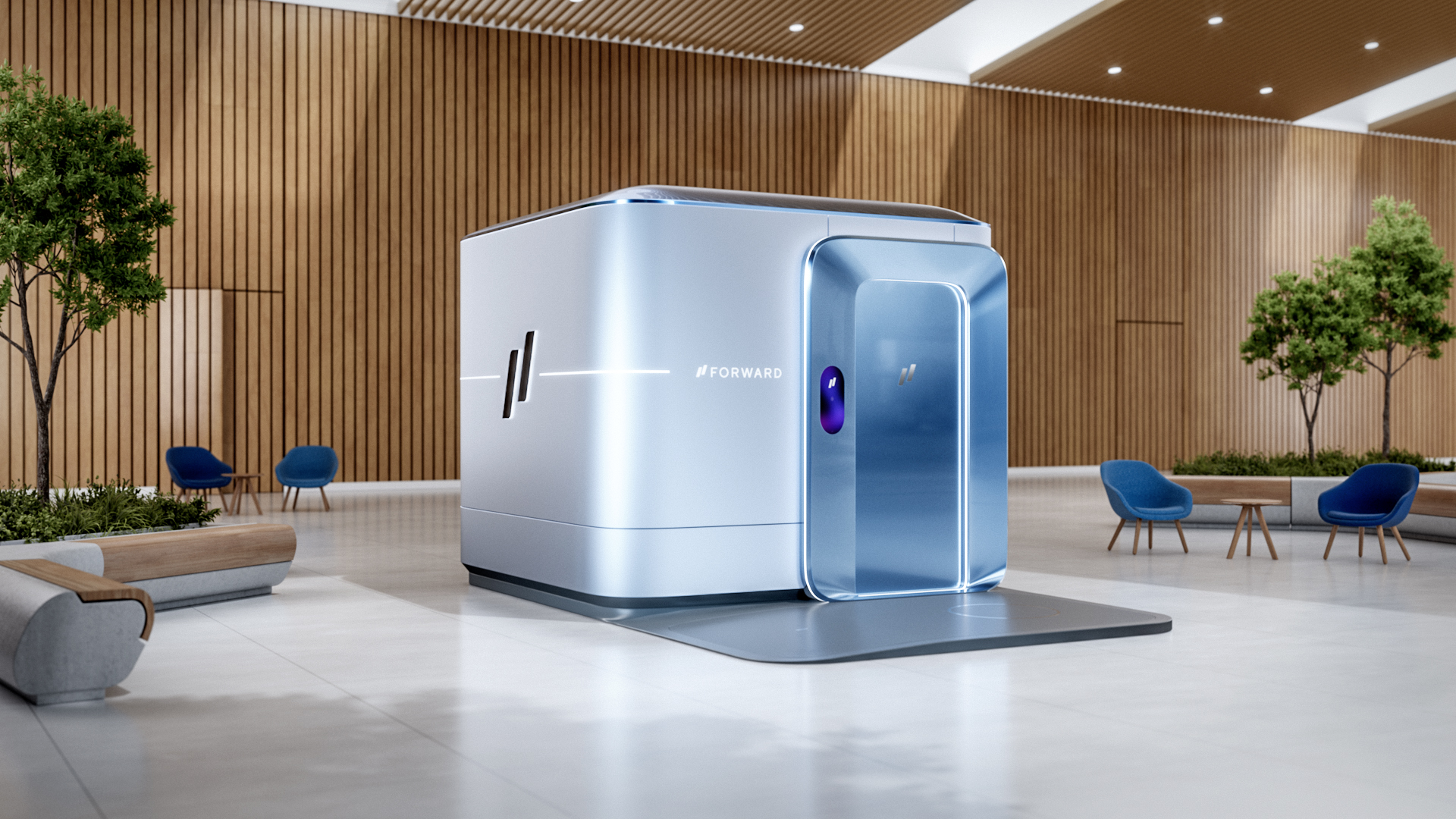
The membership started at $99 a month. The pitch was convenience and repetition: collect a baseline, return, watch for change. In its 2023 launch coverage, Axios noted both the appeal of bringing tests closer to daily life and the difficulty of asking people to pay that much for an untested concept. A diagnostic station also had a narrower remit than an emergency department.
The box still had to work
There were warning signs in the machinery and the rollout. Business Insider’s reporting, summarized by SFGATE, described expensive early pods, trouble installing them and patients occasionally getting stuck inside. Its follow-up reported problems with self-service blood collection and weaker patient interest than hoped. These accounts establish several difficulties before closure; they do not identify one definitive first failure.

The distinction matters. An algorithm can be copied; a pod must be manufactured, placed and maintained. A patient must choose it, complete the visit and want to return. Each dependency adds work before the promised efficiency arrives. That is an operational reading of the evidence, rather than proof that healthcare automation can never succeed.
Aoun’s post-shutdown explanation emphasized financing. After the $225 million round in 2021, he said, the company chose to “swing for the fences.” By November 2024, a proposed funding round would not get it through the changed market, in management’s judgment. He still defended CarePods. The decision to stop was a changed assessment of the company’s prospects, rather than a public renunciation of the idea.
Copy the connection. Test the machine.
There is something useful to borrow here: put records, measurements and follow-up into one understandable experience. Price it clearly. Give patients a way to ask questions between visits. Forward’s pandemic-era home monitoring and doctor-led programs show that its work extended beyond the pod. Those ideas can be evaluated separately from the hardware bet.
The lesson I take is to prove a complete care pathway before expanding it: a reliable test, clinical review, follow-up and repeated customer demand at a sustainable cost. That approach becomes harder where people cannot afford the fee, installation is costly or patients need substantial hands-on care. Forward’s abrupt closure of clinics and app adds one final requirement. For a company selling an ongoing relationship, continuity has to be designed as carefully as the first appointment.