The first office was a bedroom. The first desk was a bed. Across it, Adam Mopsick had spread checks made out to vendors on the apartment renovation that had just made him a 24-year-old business owner. He stepped outside. His new puppy, rescued from the street a week earlier, reviewed the paperwork with its teeth.
When Mopsick returned, the checks were confetti. He had to call the client, admit what happened and ask for every one to be written again. The client, mercifully, had a sense of humor. Mopsick kept the job and carried away a principle sturdier than any desk: bad things happen; deal with them honestly and let the consequence come.
It is a neat origin story because it contains the rest of his career in miniature. There is the improvised setup, the unexpected damage, the awkward call and the recovery built on trust. Over the next three decades, Mopsick would move from laborer to superintendent to founder, from general contractor to owner advocate, and from a company he controlled to the stranger terrain that follows a sale. The scale changed. The work of saying what was true did not.
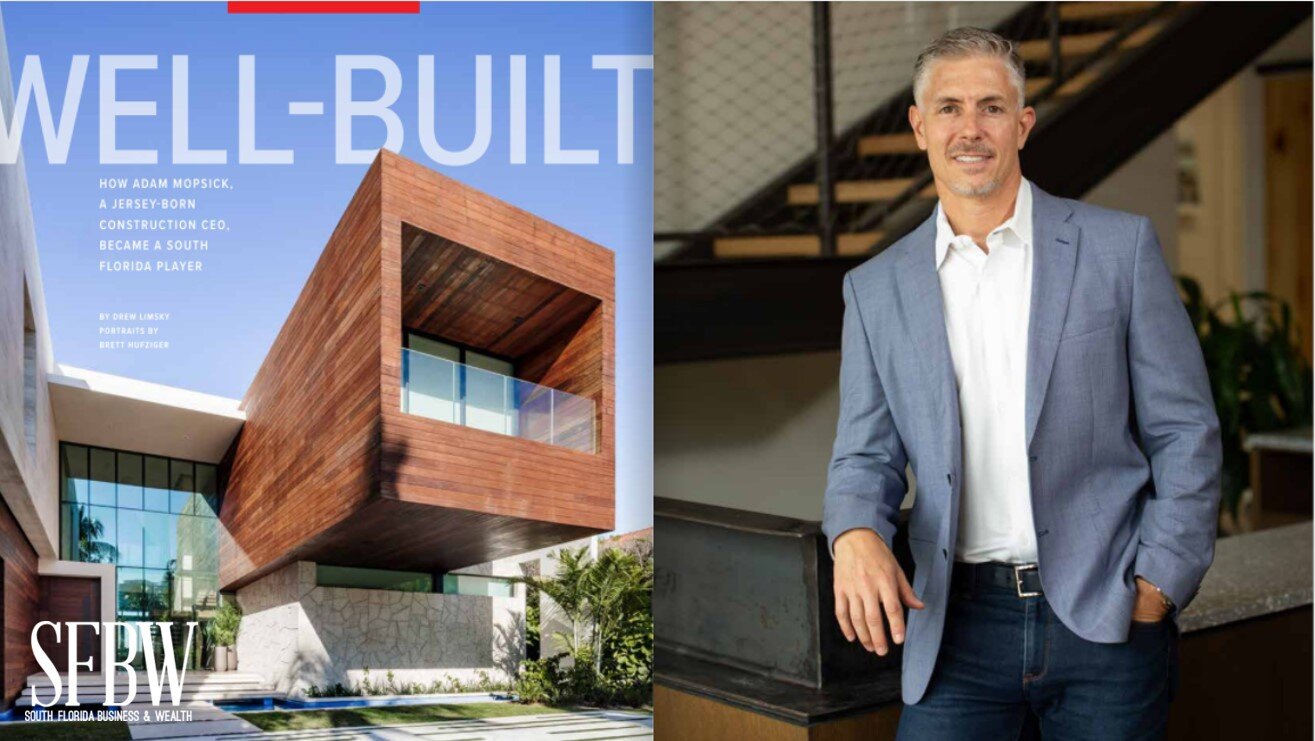
Foundation / 01
A finance degree meets a jobsite
Mopsick was born in West Caldwell, New Jersey, moved to Boca Raton during high school and started learning construction from the blunt end of the business, working as a teenage laborer. He graduated from the University of Florida in 1993 with a finance degree. Law school briefly occupied his imagination. A job as an assistant superintendent for luxury home builder Brookman-Fels occupied his days.
The jobsite won. He liked the daily movement and the fact that almost every kind of business eventually needs something built. At 24, an apartment renovation presented a simple equation: six months on his own might pay what a salary paid in a year. He had few obligations and, as he later put it, not much to lose. He took the project, completed it, then scraped forward through flooring jobs, bathrooms, apartments and houses.
The early work offered an education finance class could only model. On a bid to build two houses for a developer, Mopsick made a $30,000 estimating error. Amicon won as the lowest bidder and lost money on the line item. Yet the project led to roughly a dozen more houses for that developer and others. The error paid back in opportunity, while the embarrassment tightened the estimating process.
“Growth is not a straight line; be patient. Growth comes in spurts and you need to take it as it comes.”Adam Mopsick
He does not tell the story as a license for sloppy math. He tells it as evidence that mistakes have second-order effects. The first order was a loss. The second was a relationship. A founder’s job is to survive the first long enough to notice the second.
Structure / 02
The empty chair at the project table
Mopsick teamed with Ross Adickman to form Amicon in 1996. They wanted a boutique construction firm with disciplined project management, careful service and a culture where people worked as a team. One early assignment, the build-out of Espírito Santo Bank in the building now called Brickell Arch, gave the young company a visible corporate-interiors credential. Mopsick remembers the pride of finishing something at that scale. He remembers the first client check even more vividly.
As the jobs became larger, he noticed a structural flaw. Projects had architects, contractors, engineers and consultants, each with a defined scope. Owners could still lack a single professional charged with protecting their intent across all those scopes. Work drifted. Schedules stretched. Money followed the wrong priority. There were plenty of experts in the room, but the client’s chair was curiously empty.
In 2005, Amicon Management formalized that missing role. The owner-representation practice helped clients choose design and construction teams, negotiate contracts, manage permits, control costs and keep decisions aligned with the original goal. The Great Recession made the shift urgent. Work in the old model contracted. Advisory services became a way to keep moving and, eventually, a substantial business of their own.
The cleverness was not in inventing another specialty. It was in coordinating the specialties already there. Mopsick described Amicon’s position as expert client advocacy. The phrase sounds modest, which suits the work. An owner’s representative wins by preventing the expensive drama that would otherwise become the story.
The portfolio widened across luxury residential, hospitality, education, retail, cultural institutions and condominium associations. Projects associated with the firm included Brickell Arch, Gulliver Schools, Jungle Island and Make-A-Wish Southern Florida. By 2023, when Amicon Management joined Cumming Group, the Miami consultancy had more than 65 local team members.
Miami supplied both the market and the temperament. Mopsick arrived after high school and stayed as the city moved through building cycles, neighborhood reinventions and waves of new residents. He spoke with equal enthusiasm about a morning run at the beach, a cafecito on Calle Ocho and the work his teams completed at Uchi, CHICA and Joia Beach. The recommendations reveal a local operator’s way of seeing: a restaurant is an evening out, but it is also a finished schedule, a stack of coordinated trades and a client finally opening the doors. For Mopsick, the city is never merely scenery. It is a rolling ledger of decisions made visible in concrete, millwork, landscaping and light.
Operating system / 03
Make the mistake useful
Mopsick’s public advice is conspicuously short on swagger. Be patient with uneven growth. Do not burn bridges. Treat people with respect. Reacting emotionally, he has said, is usually followed by regret. The calm sounds inherited from construction, where an agitated meeting does not make concrete cure faster.
His preferred metric also resists ornament: client satisfaction. At the Uchi restaurant project in Wynwood, work paused amid uncertainty, then restarted and finished. What Mopsick recalled was the concern in the client’s voice, followed later by satisfaction with the outcome. Buildings create the photographs. Relief creates the repeat customer.
The early estimating loss became practical tuition. The transferable habit was not celebrating the mistake; it was correcting the system, preserving the relationship and staying available for the next project.
Technology helped convert those instincts into an operating system. Mopsick watched construction, habitually slow to change, adopt tools that made project information easier to track and teams easier to scale. Yet he placed equal weight on recruiting and teaching younger professionals. Internal systems matter because they let judgment travel beyond the founder.
That concern extended to the University of Florida. In 2019, he pledged $50,000 to establish an Amicon Management engagement program with the university’s Innovation Academy. Students visited Miami, toured active sites and met local leaders. The arrangement served both sides: students saw a construction career from inside, while Amicon met people who might shape its future. Mopsick told them to keep an open mind. It was the advice of a finance graduate who nearly became a lawyer and instead found his vocation in a superintendent’s boots.
“There is a solution to every problem and a calm, thoughtful approach is the best.”Adam Mopsick
Next phase / 04
After the transaction, another foundation
Amicon Management’s 2023 combination with Cumming Group marked a change in scale. The local practice gained access to a larger international project-and-cost-management platform. Mopsick said the alignment could expand client services and career opportunities for the team. During integration, the Miami group continued under its executive leadership as Amicon, a Cumming company.
Transactions are tidy in announcements and untidy in a founder’s calendar. A company built across decades is an employer, a reputation, a schedule and a social world. Selling it changes more than ownership. In later podcast conversations, Mopsick discussed the disorientation of separating identity from the enterprise and the need to decide what comes next. The old habit soon reappeared: curiosity looking for a project.
The public record in 2026 shows a builder still in motion. Amicon Construction lists Mopsick as founder and CEO. Florida lists his Certified General Contractor license as current and active. Young Musicians Unite names him treasurer on its executive board, while Vizcaya Museum and Gardens lists him among its directors. These roles place him near two different kinds of Miami infrastructure: the crews and contracts that shape physical space, and the civic institutions that give a city memory and music.
There is a pleasing symmetry here. Early Mopsick found opportunity because he was willing to begin with one apartment. Mid-career Mopsick found it by noticing an empty chair. The current version is again dealing with open space, only now the site is his own next chapter.
He has said one phone call can change a company’s trajectory for an entire year. Three decades of evidence support the broader point. A project arrives. A number is wrong. A market contracts. A partner offers a larger platform. None announces its full importance at the time. The work is to meet the moment honestly, keep the relationships intact and make the next decision sturdy enough to build on.