Adam Lynn once helped put on a Wiz Khalifa show and made about $4,000. For a college promoter, this was an encouraging result. An arena show with Nas followed, and the arithmetic became considerably less encouraging: Lynn says he ended up $60,000 in the hole. He had discovered an unpleasant feature of the concert business. You can book an artist you love, announce an event you believe in, and still be the person left holding the bill.
That early loss belongs near the beginning of any account of Lynn, the co-founder and CEO of Breakaway. His business now takes dance music festivals to cities across America. Its March 2026 financing announcement put the company’s valuation in nine figures. Yet the distance between those two moments is best measured in decisions about how much to attempt, whom to work with, and which cities deserve a weekend of their own.
The interesting question is how someone who went too big learned to build something that could keep getting bigger. In Lynn’s case, the answer involves an Australian apprenticeship, a former rival, soccer stadiums, and a surprisingly durable enthusiasm for places the touring business could overlook.
The music kid meets the balance sheet
Before he booked musicians, Lynn was one. He played tenor saxophone for 11 years, growing up with jazz and hip-hop as his reference points. Electronic music arrived later. He went to the University of Michigan to study finance, and booking shows began as a hobby. That combination makes a certain sense: an interest in the performance, paired with an education in what happens when the numbers stop behaving.
Even in high school, his parties had guest lists and security. At Michigan, he became his fraternity’s social chair and began organizing events in local venues. The Wiz Khalifa profit suggested a future. The Nas loss suggested that this future might require further instruction. During a semester in Australia, he took an unpaid internship with an independent music events company.
In Sydney, he met concert promoter Michael Chugg after an invitation to a Kings of Leon concert. Working around an established operator gave him a different way into the business: observe the people who already know how to make a show happen. Later, discussing the experience, Lynn emphasized the value of meeting people and finding a partner whose abilities complement your own.
His own listening habits were changing too. A show featuring Tiësto with Avicii opening drew him toward electronic music. For someone raised on a saxophone, the route to a festival’s DJ booth had taken a pleasingly indirect turn.
A rival, a weekend, a city
Zach Ruben had been booking college shows as well. The two promoters initially competed for dates before working together on a Steve Aoki college tour in 2010. Their businesses eventually came together as Prime Social Group. The name preserved a piece of each: Ruben’s Prime Productions and Lynn’s Social Studies.
Ruben invited Lynn to Columbus. For a University of Michigan student accustomed to Ann Arbor, moving to Ohio carried its own cultural negotiations. Lynn later described a long weekend that turned into seven years in Columbus. A visit became an operating base. That is a useful origin story for a company built around the idea that an unfashionable dot on somebody else’s map can be quite a good place to work.
The partnership also let them divide responsibilities. By 2019, Lynn was publicly crediting Ruben’s work on talent buying, production and finance. The relationship mattered as much as any individual booking. A promoter can have a persuasive pitch; a recurring festival needs people who can turn that pitch into a functioning site.
“Build trust, build relationships, and the rest will follow.”
Adam Lynn, 2019
The first Breakaway had a second act
Breakaway’s original announcement arrived in June 2013. Columbus Crew Stadium would host a September event with Kendrick Lamar, Empire of the Sun, Twenty One Pilots and Porter Robinson among the performers. A Dallas-area edition was scheduled for the following weekend, featuring Wu-Tang Clan and Explosions in the Sky. The billing mixed musical worlds, and the setting borrowed infrastructure from professional soccer.
The early slogan was “Your Field. Your Fest.” It neatly expressed the proposition: give a place its own event, using a field people already knew for something else. Lynn’s launch statement emphasized the connection between sports culture and music. The stadium was part of the plan rather than an incidental backdrop.
Those first festivals did not lead to uninterrupted expansion. Breakaway paused after the founders found themselves stretched too thin. That matters to the story. The familiar retrospective of a promising first show followed by a steadily rising line leaves out the awkward business of stopping, reconsidering and trying again.
By 2018, Columbus had expanded to a three-day edition, while Grand Rapids ran a parallel two-day festival. The larger Prime Social operation encompassed several festival brands. Breakaway was becoming repeatable, with the earlier overreach still close enough to remember.
- 2010College promoters collaborate on a Steve Aoki tour.
- 2013The original Breakaway festivals are announced.
- 2019Lynn joins Pollstar’s Impact: NextGen class.
- 2025Breakaway Projects adds a label and management division.
- 2026A Series B supports the next expansion.
An audience close enough to go home
Location remained the organizing idea. Lynn distinguished festivals aimed specifically at college towns from Breakaway’s broader focus on secondary cities that also happened to have colleges. Those audiences could support a substantial event without living in one of the cities that dominates the industry’s imagination.
There was a practical limit to what those audiences could spend. In 2018, Lynn described the difficulty of balancing higher artist fees against ticket prices for students. A small increase at the box office could matter a great deal to a customer saving for a night out. The challenge was already visible years before affordability became central to Breakaway’s public identity.
By 2025, his explanation extended beyond the ticket. Travel can make a festival expensive before anyone reaches the gate. Put the event near its audience, and the calculation changes. A ride across town replaces a journey organized around an unfamiliar city. There is a domestic convenience to the idea: enjoy the spectacle, then return to a place where you already know how the coffee maker works.
That proximity helps explain why cities such as Columbus and Grand Rapids recur in Lynn’s story. They are places where relationships can accumulate over repeated visits. A festival that returns can become part of a local calendar, with friends making plans before the next lineup has answered every question.
The people behind the afternoon slot
The festival circuit also gave Lynn a long view of artists’ careers. He has described booking John Summit on an Ohio second stage in 2019, then seeing him return as a headliner. An afternoon slot can become a chapter both the promoter and performer remember long after the running order has changed.
Breakaway Projects formalized another way to work with those artists. Announced in 2025, the label and management division launched with distribution partner The Orchard. Its first roster included Surf Mesa, JADED, EVAN GIIA, Night Tales, Mojave Grey, Klo and Myles O’Neal. The proposal connected recorded music with a live business that already had stages on which artists could meet listeners.
Artist development changes the time horizon. A festival booking places someone in front of a crowd on a particular date. Management and a record label create reasons to keep working together between those dates. For Lynn, it extends a relationship the festival business had been building for years.
Growing the team behind the party
As Breakaway expanded, its commercial relationships became more structured. In May 2025, it signed with Creative Artists Agency for representation through the agency’s media and entertainment partnerships division. Plans included a sponsorship platform, original intellectual property and international growth. Breakaway Presents supplied another format through pop-up experiences beyond the main festival calendar.
The operational changes were equally telling. By August 2025, Lynn described a company with more than 40 full-time employees. He and Ruben had once handled duties that now belonged to a larger team. He also stressed the work required after a sponsorship sale: delivering what had been promised and making a renewal possible. Selling the party is one task. Being invited to do it again is another.
Recognition had arrived along the way. Goldman Sachs honored Lynn and Ruben for entrepreneurship in 2022. Breakaway received the Best Festival Series award at the 2024 EDM Awards. In accepting that recognition, Lynn talked about the community and the expansion of the company’s activities. The trophies sat alongside a more demanding measure: the next event still needed to work.
The next city, and the same old advice
In March 2026, Breakaway announced a Series B at a nine-figure valuation. It identified live entertainment, recorded music and digital media as areas for investment, with international festivals in Asia planned for the following year. The announcement listed 13 US festival stops for the 2026 season. A plan for overseas events remained a plan, with details to follow.
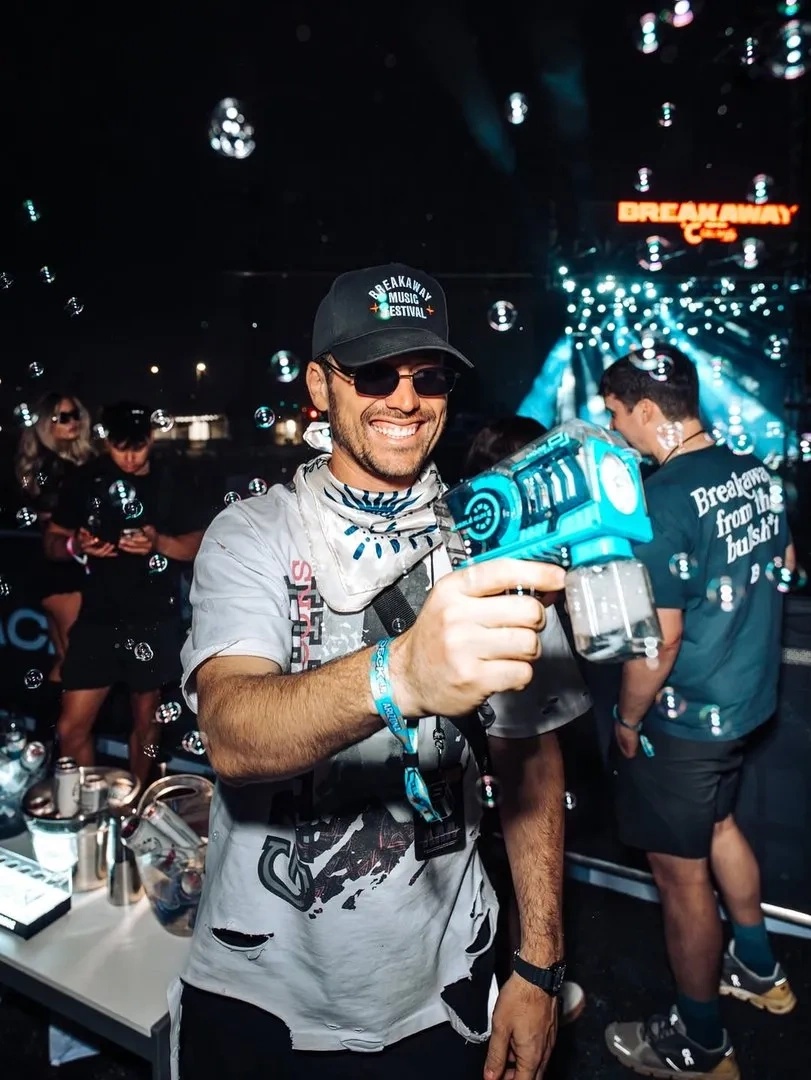
Lynn has a domestic voice to balance those ambitions. After the early arena loss, his mother Joanne advised him to take baby steps. He still invokes that advice when discussing growth. In another memory, a stranger wearing a Breakaway hat at Barcelona’s airport told him about attending the Charlotte festival. He listened without announcing that he had started the company.
That encounter brings the story down to a manageable size. Somewhere between the financing announcement and the next festival, a customer had chosen a hat from her wardrobe and carried a local weekend into another country. Lynn could ask whether she had enjoyed herself. For a business that began by trying to get people through a door, it was a pleasingly ordinary conversation to have.
Keep the conversation going
Profiles, interviews & more