In the useful fiction of advertising, a message begins with a client, passes through an agency and arrives in a rectangle someone has paid to occupy. Ad Council works backward. It starts with a behavior: buckle your seat belt, call a friend before they drive drunk, check the car seat, ask a teenager how they are doing. Then it assembles the people who can make that behavior feel obvious.
The New York nonprofit reported $74.5 million in fiscal 2025 revenue. In the same period, it says partners contributed more than $1 billion in media. That is the revealing ratio. Ad Council does not own a broadcast network, a social platform or an agency holding company. It coordinates the owners. A government department or nonprofit sponsor brings a public problem. Researchers find the friction. Agencies donate or discount creative talent. Media companies offer inventory. Brands, athletes, clinicians, creators and community leaders lend distribution or trust.
What emerges may be a television spot, a TikTok, a pharmacist's conversation, a gaming activation or a search result. The organization calls these public-service campaigns. A more accurate description is temporary infrastructure for persuasion.
The bear was a distribution system
The organization was incorporated in 1942 as the War Advertising Council, after Young & Rubicam executive James Webb Young proposed that the advertising industry pool its machinery for public use. The wartime work included bond drives, recruitment and propaganda. In 1944 came a bear in a ranger hat, created for a Forest Service wildfire campaign. Smokey did not merely carry a line. He gave thousands of unrelated publishers, stations and public offices a shared character.
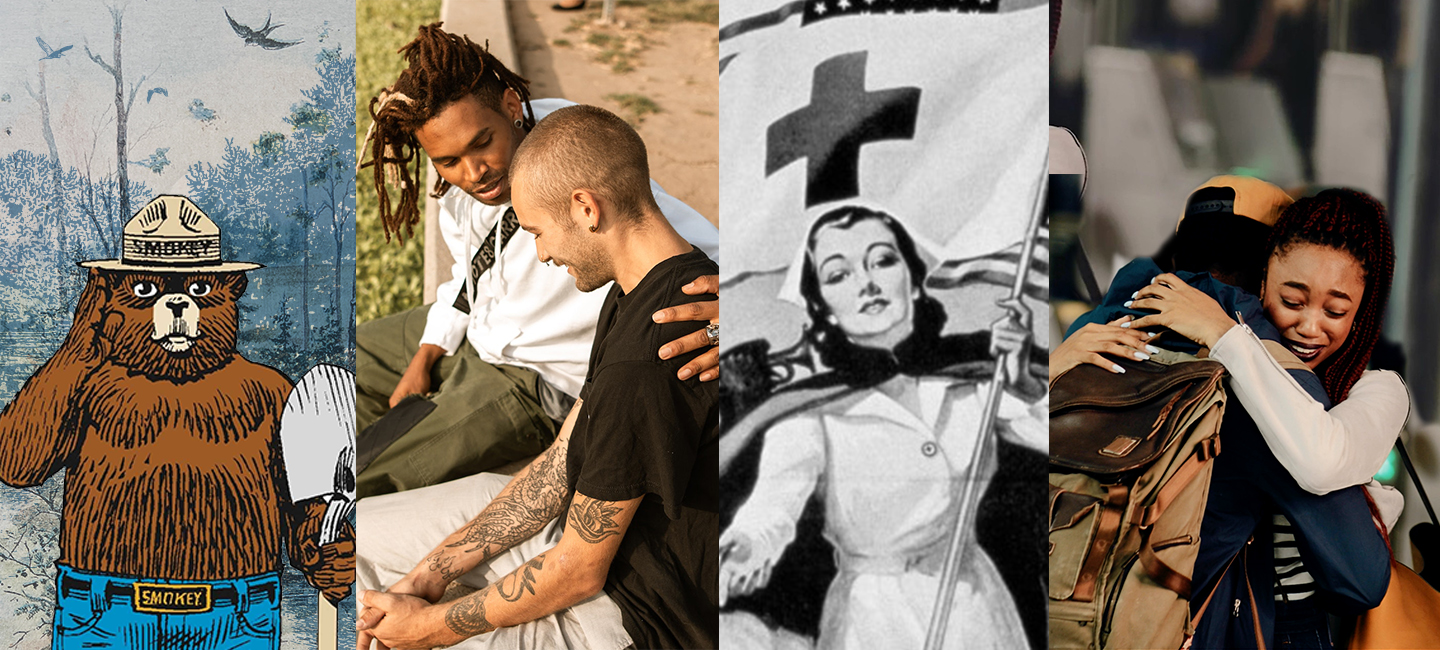
That trick kept working. “A Mind Is a Terrible Thing to Waste” gave UNCF a phrase that helped raise more than $2.2 billion. “Friends Don’t Let Friends Drive Drunk” made intervention part of friendship. Vince and Larry, two crash-test dummies who bickered while being smashed into things, made seat belts funny enough to remember. “Love Has No Labels” turned an X-ray-screen stunt into one of YouTube's most watched videos of 2015 and the first PSA to win the Emmy for Outstanding Commercial.
The line is short because the coalition behind it is long.
This is Ad Council's difference from an ordinary social-impact agency. Purpose, Fenton or a capable public-relations firm can research an audience and make persuasive work. A government team can buy reach. A foundation can convene experts. Ad Council's specialty is stacking all of those functions, then asking the commercial media system to donate part of itself. The moat is accumulated permission.
The coalition machine
The first six answers were wrong
The cleanest view of the company's expertise comes from a project that did not go cleanly. Its research institute spent much of 2022 and 2023 studying how to explain extreme-risk protection orders - laws that can temporarily limit access to firearms when someone poses an imminent risk.
Experts helped construct six message frames. The public disliked all six. “The Big Pause” made an emergency sound small. “A Lethal Combination” felt condescending. “Moment of Truth” seemed political. Two other frames put too much responsibility on family members. Even the apparently harmless word “temporary” broke in opposite directions: gun owners worried it might mean too long, while non-gun owners worried it might mean not long enough.
What changed their minds
- Audience interviews beat expert intuition.
- Local process details mattered more than a soaring national phrase.
- A story of the law in action worked better than abstract reassurance.
- The likely user mattered more than the statistically average person.
The team dropped three frames, rewrote the others and added a concrete “Success Story.” Reactions improved but stayed lukewarm. More detail sometimes produced more questions. Eventually the researchers narrowed the audience to people who knew someone in crisis, gun owners and active-duty military or veterans. Their published conclusion was refreshingly modest: on a polarizing, rarely used law, “pretty close” may count as success.
That episode explains both the promise and the limit of behavior-change advertising. A message can create awareness, make an action socially permissible and point to a tool. It cannot repair an unavailable service, erase political distrust or guarantee behavior. Communication works best when the requested action is specific, the resource exists and the messenger is credible. Remove any one of those conditions and reach becomes a very expensive form of weather.
A moonshot made of many small audiences
COVID-19 forced the model to operate at emergency speed. Five days after the World Health Organization declared a pandemic, safety messaging was in market. The response ultimately generated a reported $445 million in media value and 47.7 billion impressions. But vaccine education exposed the danger of treating “the public” as one audience.
The initiative began with a $50 million fundraising target and grew beyond it. More than 300 partners joined. Pereira O'Dell built the umbrella brand; Alma led work for Hispanic and Latine communities; JOY Collective addressed Black audiences and the historical reasons for distrust. Pharmacists, faith leaders, sports leagues, former presidents, Pope Francis and television characters took turns as messengers. Content appeared in English, Spanish, Vietnamese, Arabic, Haitian Creole and Tagalog.
The campaign's important adjustment was tonal. Early research made “it is normal to have questions” a governing principle. The target was a movable middle, not hardened opponents. By November 2021, Ad Council's tracking put vaccine hesitancy at 8 percent, down from 50 percent the previous December. The organization cannot claim sole credit for a national change shaped by availability, mandates, fear, doctors and daily experience. It can show that three-quarters of eligible adults had seen its work by August 2021.
What it sells, and who pays
For campaign sponsors, Ad Council provides production, distribution, research, strategy and evaluation. Its audited accounts describe cost-plus and fixed-fee arrangements, with government and private sponsors reimbursing direct campaign costs and allowable overhead. Contributions, grants and the black-tie Public Service Award Dinner support the institution. The 2025 dinner raised a record $10 million.
The organization has also productized its know-how. Ad Council Edge sells custom strategy, training and applied tests. The Ad Council Research Institute runs audience segmentation, message testing and mixed-method studies for brands, foundations and nonprofits. Creators for Good reports more than 3,500 talent partnerships and a reach above 350 million. In 2025, a Sugar23 partnership opened Ad Council Entertainment, an attempt to put social issues inside films, series and documentaries instead of between them.
The expansion reflects a practical fact: the thirty-second PSA no longer owns thirty seconds of anyone's attention. By 2026, gun-safety work was appearing inside mobile games and through a conversational AI resource built with Microsoft, DEPT and RSM. Child car-seat guidance still ran on television, radio, print and billboards. Ad Council is format-agnostic because the format is borrowed.
The part worth copying
- Define one observable action before writing the line.
- Test the explanation with the person who may act, not only the expert who knows the issue.
- Let resistance choose the messenger and channel.
- Design a coalition so every partner contributes a distinct asset.
- Measure the next step - visits, tests, conversations or sign-ups - alongside impressions.
An archive with corrections in the margin
Longevity creates a less flattering kind of expertise: the chance to see yesterday's celebrated work become today's warning. Ad Council now acknowledges that some of its wartime propaganda stoked racist paranoia toward Japanese people. Its history also confronts the 1971 anti-litter spot built around the “Crying Indian,” played by an Italian American actor who falsely claimed Indigenous heritage. The ad won awards and reduced littering; it also turned a stereotype into a moral prop.
That candor matters because the institution traffics in borrowed trust. A campaign can be effective by one measure and harmful by another. An organization designed to change minds has to permit its own mind to change, then show the edit.
Where the model loses leverage
A coalition campaign is a poor fit when the service behind the call to action is missing, the desired behavior cannot be made concrete, partners need tight control of the message, donated inventory cannot reach the audience, or trust is too local to be transferred by a national institution.
The contemporary Ad Council is best understood as a nonprofit media orchestrator sitting between public health, advertising, research and culture. Its customers are the institutions with a behavior problem. Its users are the millions of people being asked to do one small thing. Its product is the arrangement that connects them.
That is why the famous lines feel strangely ownerless. They arrive as advice from a bear, a friend, a dummy, a doctor or an athlete. The institution steps back. If the campaign works, the instruction belongs to everybody.