There is a small but consequential distance between reading the words “help is near” and asking for help. That distance is where MORE Advertising works. It is not a media channel, exactly. It is a thicket of embarrassment, fear, habit, language, mistrust and the stubborn human preference to do tomorrow what feels difficult today. A billboard can reach the right person and still miss the point. A beautifully designed website can answer every question except the one preventing a visitor from clicking.
MORE is a Watertown, Massachusetts communications agency founded in 1997 as causemedia. It creates campaigns, brands, video, websites and media plans for government agencies, health organizations and nonprofits. That sounds like a familiar agency menu. The more revealing description is the one the company uses for its specialty: social marketing. Not social media. Social marketing begins with a desired behavior and works backward through the frictions surrounding it.
The real creative brief is often hidden inside a hesitation: What makes the next move feel impossible?
The distance between seeing and doing
A conventional campaign might begin with a product and ask how to make it appealing. MORE's public-interest assignments often begin with a more awkward fact: the “product” may be a vaccination, a tobacco quitline, an emergency-contraception benefit, a tax-amnesty window or a community behavioral-health center. The audience may be worried, skeptical, ashamed, pressed for time or simply tired of institutional language.
The agency's method is pleasantly unromantic. It uses surveys, stakeholder interviews, online discussion boards and focus groups to understand what people know, believe and avoid. Strategy turns those findings into a behavioral objective. Creative gives the objective a voice and a face. Media places it across paid, earned, shared and owned channels. Measurement checks whether attention became useful action.
Three hundred versions of “near”
Consider the statewide “Near Me” campaign for the Massachusetts Behavioral Health Partnership, the Department of Mental Health and MassHealth. The assignment was not merely to explain Community Behavioral Health Centers. It was to alter what people do during a mental-health crisis - to help them find specialized community care rather than automatically go to an emergency room.
MORE targeted young adults, teenagers and parents with live-action video, photography, digital and social advertising, outdoor placements and print. Then came the detail that makes the scale tangible: more than 300 creative assets in eight languages. One phone mockup shows Vietnamese copy laid over the image of a young man searching for help. “Near” is a geographic word, but the campaign treated it as a cultural and linguistic one too.
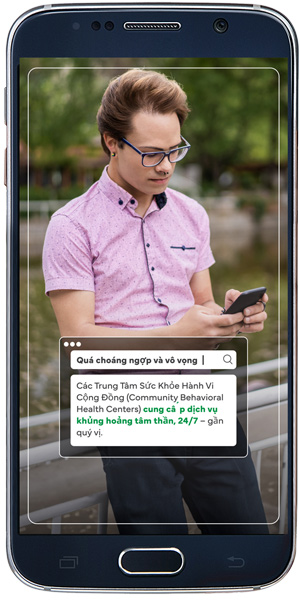
The campaign received a Platinum Viddy and a Gold MarCom award in 2024. The awards are tidy. The production logic is more interesting. Translation swaps words; transcreation preserves meaning and motivation across communities. The agency's health-equity claim therefore has a production cost: more versions, more review, more community knowledge and less temptation to treat a statewide audience as one person.
Sometimes the barrier is not information
For Massachusetts' 2024 tax-amnesty program, unresolved debt looked like the subject. MORE identified anxiety as the obstacle. People were not necessarily refusing to comply. Some feared penalties, scrutiny or making matters worse. The campaign reframed amnesty as a limited opportunity to take a safe first step, then put the message into campaign creative, video and paid media.
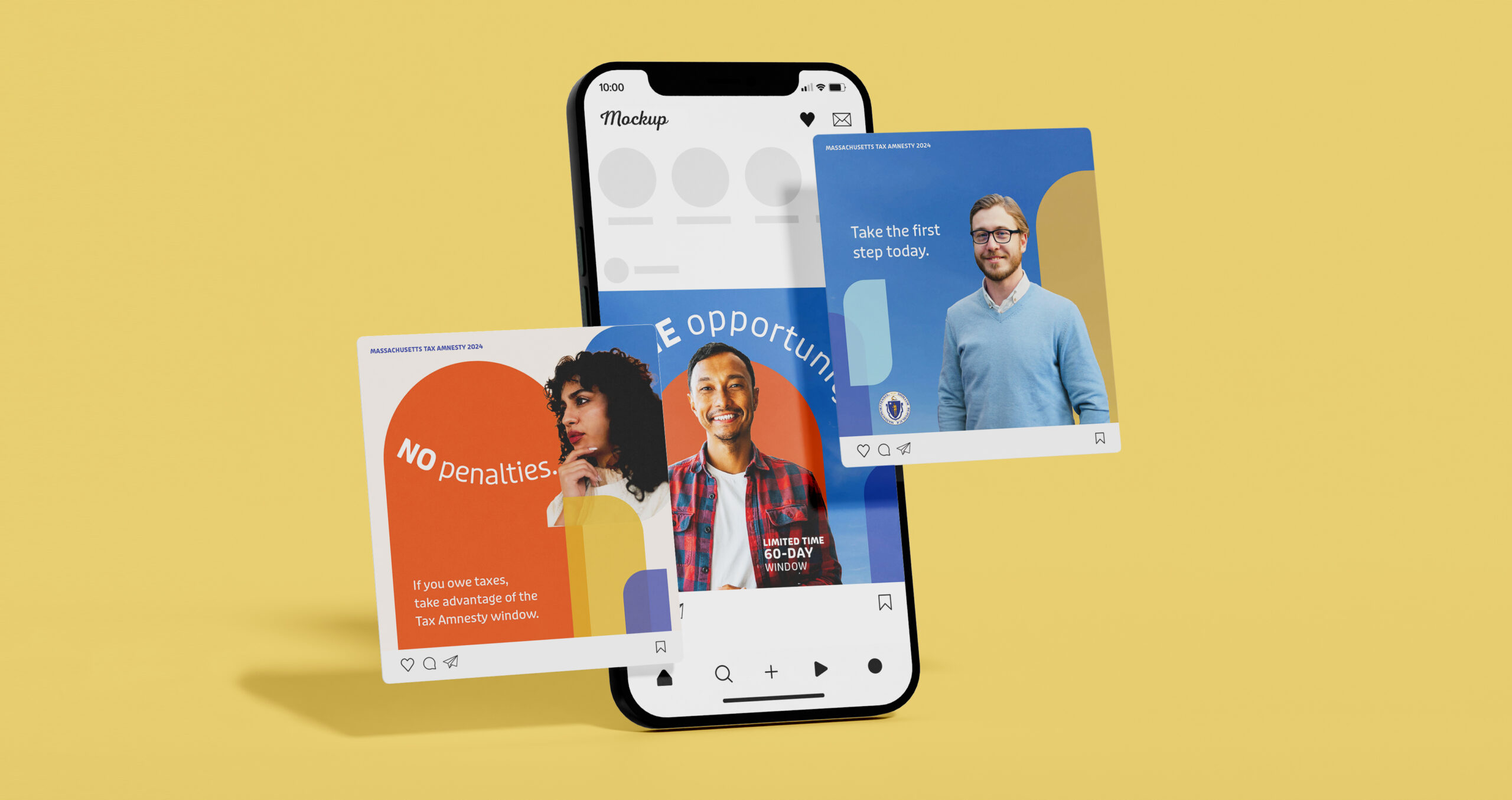
The tax-amnesty campaign exceeded the Commonwealth's collection goal by 43 percent, according to MORE's case study.
This is the useful transferable idea: diagnose the emotional cost of action before writing the rational argument for it. More facts may be welcome, but facts alone are a poor solvent for shame. A public agency can know everything about its program and still misunderstand what it feels like to use it.
The succession search leaves the building
The company eventually had to apply a similar logic to itself. Founder Donna Latson Gittens had left a long broadcasting career at WCVB-TV to start causemedia. Judi Haber joined a month later. In 2012, the fifteenth anniversary brought the MORE name - a reference to wanting to do more mission-oriented work. By the early 2020s, the two leaders were planning their exit.
Their first approach did not work. They hired a business consultant, met prospective buyers and found the results unsatisfying. An agency can place mission in its pitch deck; preserving it through a sale is harder. Then two people who already understood the operating culture made their case. Megan Palamé, head of account services, and Beth LePage, the finance chief, proposed buying the firm.
The transaction closed on January 3, 2025. Palamé became chief executive; LePage became chief operating officer while retaining the CFO role. Gittens and Haber moved to a new board during the transition. The financial terms were not disclosed. A public Massachusetts consultant report lists a separate $3.76 million causemedia contract running from July 2021 into 2026, but that is neither the sale price nor evidence of what any one campaign cost. The honest answer to “what did it cost?” is that campaign fees and sale terms are private.
What changed the owners' minds was fit, not novelty. The insiders offered continuity without pretending nothing would change. For a firm whose business depends on trust accumulated with public agencies and communities, institutional memory was not sentimental decoration. It was an asset.
Causemedia opens
Gittens leaves television to build a communications firm around important causes.
The name says MORE
The agency adopts a brand that makes its mission-oriented ambition explicit.
The largest account arrives
Massachusetts taps the firm for pandemic prevention and vaccine-awareness work.
Outside buyers disappoint
A conventional succession search gives way to a proposal from two senior employees.
The keys stay close
Palamé and LePage acquire the agency and take its top operating roles.
What another team can borrow
MORE's full stack is broad: research, strategy, branding, writing, design, video, paid and organic social, traditional and digital media buying, analytics and accessible web design. Its sharper advantage is narrower. It understands the machinery of public-sector work - procurement, tight timelines, transparency, accessibility and the consequence of getting a health message wrong. It also holds minority- and women-owned business certifications that matter in supplier-diversity programs.
Ask what stops the action, not merely whether the audience recognizes the issue.
A call to action should reduce uncertainty, not add one more institutional instruction.
Language access and cultural relevance require versions, review and real production time.
Impressions show exposure. Traffic quality and behavior reveal whether the message helped.
These lessons travel well, but the whole model does not transfer automatically. It depends on access to the people affected, room to test messages, clients willing to alter institutional language, and enough budget to produce genuinely accessible variants. Remove community input and “audience-centered” becomes guesswork. Remove measurement and behavior change becomes a handsome claim. Compress eight languages into a last-minute translation task and the equity lens becomes a filter applied after the photograph has already been taken.
In the agency market, MORE sits between large integrated firms with deeper media scale, specialist public-health consultancies with more academic machinery, and government teams that can communicate directly but may lack creative capacity. Its bet is that a compact multidisciplinary team can connect those worlds. The firm does not sell a software product or publish a price list. It sells accumulated judgment by project and public contract: what to ask, whom to involve, which words to retire and what someone should be able to do after the ad disappears.
That last question is the quiet standard running through the work. A message is not finished when it ships. It is finished when a person sees a possible next move - and believes the move was made with them in mind.