The first thing to fail was not a statute or a server. It was the folder. At Cache Creek Casino Resort, every employee had a folder on a shared drive. Inside it sat a folder for each leave. Inside that were more folders for doctor's notes, medical certifications and the rest of the paper trail. Benefits supervisor Wendy Ayala supplied the technical diagnosis: “It was bananas.”
That small domestic tragedy of office life explains AbsenceSoft better than a tour of its feature list. Employee leave is a deceptively dense transaction. A request can touch the Family and Medical Leave Act, the Americans with Disabilities Act, the Pregnant Workers Fairness Act, state rules, an employer's own policy, payroll, timekeeping, insurance and a manager who simply wants to know when someone may return. The employee may be having a baby, treating cancer, caring for a parent or asking for a workplace adjustment. Nobody in that exchange is delighted to hunt through a shared drive.
AbsenceSoft puts the case, documents, calculations, notices, messages, tasks and audit history in one place. Its employee portal takes requests and uploads. Its workflow builder moves routine work along. Its Compliance Engine applies more than 200 statutory policies while allowing employers to add their own rules. Dashboards show the pattern hiding in the caseload. The software is the machinery between “I need time away” and a documented, compliant answer.
01 / The originThe founder knew exactly where the bodies were buried
Seth Turner founded AbsenceSoft in 2013 after working in leave management at Mercer and Reed Group. He had watched HR teams spend their days on administrative choreography rather than people: calculate eligibility, locate the correct form, trigger a notice, chase a document, recalculate time, record a conversation and remember the next deadline. Broad HR systems could store employee data. They were not necessarily built to interpret the strange concurrent logic of leave.
The insight was not that HR needed digitization. HR already had software. The insight was that this one workflow deserved its own product, built by people who understood the edge cases. AbsenceSoft still uses the phrase “built by leave professionals, for leave professionals.” In a market full of interchangeable automation language, that claim points to the real product: accumulated domain judgment encoded into templates, rules and sequence.
“Other software felt like it was built by engineers who didn't think about how it would impact people.”Chris Bellinger, managing director at BBP Admin
What changed buyers' minds was usually volume. A spreadsheet is wonderfully cheap when twelve cases are tidy and one experienced person remembers every exception. It becomes an expensive object when cases multiply across states, laws change, documents live in several places and that experienced person takes a holiday. A national healthcare provider featured by AbsenceSoft had a team of four full-time employees and one part-time employee serving 30,000 workers across 36 states. Its manual process capped each full-time team member at about 250 cases a year. The method had reached its natural limit.
02 / The productA case file with a rules engine attached
The product has two jobs that pull in opposite directions. It must standardize the process enough to make it reliable, and remain configurable enough to reflect a company's workforce, tone and policies. AbsenceSoft handles that tension with modules rather than a single rigid path.
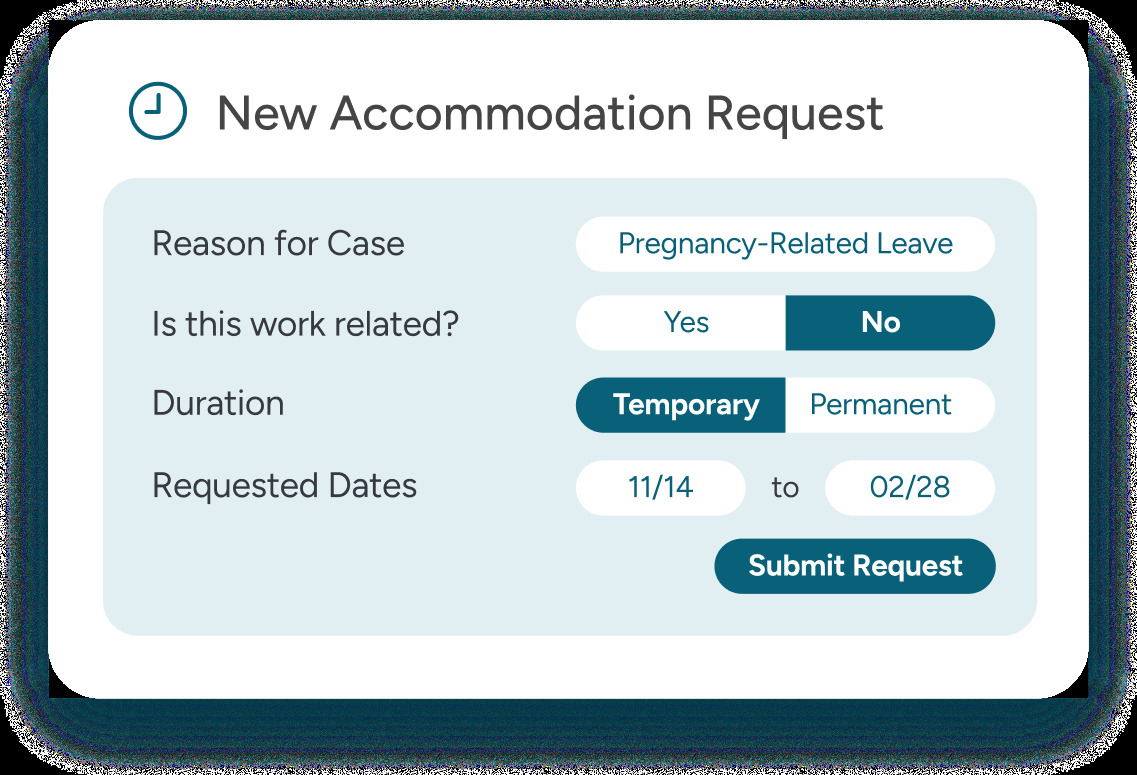
Case management is the spine. Inbound and outbound email, text messages, forms and notes are attached to the case. Templates generate branded communications. Automated tasks and reminders keep deadlines visible. Eligibility calculations and the compliance engine address the legal layer. The workplace-accommodations module structures the interactive process without pretending that software should make every judgment. Human review remains at decision points. Employee Self-Service lets workers start a request, provide documents and check status without calling HR. Integrations move employee, payroll and time data to and from the systems already running the company.
One request, five operational moves
The company also sells the less glamorous work required to make enterprise software useful: implementation, support, training and a customer community. AbsenceSoft says its implementation team has more than ten years of experience and its support staff includes Certified Leave Management Specialists. WaFd Bank said its launch arrived a month early. That is not a decorative service claim. In regulated workflow software, a botched configuration can faithfully automate the wrong process.
03 / The proofThe business case fits on a timesheet
AbsenceSoft does not publish list prices. Sales run through demos and custom quotes, which is common for configurable enterprise software with implementation work attached. So the honest answer to “what did it cost?” is that outsiders cannot calculate the invoice. They can examine the other side of the ledger.
BBP Admin, a third-party administrator, reported saving 40 minutes per case and 290 hours in 2024 while expanding its FMLA and ADA client base from six to more than 55 over three years. OneDigital said work that once took an hour could take as little as ten minutes, avoiding the equivalent need for seven additional full-time employees at its volume. Tillamook says one specialist now manages about 400 leaves a year and saves at least ten hours a week. The national healthcare provider lifted annual cases per full-time team member from roughly 250 to 685.
Those are vendor-published case studies, not randomized trials. Still, the before state is consistent across them: folders, spreadsheets, duplicate entry, manual letters and fragile memory. The after state is equally consistent: one record, generated communications, scheduled tasks and measurable capacity. The pitch works because the unit of value is not a vague promise of transformation. It is minutes per case.
04 / The companyPrivate equity discovered the least glamorous corner of HR
Bow River Capital acquired a majority position in 2019. Norwest Venture Partners became the majority investor in 2021, with Bow River reinvesting. Six months later AbsenceSoft bought Montreal-based Presagia, then described as its closest competitor. The company recruited executives, modernized its technology stack, repaired the economics of professional services and built a more repeatable go-to-market operation.
Norwest says that from 2021 to 2024 annual recurring revenue grew more than fivefold, the customer base expanded more than 2.5 times, net revenue retention rose above 110 percent and the company recorded its first cash-flow-positive year. Bow River, looking across its five-year holding period, reported revenue growth of 12.5 times. Luminate Capital Partners acquired AbsenceSoft in September 2024 for an undisclosed amount.
The ownership story matters because it shows what scale changed and what it did not. Investors added management, distribution and operational discipline. The wedge remained leave and accommodations. In February 2026, Luminate operating partner Chris Murphy replaced Mark Schiff as chief executive. Murphy brought long enterprise-software experience from BlackLine and Infor and promised an “intelligence-first” direction, including investment in AI-powered features. The useful constraint is obvious: a clever suggestion is welcome; an invented eligibility determination is not.
05 / The marketToo complicated for a vacation tracker, too human for a ticket
AbsenceSoft sits between broad HR suites, specialist leave platforms and fully outsourced administration. Workday, UKG and Rippling can keep absence functions close to a wider employee system. Specialists including Sparrow, Cocoon, Pulpstream and edays compete with focused products or service-heavy models. Insurers and third-party administrators can take over more of the work. The choice is partly software and partly operating philosophy: does the employer want to own the leave experience, share it or hand it off?
Convenient system consolidation, but leave may be one module among many.
Deeper compliance and workflow tools, with the employer retaining program control.
More administration is outsourced, trading direct control for external capacity.
Cheap at low volume, brittle when laws, locations and case counts multiply.
AbsenceSoft differentiates on depth: more than 200 statutory policies, leave and accommodations in one case environment, configurable workflows, customer support with leave credentials, and integrations that let it become a specialist system of record rather than another isolated app. Partnerships widen that role. Its integration with insurance software company EIS, for example, passes leave and claims data between AbsenceSoft and EIS OneSuite in real time.
The approach does not fit every employer. A small company with few cases, one jurisdiction and simple policies may be better served by its existing HR suite or a lightweight tracker. Software also cannot rescue an organization that has not decided who owns each step, keeps poor source data or expects automation to settle sensitive accommodation judgments. Configuration, integration, training and employee communication are preconditions, not extras.
The part worth stealing
- Find the regulated workflow being held together by folders and memory.
- Make one case record the source of truth before adding clever automation.
- Encode recurring rules, but mark the judgment points where a person stays responsible.
- Integrate with the systems customers already trust instead of replacing the whole stack.
- Sell the outcome in minutes per case, capacity per specialist and employee feedback.
06 / The tensionCertainty without coldness
AbsenceSoft's mission uses three nouns: humanity, certainty and efficiency. The order is telling. Compliance software tends to advertise certainty. Workflow software advertises efficiency. Humanity is harder to demonstrate in a product diagram. It appears indirectly: fewer repeated questions, faster status updates, communications that use the employer's voice, and more time for a leave specialist to talk to the person behind the case.
That is also where the company will be tested as it adds AI. Leave administration contains plenty of material that machines can summarize, route, draft and flag. It also contains medical information, legal rights and moments when an employee may be frightened. The winning product will know the difference between paperwork that should disappear and a decision that deserves a human being.
There is an appealing modesty to the original AbsenceSoft idea. It did not promise to reinvent work. It noticed that an important part of work was being run from a shared drive and made the folder behave like a system. Thirteen years later, that system supports more than seven million lives. Boring workflow, expensive mistakes, visible relief: sometimes the best software thesis really is hiding inside the folder everyone hates.