Consider the ordinary bank card. It spends most of its life ignored, wedged between receipts and other cards. Yet somebody has to choose its materials, position its antenna, encode its chip, protect its owner’s information and get it to the correct address. A surprisingly large amount of civilization sits inside that small rectangle. ABCorp works on the part we rarely notice.
- Secure cards, from design through delivery.
- Issuance and authentication for banks and fintechs.
- Industrial 3D printing, including custom prosthetic components.
The Boston company calls itself a payments, authentication and additive manufacturing business. That last item makes the list interesting. What is a company associated with banknotes doing making parts for prosthetic limbs? The answer begins with a distinction: a manufacturer’s products can change faster than its habits.
01 / A very old answer to a very current problem
ABCorp dates its ancestry to 1795 and secure printing for the First Bank of the United States. Its family tree includes engraving businesses that combined into American Bank Note Company in 1858. This is a corporate lineage, assembled through mergers and acquisitions. The present organization did not arrive fully formed in the eighteenth century.
Nor was the journey financially smooth. American Banknote Corporation entered bankruptcy protection in December 1999. Its 2002 reorganization reduced debt by more than $100 million, including accrued interest; holders of one class of debentures received nearly 90 percent of the reorganized equity. Longevity here includes a substantial financial reset.
The recurring commercial problem is easier to follow than the corporate genealogy. A printed object must be trusted by people who did not make it. Earlier generations addressed counterfeit banknotes. Today, ABCorp manufactures payment cards and government IDs under security-printing controls. Intergraf lists its North American operation at the governmental certification level.
02 / The envelope is part of the product
For an issuing bank, a card program contains several businesses’ worth of chores. ABCorp offers card construction, contactless technology, personalization, packaging and mailing. Its central issuance service takes incoming customer files through to finished mail. The practical attraction is coordination: materials, sensitive data and delivery can be managed by one supplier.
- 01BuildMaterials + chip
- 02PersonalizeData + identity
- 03DeliverCarrier + mail
- 04ActivateCard + phone
There are other routes into the customer’s hand. Instant issuance supplies software, printers and consumables for branches or kiosks. Digital issuance supports wallet-ready companions and virtual cards. Tap to Authenticate adds a card-chip applet and integration into an issuer’s mobile app, letting the card help authenticate an online purchase. These services require integration; the plastic alone cannot deliver them.
This places ABCorp among infrastructure suppliers rather than consumer banks. CPI Card Group names it among payment-card competitors alongside companies including IDEMIA, Thales and Giesecke+Devrient. ABCorp’s pitch combines physical production with the surrounding services. Buyers still have to compare the particular program, security requirements and operating support.

03 / When the supplier disappears
Hello Network offers a useful test of that proposition. The Quebec fintech operates prepaid Visa programs, including shopping-centre and community initiatives. In 2019, its local manufacturing and personalization supplier unexpectedly closed. Existing programs still needed cards. The supplier search had become an operational emergency.
Hello Network’s full supplier transition, according to ABCorp’s customer account.
ABCorp’s May 2026 account says the transition took two months and preserved program continuity. The ongoing service includes on-demand manufacturing, individual shipments and bulk fulfillment. French-speaking account support matters, too. These are modest-sounding details until a holiday program needs cards on a compressed schedule. A card supplier is also a promise about Tuesday afternoon.
04 / The factory learns a new shape
ABCorp established its 3D division in 2020. A 2022 Desktop Metal case study describes an early pandemic PPE manufacturing effort that revealed a broader opportunity. Existing experience with on-demand card production made the operating pattern familiar. As Neil Glazebrook, then vice president of 3D Solutions, put it: “We sell security.”
“We sell security.”
Neil Glazebrook / 2022 Desktop Metal case study
The new objects demand their own expertise. In metal binder jetting, furnace distortion can spoil a part late in production. The case study describes ABCorp using Live Sinter software to compensate for that distortion. The significant detail is the process beyond printing: simulation, heating and dimensional accuracy determine whether a component is usable.
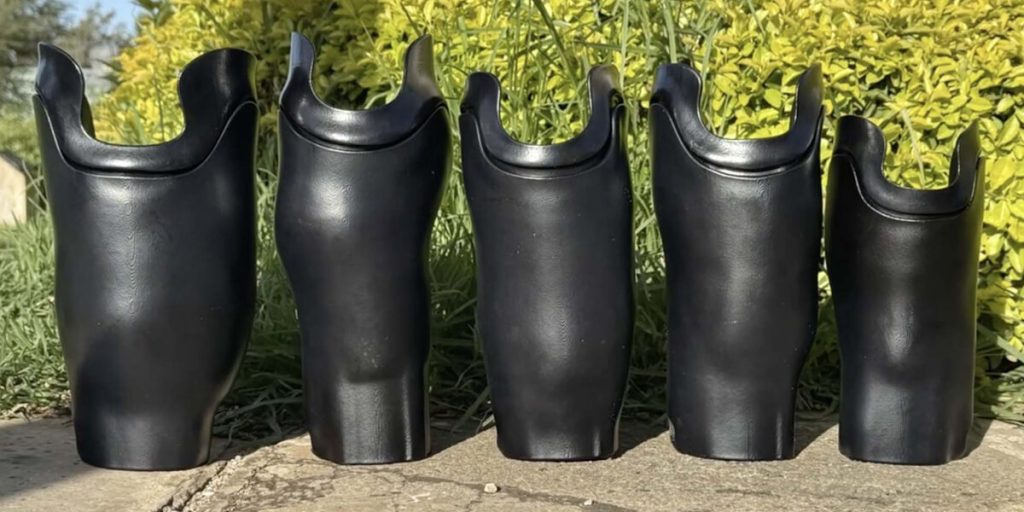
A different workflow appears in the company’s December 2025 Limb Kind Foundation story. The charity sends digital scans for custom prosthetic sockets. ABCorp describes printing a batch overnight, cleaning and smoothing it, then having it ready for transport the following afternoon. Traditional fabrication required plaster, resin and considerable manual finishing. Moving fabrication to Boston changed the logistics of serving children overseas.
05 / What travels, and what has to be rebuilt
The business model is contract manufacturing plus related services. For a buyer, cost extends beyond the object: tooling, finishing, integration, packaging and shipping all enter the calculation. The additive proposition becomes attractive when customization or design changes make conventional tooling awkward. Large runs of identical parts require a different economic comparison.
Medical work adds another condition: dependable production needs an appropriate quality system. ABCorp announced ISO 13485 certification for its Boston additive center in April 2025. That concerns quality management; it does not make every printed design an approved medical device. A well-run factory and a suitable product remain separate requirements.
The expansion is tangible. In January 2026, ABCorp announced a nearly 60,000-square-foot additive center in Columbia, Tennessee. In May, it added flame-retardant PA12 to its materials portfolio. Both moves point toward production applications with specific material and performance demands.
The lesson worth borrowing is procedural: follow the entire object through the system. Ask who owns the data, who finishes the part and what happens when delivery slips. ABCorp’s unusual collection of products becomes easier to understand once those questions take centre stage. The object changes. The obligation travels with it.
Keep following the object
Explore the products, customer stories and a digital prosthetics walkthrough.