At 15, Aaron Ward received some sensible advice. His father, a Māori panel beater, thought his son’s ability with numbers pointed toward accounting. It was a respectable destination, visible from where the family stood. Ward followed the suggestion. Years later, having become a technology founder, he would look back on that conversation with affection and a different understanding of what had been missing.
The advice had come from experience. Its limits had, too. A parent can name the occupations he has encountered. The work a child might eventually love could be happening somewhere neither of them has seen. Ward’s eventual career would give him a reason to return to that gap between possibility and visibility.
Two Metallica shirts and a change of clothes
His route out of finance took him into strategic marketing at Orange in the United Kingdom. There, he became interested in the connection between a brand’s promises and the commercial results that followed. Marketing offered a wider field of questions than the accounts alone could answer. It also introduced a problem that would stay with him: businesses could gather plenty of information about customers without helping the people who actually served them.
London supplied another education. On his first day at a growing telecommunications company, Ward was told to abandon his corporate attire. His suitcase offered two Metallica T-shirts as alternatives. The wardrobe adjustment accompanied an introduction to startup culture, where his appetite for finding a better way could find some employment of its own.
The detail is pleasing because it makes a career change look appropriately untidy. Nobody issues the aspiring founder a new personality at passport control. Sometimes there is simply a different office, a different expectation, and an unexpectedly useful band shirt. Ward later returned to New Zealand with a view of working life that would sit uneasily in another corporate boardroom.
He could see executives and consultants discussing customers at a considerable distance from the customer’s actual experience. Uber’s immediate request for a rider’s opinion suggested another arrangement. Feedback could arrive while the encounter was fresh. Perhaps the same mechanism could help other service businesses, and give their employees some recognition along the way.
A business plan with excellent kitchen access
Ward already knew the person he wanted to build with. Developer John Ballinger had worked on an earlier venture with him. Getting Ballinger to accept a new idea took, by Ward’s account, ten years. The attraction was their complementary abilities and shared ambition. Agreement, evidently, came with a substantial waiting period.
AskNicely began in 2014. Its plan fitted on an A5 card taped to Ballinger’s fridge: product milestones, customers, revenue and funding, placed where making coffee required passing the strategy. “Every startup should have a Fridge Plan,” Ward later said. The founders worked from an Auckland garden shed. The surroundings were modest; the intended market was international.
“Every startup should have a Fridge Plan.”
Aaron Ward
Ward handled the commercial work while Ballinger built the software. Their first New Zealand customer arrived within a month of product development starting. Jetstar became an early major customer. An approach to Ice Angels in late 2014 led to a presentation at its Christmas dinner, where investor John O’Hara took an interest and subsequently became chairman.
There is something wonderfully practical about that sequence. A business has to survive the interval between somebody liking an idea and somebody paying for it. A first customer, a working product and an investor prepared to help are tangible answers to that problem. They also make rather better kitchen conversation than an immaculate forecast with nobody behind it.
A calendar of features, customer targets, revenue and funding. The plan lived where the founders would encounter it.
Getting the compliment to the person who earned it
AskNicely used Net Promoter Score, the recommendation-based customer feedback framework, as a starting point. Ward’s interest extended beyond the score. He wanted the response to reach the employee whose work had produced it, quickly enough to affect what happened next.
In his writing about frontline work, he returned to the familiar pleasure of a kindergarten gold star. Adults might acquire more sophisticated job titles, but appreciation could still matter. A person serving customers could finish a shift knowing which efforts somebody had noticed. A manager could recognise good work with something more specific than a general instruction to keep it up.
The software put customer feedback, recognition and coaching into a mobile experience for frontline teams. For Ward, the practical question was how to repeat those interactions across a business without making every one of them depend on a supervisor finding spare time. A useful response needed somewhere to go and a person able to use it.
- 01 A customer has an experience
- 02 The customer gives feedback
- 03 The employee receives recognition or coaching
- 04 The next encounter benefits
Portland was a working decision
The American chapter had a commercial logic. In April 2019, AskNicely announced a US$10 million investment led by Nexus Venture Partners, with Blackbird Ventures and K1W1 participating. Its headquarters moved to Portland. At the time, the business had more than 1,000 customers and about 50 employees.
Ward valued Portland’s customer-facing technology talent and its service culture. He also pointed to the city’s economics and the standard of living the company could support for employees. These were choices about the kind of organisation he wanted to run, as well as the market he wanted to reach.
A headquarters address can look like a line in a company biography. In practice, it places a business among particular people, habits and costs. Ward’s explanation of Portland was rooted in those everyday considerations. The people selling a customer experience product needed to understand the subject themselves. Where they lived and worked helped determine whom the company could hire.
Ward and Ballinger start AskNicely in Auckland.
US$10m Series A; headquarters moves to Portland.
US$32m Series B led by Five Elms Capital.
The award had another audience
In June 2023, AskNicely won Māori Company of the Year at the New Zealand Hi-Tech Awards in Christchurch. Ward, who is Ngāti Maru, spoke about being proud to be Māori and a New Zealander. The company brought its executive team from the United States to celebrate. A haka followed his remarks.
He described Aotearoa as the company’s spiritual birthplace: the place where the original vision, discovery, design and building had happened. The US and European teams carried that work to customers elsewhere. International growth, in this telling, had a point of origin worth naming aloud.
The award also sharpened a concern about who gets to imagine themselves in technology. Ward called for Māori role models to be more visible. His own change of direction gave that argument a personal foundation. Someone contemplating a first job needs examples close enough to make an unfamiliar career feel possible. A successful company can supply one, provided its story travels beyond the awards room.
Learning to leave the executive chair
The following month, Ward announced that Kirsten Newbold-Knipp would become AskNicely’s CEO. He moved into a chief strategy officer role, with responsibility for developing channels, capabilities and relationships. It was a change of work inside a company he had spent years helping to build.
In May 2024, he announced another transition: he had exchanged his executive position for a board seat and flown to New Zealand to begin a new venture. He thanked his wife Stephanie and their two daughters for supporting the family’s move to Portland. The geography now had a comic wrinkle. He was back in New Zealand while they were in the United States.
His farewell to executive life at AskNicely made room for Ballinger, the team, investors and customers. A founder’s career is often presented as an individual journey. Ward’s account had a crowded cast. The people willing to build with him, buy from him and move countries with him were part of what the company had required.
The feedback founder’s awkward confession
Huckleberry grew out of a difficulty close to home. Ward has described repeated attempts to make internal 360-degree feedback work at AskNicely. Different tools and approaches produced disappointing participation and reports that could be bland or bruising. Running a feedback company had not made the problem disappear.
That admission gives his next venture a useful starting point. He had direct experience of asking colleagues to take part in a process, then watching the process fail to produce the hoped-for development. Collecting opinions was only one part of the job. Somebody still had to decide what to do with them on an ordinary working day.
Huckleberry initially launched as a voice-based peer feedback platform in 2025. Colleagues could speak their responses rather than work through written surveys. The ambition included giving individuals a professional reputation they could carry with them, rather than leaving their feedback inside a former employer’s files.
A coach before the corner office
By 2026, the product had expanded into professional AI coaching. Huckleberry’s team includes co-founders Diogo Böhm, Marcus Hoefliger and Nathan Christensen. The business has announced US$1.2 million in pre-seed funding led by Oregon Venture Fund. It operates from Portland and Auckland.
Ward’s own experience of executive coaching helped shape the ambition. As AskNicely grew, he felt he had to keep developing to remain equal to the CEO’s job. A coach helped. The question that bothered him was why that kind of support had arrived only after he had become the chief executive of a venture-backed company.
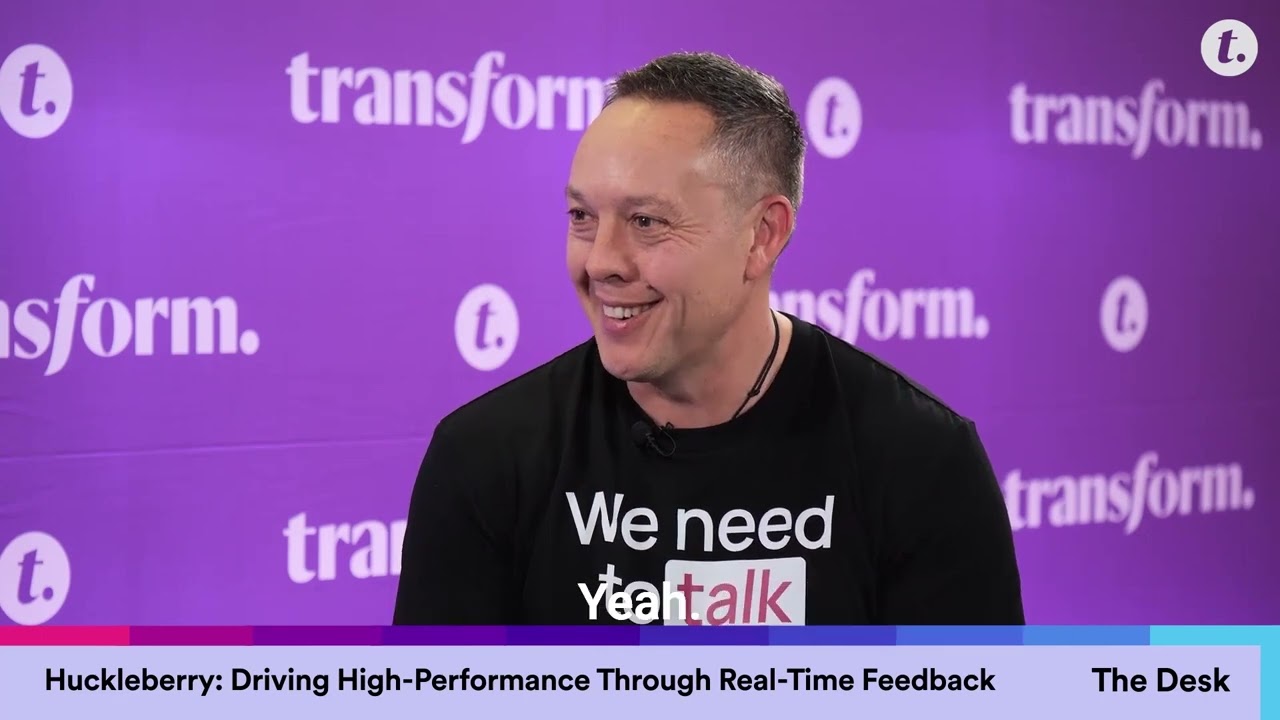
In an interview at Transform 2026, he demonstrated Huckleberry and discussed making coaching available beyond senior leadership. The product combines spoken conversations with context from peer feedback. Huckleberry says an employee’s coaching conversations remain private from their employer. Those are central promises of the product Ward is now building.
The teenager steered toward accounting has become a founder trying to help other people navigate their working lives. He cannot give them a map of every possible destination. His wager is that hearing from people who know their work, and having help to think it through, will make the next turn a little less accidental.