Consider the salad in the supermarket refrigerator. It looks like a simple purchase: leaves, a plastic box, dinner. Behind it sit weather forecasts, harvest schedules, truck routes and a race against decay. 80 Acres Farms proposed a different arrangement. Bring the field indoors. Stack it. Give the plants artificial light and a carefully managed environment. Move the harvest closer to the people who eat it. How much uncertainty could a farmer remove?
- The product: pesticide-free greens, herbs, microgreens and salad kits for grocery and restaurant customers.
- The machine: an indoor growing system combining biology, software and industrial automation.
- The outcome: national distribution, followed by an August 2026 wind-down when financing fell through.
A farm with a plug
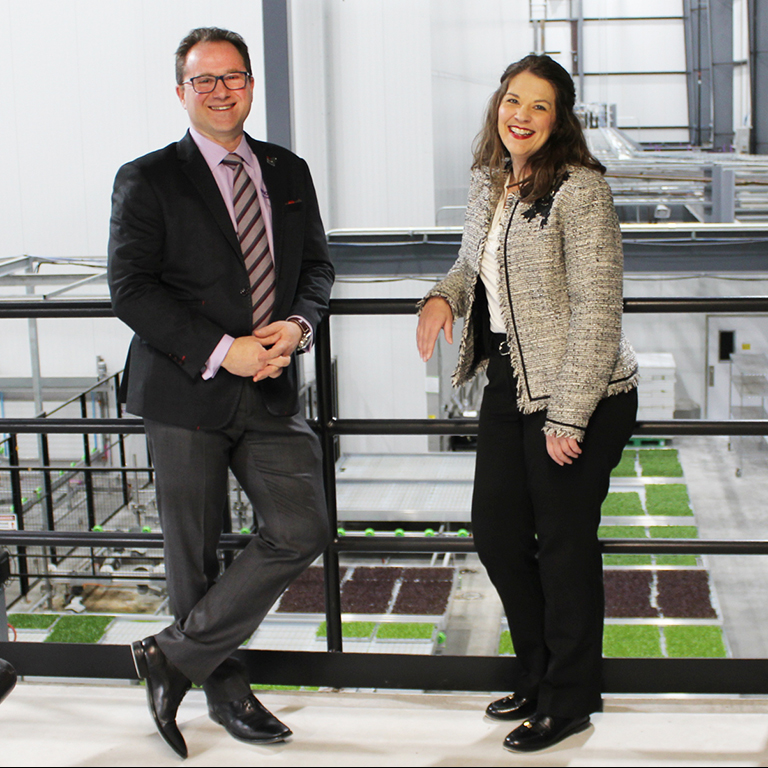
Mike Zelkind and Tisha Livingston founded 80 Acres Farms in 2015. Both came from the food industry. Their starting point was modest enough: experiments inside a shipping container. Eventually came a 70,000-square-foot Hamilton farm with ten growing levels. The interesting unit of land was becoming the shelf. A farm could acquire more growing area by going upward.
That changed the farmer’s job. Outdoors, weather arrives. Indoors, conditions must be supplied and maintained. Hydroponic roots receive nutrient-rich water; LEDs provide light. Engineering and plant science share responsibility for the harvest. Livingston led Infinite Acres, the subsidiary developing the operating technology. The founders were building a food company with an industrial control system inside it.
The salad is the interface
For shoppers, the machinery stayed backstage. The proposition was recognizable: fresh greens, grown without pesticides, with less distance between harvest and refrigerator. Salad kits added toppings and dressing. Herbs supplied flavor. Microgreens offered a small handful for sandwiches, salads and finished dishes. Names such as Romaine Calm gave the packaging a wink. Buying lunch did not require an interest in agronomy.
The business sold through retailers and foodservice distributors. Kroger, Whole Foods and Meijer put the produce in front of households; Sysco and US Foods connected it with restaurant kitchens. January 2026’s microgreen expansion named Walmart, H-E-B and other chains. This was a packaged-food business competing for repeat purchases, shelf space and a place in someone’s weekly grocery budget.
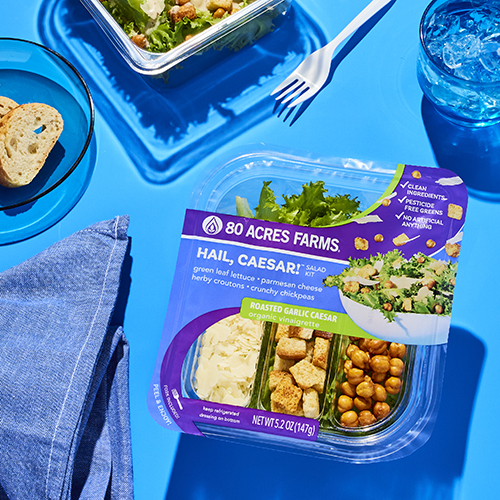
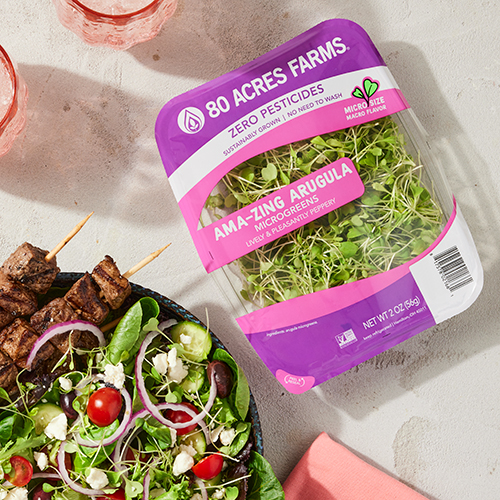
Behind those boxes was the platform eventually called GroLoop: crop software, environmental controls, hardware and automation. Siemens brought industrial controls and facility-management expertise. Signify contributed lighting expertise. Compared with field-grown or greenhouse produce, the distinguishing wager was greater control over growing conditions. That control required equipment, electricity and people who could keep the whole system running.
Light02
Water03
Climate
Outside the growing room: customer demand, selling prices, financing.
The expensive part of certainty
In 2021, a $160 million Series B led by General Atlantic supplied expansion capital. The Kentucky facility, formally opened in 2023, covered 200,000 square feet. A University of Cincinnati account put its investment at $95 million. Those numbers describe different things: one is money raised for the company, the other an investment in a particular site. Neither is a complete cost ledger.
80 Acres promoted water savings of up to 95% against traditional farming producing a similar quantity. It also described using 100% renewable electricity. Its own FAQ included renewable energy certificates among the ways it sourced that electricity. These claims concern resources and sourcing. They do not, by themselves, establish low electricity consumption, a cheaper harvest or a profitable company.
“There will be winners and losers and there will be losers with very big names.”Mike Zelkind, speaking to AgFunderNews in 2021
Buy the missing pieces
The strategy broadened. In 2024, 80 Acres bought Mother Raw, its salad-dressing supplier. Plantae Biosciences brought plant-breeding capabilities. The company disclosed $115 million in aggregate 2024 capital raises the following February. It was assembling more of the chain: the crop, the production system and the ingredients surrounding the leaves.
Then came Soli Organic. The August 2025 merger paired 80 Acres’ technology with Soli’s retail relationships and agronomic experience. The announcement described more than 17,000 storefronts and projected first-year revenue approaching $200 million. That was a forecast. The visible strategic shift was clear: building individual farms had become combining capabilities and distribution across a national network.
- 2021$160m Series B
- 2023Kentucky farm opening
- 2025Soli Organic merger
- 2026August wind-down
Sunday evening, then Monday morning
On August 3, 2026, 80 Acres announced it was winding down. Closure reporting described a prospective acquirer withdrawing the previous evening. Without the expected transaction proceeds or alternative funding, the business could not continue. The immediate documented failure was financing. Assigning the outcome to a particular lighting choice, crop or acquisition would go beyond that evidence.
Zelkind’s closure statement said the farms had ultimately supplied more than 18,000 retail locations. The juxtaposition is uncomfortable: food reached customers, while the company still needed another transaction to survive. Store count measures access to customers. It says little about how much cash remains after producing, packing and delivering the next box.
Copy the trial, count the cash
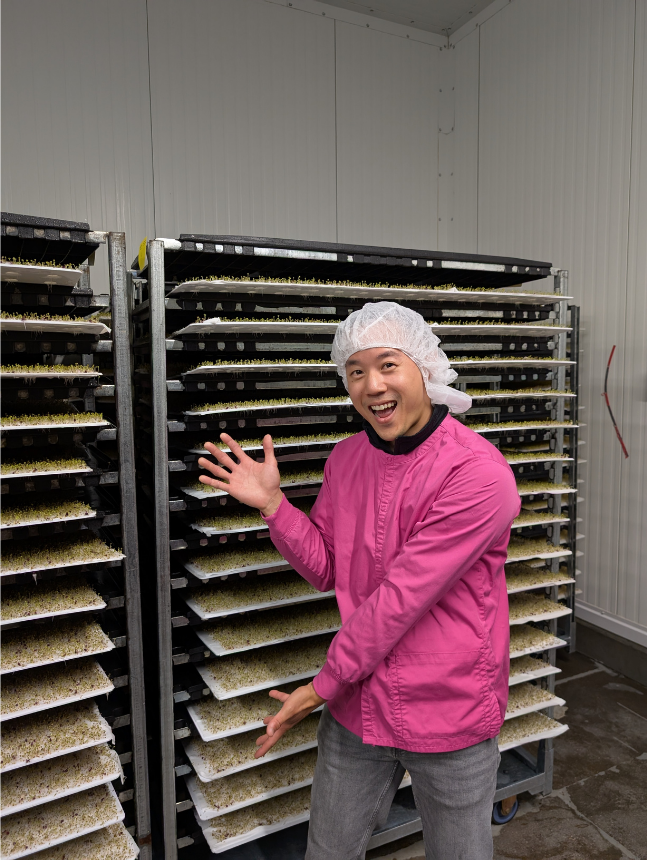
A smaller detail offers something useful to copy. Supplier Vegbed described almost a year of trials before its grow mats entered 80 Acres’ automated production. Growers tested performance and gave specific feedback. For anyone introducing a material into a physical operation, that is a practical discipline: qualify it in the system where it must actually work.
The broader lesson is a question to ask before adding capacity: can each sellable crop cover its share of the operation, including the building and equipment? Indoor production needs suitable crops, reliable equipment, manageable energy costs and customers willing to pay. If those conditions leave a persistent cash gap, another growing level also adds another obligation. 80 Acres made the supermarket salad’s hidden machinery visible. Its ending makes the financing visible, too.
Company website ↗ · Products ↗ · Infinite Acres ↗
LinkedIn · Instagram · X · Facebook · TikTok
Watch: company videos ↗ · Company newsroom ↗ · Read: the wind-down ↗