At Calspan, a vehicle crash produces something that survives the wreck: a report running to 170 pages. By March 2025, the testing company said it had produced more than 950 reports using TITAN, software from 12th Wonder. Each report took over five hours less to prepare. Customers received the finished document within 24 hours of testing. Here was an improvement in automotive engineering measured in the decidedly unromantic business of assembling paperwork.
- The product: TITAN joins test planning, people, equipment and reporting.
- The evidence: Calspan reports saving more than five hours per 170-page report.
- The wider business: custom software, spatial data, cloud integration and AI automation.
That is a useful place to meet 12th Wonder. Its public offering stretches from mobile applications to geographic information systems and AI agents. The list can sound sprawling. The crash report supplies a more concrete organizing idea: important work slows down when the information needed to finish it lives somewhere else.
The report is part of the test
Founded in 2012, 12th Wonder builds software for complicated business processes. Founder and CEO Ajay Krishnamurthy leads a company whose automotive experience now sits alongside work in utilities, telecom and other enterprise settings. Its services include application development, cloud migration, quality engineering and integration. TITAN is the clearest expression of its product business.
The platform manages physical engineering tests. Requirements lead to verification plans; plans require resources; execution produces records; those records must become usable evidence. A test manager needs to see the whole chain. A collection of separate tools can leave each individual task documented while making the overall operation difficult to understand.
Calspan describes a practical intervention. Electronic checklists and predefined templates standardized preparation and execution. Centralized information helped automate certification reports. The customer also credited responsive support and a willingness to incorporate feature requests. That last detail matters: software for a specialized lab has to accommodate the way the lab actually works.
“We consider TITAN a true partner in our journey”Customer statement published by Calspan / March 2025
There is a distinction here between making a report faster and making it shorter. Calspan still needed the long report. TITAN reduced the effort of producing it consistently. For a buyer comparing software, that is a better question than how many screens a demonstration contains: which recurring piece of necessary work becomes easier?
Calspan’s reported saving on a 170-page document. A workflow gain, not a faster crash.
Four resources, one appointment
A test appointment is a small coordination puzzle. The laboratory, technician, equipment and test article all need to be available together. TITAN’s scheduling system brings those resources into a shared calendar. It also accommodates maintenance, calibration and repair work, the activities that can make a seemingly available instrument unavailable.
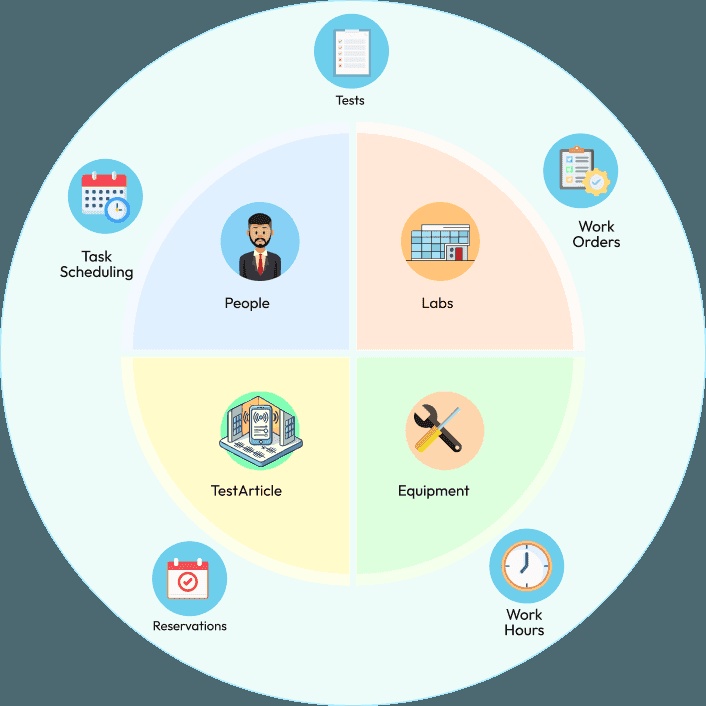
In April 2025, the Automotive Research Association of India selected TITAN for crash, pedestrian safety and airbag testing operations. The vendor’s account describes a lab facing growing demand without a unified view of customer requests, bookings and resource load. The proposed system connected intake, planning, scheduling, checklists, approvals and reports.
That puts TITAN in the market for laboratory and engineering operations software, where alternatives include conventional laboratory information management systems, project tools and homegrown databases. Its proposition is the connection between test evidence and physical resources, supported by configuration and integration. Buyers still need to check those connections against their own procedures.
The map has the same problem
Move from a crash lab to a utility network and the nouns change. Now the work involves assets, field records, geographic databases and enterprise applications. The coordination problem remains recognizable. 12th Wonder offers GIS development, imagery processing, data migration and integration to connect spatial information with operational systems.
NetMapper addresses the data pipeline. Teams design visual workflows to extract, transform and load spatial and business data. They can validate records, change coordinate reference systems and reuse processing rules. NetGraph addresses network digitization and spatial data management. Both belong beside the company’s custom engineering work: tools for organizations whose information has to travel between systems.
Another example is Phoenix Connect. In an August 2026 case study, 12th Wonder described moving its clinical database and image store to Microsoft Azure. The work used source baselines, encrypted transfers, reconciliation checkpoints and a controlled cutover. The company reported intact records and uninterrupted clinical operations. The interesting technique is the verification between stages.
A practical test for the AI pitch
The newer pitch is agentic automation: custom agents, language-model integration and retrieval systems connected to enterprise workflows. TheOneEye is presented as a managed automation service. This extends the company into a crowded AI services market, where demonstrating a workflow is easier than keeping it dependable.
A useful counterweight appears in 12th Wonder’s quality engineering offering. AI can help generate and prioritize tests, but experienced engineers make final release decisions. That is a concrete allocation of responsibility. Buyers can apply the same scrutiny to an agent: what can it change, who approves the exception, and where is the record?
The commercial model combines enterprise products with implementation, custom development, integration and managed services. TITAN offers cloud and on-premises hosting, with pricing tailored to the organization’s size and needs. The sensible cost comparison includes configuration, migration, training and support alongside the software itself.
Count the handoffs
The lesson to borrow is to measure the journey through the operation. Track a request from arrival to approved output. Count the rekeying, waiting, missing approvals and searches for the current file. Then choose a recurring handoff to improve and measure again.
This approach depends on accurate records and people using the shared workflow. If equipment status is stale or approvals remain in private inboxes, a central platform will inherit those gaps. Software cannot create additional physical capacity when the equipment is already fully occupied. Its opportunity is the capacity lost between tasks. Calspan’s long report makes that opportunity unusually easy to see.