A technology company can explain its product for twenty minutes and still leave a prospective customer wondering what it does. 1185 Design has spent its history working on that introduction. The Palo Alto agency turns business arguments into names, identities, websites and marketing materials. Its clients have included companies whose products sit deep inside the machinery of modern life, where an attractive photograph rarely explains very much.
Consider Cisco. In a first-person account published by Yodlee, founder Peggy Burke described multiple logo redesigns that retained the bridge as their central idea. The company could update its appearance while continuing to suggest connection. That is a useful ambition for a technology brand: give people something they can remember without requiring them to become network engineers.
1185’s more revealing work, however, includes the things that never became final logos. Its records at the Computer History Museum preserve alternative designs and client annotations. The collection makes an agency’s usually private act of persuasion visible. Someone had to choose. Someone had to explain the choice. Someone, inevitably, wanted changes.
A date on the door
The name is a small calendar trick. Burke started the agency in November 1985, giving it the month and year for an identity; her own account specifies November 11. Before that, she studied graphic design at the University of Cincinnati and moved west to work at software company Boole & Babbage. She began 1185 on her own.
The surrounding market supplied both clients and an education. A University of Cincinnati computing-history account describes venture capital firms referring young businesses to Burke for help articulating their distinctions and developing websites. Working close to that network meant encountering new technologies before their public explanations had settled. An agency could participate at the moment a business decided how to introduce itself.
The client list eventually stretched across established technology companies, biotechnology, nonprofits and consumer businesses. Silicon Valley Business Journal’s 2014 Women of Influence profile identified work for Adobe, Cisco, IBM and Sun Microsystems. An older agency-directory description claimed more than 350 corporate launches. That figure describes a historical body of work, rather than the number of clients simultaneously keeping designers busy.
The product is the explanation
1185 sells professional services. Its public specialties include corporate identity, positioning, advertising, user experience, wireframes, website architecture and mobile design. For a customer, these can be parts of the same problem. The sales presentation says one thing, the website emphasizes another, and the visual identity belongs to an earlier version of the business.
The agency’s role is to help those pieces agree. Its business model follows client engagements and agency-of-record relationships, with specialists contributing particular skills. A buyer is paying for judgment, design development and execution. The scope can extend from deciding what a company should communicate to producing the materials through which people encounter it.
Jive offers a concrete positioning example. The Yodlee account describes 1185 helping move its presentation from collaboration software toward a social-business platform. The intended shift was in the buyer’s frame of reference: what kind of company is this, and which alternatives should sit beside it? That account establishes the branding intervention. It does not isolate its contribution to Jive’s commercial results.
Physical work also matters. Symantec’s 2004 annual report credits 1185 with its design. An annual report has a different audience and rhythm from a homepage, but it poses a related challenge: organize a complicated company so a reader can follow it. This is where the agency fits within the market - a technology-oriented brand practice with work across corporate communications and digital experiences.
Let the browser have a vote
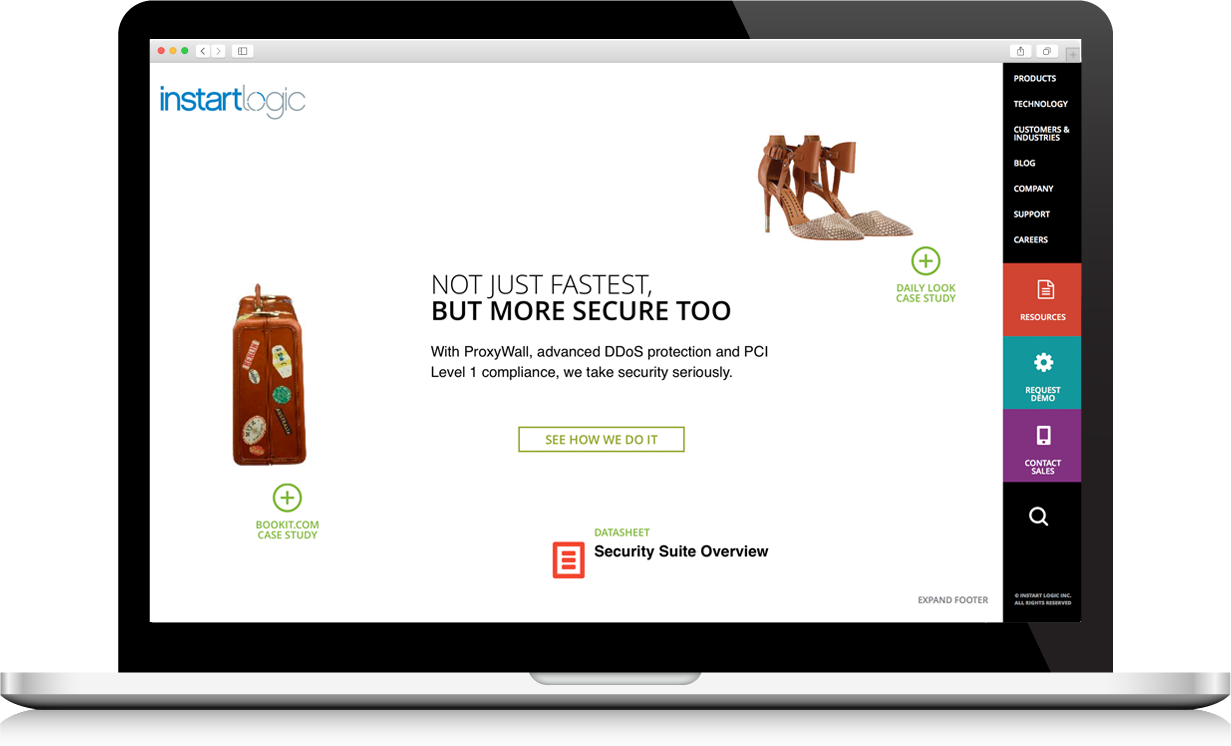
The Instart Logic website project brings the trade-offs down to earth. Busse Design’s case study describes 1185 as the client’s design agency of record. The assignment involved a Drupal website, high-quality imagery delivered through Instart Logic’s technology, and content that the marketing department could update.
The homepage called for large animated images. Performance mattered. Busse built a prototype of the rotating imagery while design questions were still being resolved. That working version exposed technical trade-offs and helped the teams arrive at a more feasible homepage. A prototype supplied information a presentation could not.
The collaborators also refined tablet and mobile layouts. Busse delivered guidance and training for maintaining the Drupal site. That final detail deserves attention: a website belongs to the people who must operate it after the launch celebration. Editorial control and maintainability were part of the assignment.
The lesson for a buyer is straightforward: ask to see the troublesome part working early. An animation, unusual interaction or elaborate image treatment should face its technical constraints before the rest of the project depends on it. This case supports that sequence without requiring a dramatic tale of a failed launch.
A name can need its own specialist
Another window into the work comes from Ninth Wave founder George Anderson. In a 2021 interview with Sramana Mitra, he recalled investors responding poorly to the services-heavy character of his existing business. He decided to separate the software into its own entity and hired 1185 for branding and marketing. Catchword handled naming.
That sequence matters. The market’s reaction prompted a business decision; the brand work gave the resulting company a public identity. Anderson’s account describes a founder assembling complementary expertise around an approaching commercial debut. A logo alone would not have resolved the investors’ objection to the business mix.
The naming relationship extended beyond that engagement. In a 2019 Clutch review, Burke reported collaborating with Catchword on more than 30 corporations and described a relationship lasting over twenty years. The review lists a $10,000-$49,999 project band for naming work across a 2014-2019 engagement entry. That is historical information about the Catchword collaboration, not an 1185 price list or a complete branding budget.
For a prospective client, the practical implication is to separate responsibilities in the brief. Who owns positioning? Who develops and checks names? Who implements the site? These questions make a proposal easier to assess and keep specialist work from disappearing inside an attractive but ambiguous promise to handle the brand.
The boom stopped paying
Being close to Silicon Valley’s growth also meant being close to its collapse. The Computer History Museum’s account says 1185 lost every client but one in the 2001 downturn. Its historical guide records a reduction from 60 employees to 30 and the closure of the Portland, Maine office.
Employees before and after the reduction. Half the team lost their jobs.
Burke had saved during the prosperous years. The museum reports that those reserves helped her provide six months of severance, even though they could not replace the missing revenue. The company continued operating. Survival still involved people losing jobs and an office disappearing.
“You have a responsibility to your employees.”
Peggy Burke / Computer History Museum
The commercial limit is plain. Branding depends on customers having a business to build and money to spend. A cluster of successful technology clients can become a cluster of exposed clients when their market turns together. The agency’s own history puts a hard boundary around the idea that persuasive design can overcome any business condition.
Client confidence affects the creative work, too. In PRINT’s regional design coverage, Burke described recession-era customers as less willing to take risks. She also argued that impressive technical skills needed fundamentals such as an underlying typographic grid. Those observations meet in a familiar agency problem: software can make another option easy to produce, while choosing a coherent direction remains difficult.
The work after the applause
1185 helped create the Computer History Museum’s identity, publicly introduced in 2002. The accompanying logo guide stresses consistent use across communications. The museum later became custodian of the agency’s records. There is a pleasing loop here: the institution that received a public face eventually collected the work of the people who helped draw it.
The records describe designers developing different directions, presenting them in creative books and incorporating client feedback. For readers running a smaller business, the method is portable. Put alternatives next to one another. Explain what each is trying to communicate. Record the reason for the choice so that the next round of discussion has somewhere to begin.
A second habit follows from the logo guide: treat approved work as a system colleagues must use. A shared reference for appearance and application can prevent everyday materials from drifting apart. It also gives future designers something firmer than somebody’s memory of the meeting where the logo was approved.
The buying decision, then, turns on the problem. A company wrestling with positioning across a website, sales materials and corporate identity has reason to consider an agency with this breadth. A tightly defined production task may suit a freelancer or an internal designer. The useful comparison is scope, responsibility and relevant work, rather than the glamour of past clients.
1185’s history makes branding look like a series of consequential, sometimes unglamorous decisions: keep the bridge, test the animation, bring in a naming specialist, write down the rules. The finished appearance is what the public sees. The decisions are what another company can learn to make.
Keep looking
Explore 1185’s website and its profiles on LinkedIn, X and Facebook. Read the Instart Logic project account, the startup-branding essay and George Anderson’s interview.