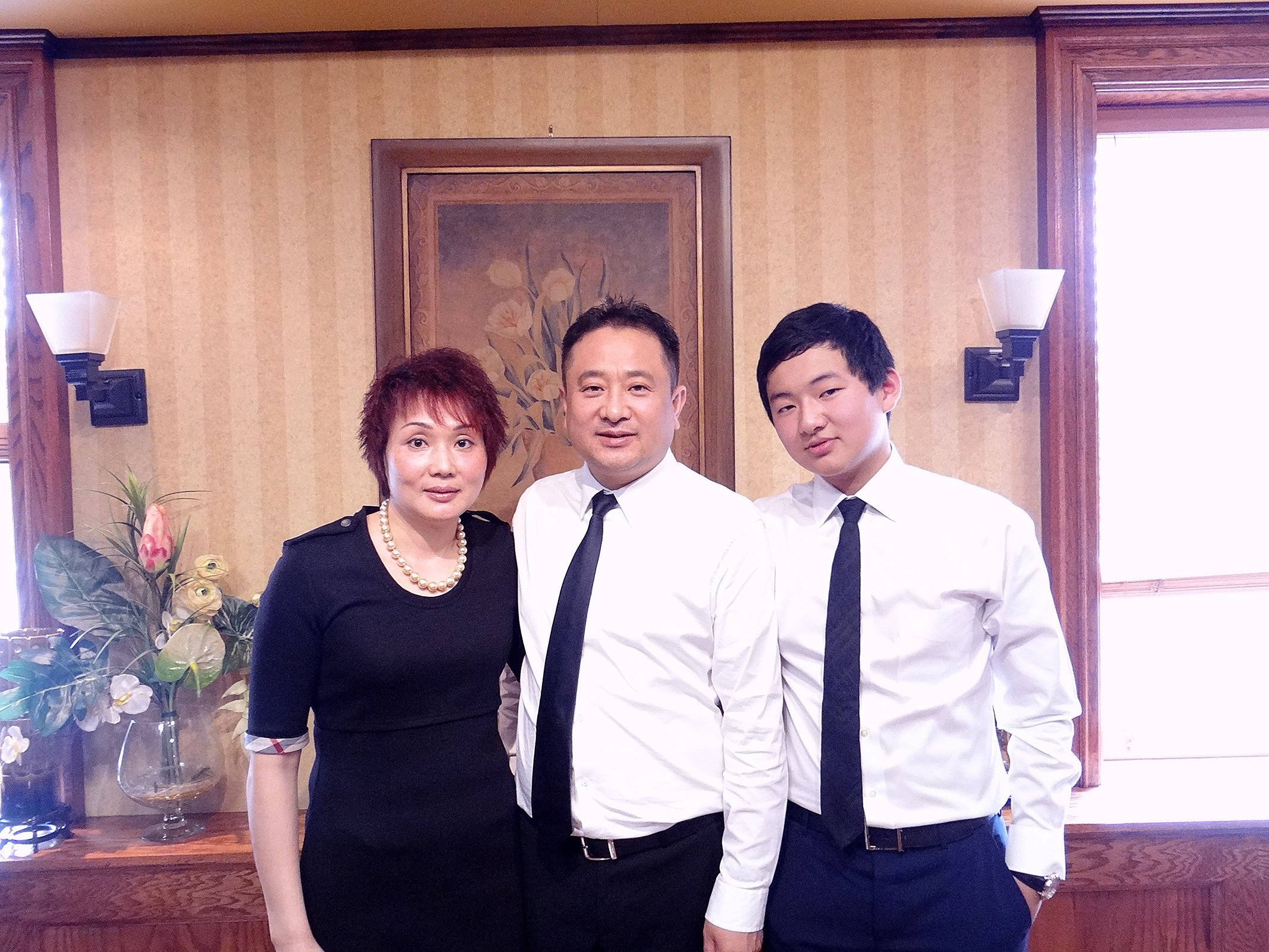
A restaurant customer sees the meal. Zhou Min Ni built a business around everything that had to happen before it: ingredients bought, stock stored, orders understood and a truck arriving at the right door. With his wife and co-founder, Chan Sin Wong, he established Han Feng in North Carolina in 1997. Twenty-one years later, the operating business reached Nasdaq through a merger. The journey from kitchen work to a stock ticker was substantial. So were the obligations that came with it.
Ni’s career contains both an immigrant business story and a public-company reckoning. He helped build a distribution network serving thousands of Chinese restaurants. He later resigned from HF Foods leadership and, in 2024, settled securities fraud charges. Those chapters belong together. The company’s expansion explains the scale of what he helped create; the settlement explains the limits subsequently placed on his involvement.
A restaurant problem becomes a business
Ni and Wong came to the United States from Fuzhou, the capital of China’s Fujian province. Their early work was in Chinese takeout restaurants. They accumulated experience, saved money and opened restaurants of their own. That placed them on the receiving end of the supply chain long before they began organizing it.
In a published recollection in 2018, Ni described an irritation familiar to restaurant operators: ingredient deliveries that failed to match the restaurant’s needs. A truck could arrive in the middle of the night. He recalled discussing the problem over dinner with friends and considering whether they should arrange food deliveries themselves. Even dinner, it seems, could become a meeting about the next delivery.
“Sometimes the delivery truck arrived in the middle of night, and it’s really a headache for us.”
Zhou Min Ni, recalling the business’s origins in 2018
Han Feng was founded in Kernersville, North Carolina, in 1997. The opportunity came from a customer problem the founders had experienced directly. Supplying restaurants would put them in a business adjacent to their own, with customers whose daily requirements they already understood. The move also shifted their attention from individual dining rooms to the purchasing and delivery needs shared by many of them.
The geography of dinner
The business expanded into Florida in 2001. It purchased a Greensboro warehouse in 2003, added an Atlanta facility in 2005 and acquired HD Foodservice in Winston-Salem in 2008. These were practical additions to a distribution network. For a business delivering restaurant supplies, a warehouse address determines how much ground a delivery operation can cover.
By 2018, HF Group described a network of about 3,200 Chinese restaurants in ten southeastern states, served through three distribution centers in North Carolina, Florida and Georgia. It employed approximately 400 people. An investor presentation listed 105 refrigerated vehicles. The company’s work combined the physical business of moving stock with the less visible work of handling orders and maintaining customer relationships.
Language was part of the service. The company used multilingual sales and customer support, and had moved sales and customer-service functions to China in 2005. Later descriptions of the combined business emphasized customers who spoke Mandarin or Chinese dialects. Understanding an order was as essential to the operation as finding space for it on a truck.
Wong’s contribution was central. Her responsibilities included sales, inventory, logistics distribution, human resources and compliance. She also helped develop the distribution network. Ni oversaw strategy, financing, acquisitions, expansion, procurement and vendor management. Their responsibilities describe two founders working across the company’s commercial and operating needs. Giving one person the entire origin story would leave a considerable amount of work unaccounted for.
A ticker symbol enters the family business
On August 22, 2018, HF Group completed its combination with Atlantic Acquisition, a special purpose acquisition company. Atlantic changed its name to HF Foods Group. Trading under the HFFG symbol was expected to begin the following day. The transaction brought an established operating business into the public markets while its existing management continued to run it.
Ni became chairman and CEO of the public company. Wong served as president and a director. Former HF Group shareholders were to receive 19.97 million shares, representing approximately 88.5 percent of the outstanding common stock at the transaction’s completion. The family business had acquired a new corporate structure and a public audience for its financial results.
A Nasdaq bell ceremony followed on September 5. At the celebration, Ni credited the company’s affiliates, employees and advisers for their work on the listing. He also discussed capital management, performance and future growth. It was a moment to recognize the distance between a North Carolina restaurant-supply operation and a business whose shares now traded on an exchange.
“Our long-term vision is to become a nationwide leader in this niche market.”
Zhou Min Ni, August 2018
The ambition was geographical. More restaurants meant a wider network, more infrastructure and relationships with additional suppliers and operators. The public-company route offered a way to pursue expansion. It also required accurate disclosures to investors who relied on the company’s accounts and descriptions of how it did business.
East meets west, warehouse by warehouse
The next major combination arrived on November 4, 2019, when HF Foods completed its merger with B&R Global Holdings. B&R supplied approximately 6,800 restaurants across eleven western states. HF Foods issued 30.7 million shares to B&R’s former shareholders. The combined network served more than 10,000 restaurants in 21 states.
Ni subsequently shared the CEO role with Xiao Mou Zhang, known as Peter Zhang. A Nasdaq video records the two executives ringing the opening bell in its November 2019 ceremony series. The image of two leaders at the exchange suited a company assembled from two regional distribution businesses.
Infrastructure followed the enlarged footprint. In January 2020, HF Foods bought entities owning ten warehouse properties for $101.3 million. These were facilities already being used by the business. Ni’s explanation emphasized control over the properties, reduced dependence on outside parties and the elimination of lease expenses. The reasoning was squarely in the language of an operator: ownership, storage capacity and cost.
The books behind the business
The later securities case concerned what investors were told about the business and how company money was used. In June 2024, the Securities and Exchange Commission charged Ni and former CFO Jian Ming “Jonathan” Ni with concealing liabilities, diverting company funds and misleading auditors. The allegations involved the period surrounding and following the transition to public ownership.
The SEC alleged that company funds benefited Ni and his family, including through spending on luxury vehicles. It also alleged that misleading documentation concealed millions of dollars in liabilities. Related-party transactions and executive compensation became central questions. These were matters affecting the company’s disclosures to shareholders, rather than its ability to assemble and deliver a restaurant order.
One part of the complaint described the separation of an egg roll mix operation into a company owned initially by Ni and his son, and later by the son alone. The SEC alleged that the operation continued using HF Group’s premises, equipment and workers while selling its product back to HF Group. The arrangement formed part of the agency’s account of transfers benefiting the family.
Ni settled without admitting or denying the complaint’s allegations. On June 10, 2024, the court entered a final judgment imposing a $300,000 civil penalty and permanently barring him from serving as an officer or director of a public company. A further injunction restricted him from participating in HF Foods management or exercising control or influence over the company.
Personal civil penalty, alongside a permanent public-company officer and director bar.
Consent settlement; Ni neither admitted nor denied the complaint’s allegations.The judgment also addressed disgorgement, interest and reimbursement obligations, deeming them satisfied by his earlier $9.25 million payment in a related shareholder derivative settlement. HF Foods separately settled the SEC’s administrative proceeding and agreed to a $3.9 million penalty. The company’s settlement and Ni’s personal judgment were distinct resolutions.
The founder and the company take different roads
Ni had already left leadership. His resignation as co-CEO, chairman and board member took effect on February 23, 2021. Peter Zhang became sole CEO, and Russell Libby became chairman. The changes separated jobs Ni had held together during the public company’s early years.
Share ownership continued beyond his tenure. HF Foods’ April 2026 proxy listed Ni among holders of more than five percent of its common stock, reporting 3,555,673 shares and a 6.6 percent interest. Ownership remained a financial connection to the company he had helped establish, alongside the restrictions imposed by the 2024 judgment.
Further civil litigation followed. HF Foods filed a District of Columbia action against Ni in February 2026; he moved to dismiss it in May. A separate Nevada action filed in June named Ni and Peter Zhang. Those filings describe disputes and procedural steps, not findings that the defendants were liable.
The business Ni and Wong began in 1997 was built around the repeated requirements of restaurant operators. Its history can be followed through warehouse purchases, delivery routes, customers and mergers. Ni’s own history then takes a different turn: resignation, settlement and a permanent restriction on public-company leadership. A stock ticker gave the enterprise visibility. The years that followed made the responsibilities behind that visibility impossible to overlook.