Zack Rinat had been working on a fighter jet when someone else decided the program would go no further. He was responsible for software in its flight-control computer, a demanding piece of engineering on an Israeli aircraft program. The team could make its part work. It could not make the government keep paying for the project. When the program was canceled, Rinat began reconsidering who would get to decide what happened to his work.
There is an awkward discovery tucked inside that experience. Being good at a job does not confer authority over its future. Rinat had planned to pursue a doctorate in computer science. Instead, he chose business school, arriving in the United States in 1988 to attend Harvard. He wanted a larger say in the fate of the things he built. It became a question about ownership.
His life before Harvard had already included several changes of pace. Born and raised in Ness Ziona, Israel, he served in the Israeli Special Forces and rose to captain. After four years in the military, he spent a year backpacking through South America. He returned to Israel for a computer-science degree at the Technion, then worked on aircraft software. Engineering supplied the training; the canceled project supplied a reason to change direction.
In 1990, he moved to Silicon Valley. At Silicon Graphics, he spent five years in roles spanning manufacturing, operations and marketing. By 1995, he was ready to leave and co-found NetDynamics.
A school fundraiser, then a server
The introduction that helped create NetDynamics came through his wife, Orli. She was organizing a charity fundraiser at their children's school and knew one of the future founders. The people she connected were exploring an Internet business selling cars, alongside an idea for linking databases through HTML. Rinat was interested in the technology. The team chose the database concept, assembled its founders and developed a prototype.
It is a pleasingly domestic beginning for enterprise software. Silicon Valley likes to advertise the garage. A parent organizing a benefit can apparently be just as useful.
Rinat selected Hummer Winblad as an early investor because it understood software and developer tools. Mark Gorenberg was his contact there. He wanted capital accompanied by relevant experience.
NetDynamics began with tools for developing web applications. Rinat soon saw a larger problem in deploying those applications and supporting many simultaneous users. The company moved toward the server. An early Canadian bank customer wanted to publish stock quotes online. Later, NetDynamics sold a downloadable entry package below $1,000, payable by credit card.
That distribution method produced an amusing reversal of the usual sales call. Rinat recalled the CTO of Federal Express asking who NetDynamics was and how three of its applications had appeared inside the company. Rinat had not sold them directly. Someone had downloaded the software. The product had arrived before the formal introduction, leaving the executive to catch up.
“My heart has always been with technology.”
Zack Rinat
Two exits, and an inconvenient retirement
Sun Microsystems acquired NetDynamics in 1998. Rinat later put the deal's original value at about $180 million, consisting largely of stock with some cash. He became vice president and general manager of the NetDynamics business unit at Sun. A successful sale supplied the conventional ending to the startup story. For Rinat, there were still some unresolved questions about what kind of company he wanted to build.
Next came an invitation from his friend Yoav Shoham, the Stanford professor, to help assemble TradingDynamics. Rinat brought together management, investors and seed funding for the business-to-business auction software company. He served as a founding board member in 1998 and 1999. Helping a friend provided another way to participate: putting the business around the idea rather than occupying every role himself.
He then tried retirement. It lasted a few months. The trouble was the available time, and a suspicion that Silicon Valley had become too interested in quick rewards. In 1999, he began Model N. He had already experienced the satisfaction of selling a software company. This time he wanted to find out whether he could build one with a longer independent life.
The founding group did not start with a fully formed product idea. They started with a desire to work together again. They explored opportunities, debated possibilities and built prototypes before narrowing their direction. That sequence matters. The familiar origin story gives a founder a revelation and then a team. Here, the team was part of the reason to go looking for the revelation.
The money hiding in the paperwork
Model N settled on revenue management. Behind that dry phrase was a lively problem: a company can sell a product, agree a price, issue a rebate and still fail to collect the money it should receive. Somewhere between the contract and the settlement, a detail goes astray.
Rinat explained the arithmetic as price multiplied by volume, less financial settlements. Discounts, rebates and incentives complicate the calculation. A customer might receive a rebate on a product it had returned. A contract might allow an annual price increase, while the document remained in a drawer and the increase went unused. The business could be busy selling and quietly losing revenue at the same time.
The opportunity was to connect those separate decisions. Pricing, contracts and settlement records needed to agree with one another. Model N concentrated on industries with complicated commercial arrangements, including semiconductors. The drama lived in an expired discount or an overlooked clause.
By 2007, Rinat described an organization of about 280 people, with offices in the United States, London and Hyderabad. It had reported eleven consecutive quarters of positive cash flow. He also described an unusual relationship with larger software companies: Model N could compete with SAP and Oracle in some situations and collaborate with them in others. Relationships came with clauses.
settlements=Revenue
Ambition needed a bank balance
Rinat wanted Model N to become an independent public company. NetDynamics and TradingDynamics had been sold; he wanted this undertaking to endure independently.
That approach combined product risk with financial caution. In 2007, he said Model N had raised roughly $42 million in June 2000 from Accel and Accel KKR, followed by another round in December 2003. He argued that large customers wanted a supplier with a conservative financial strategy. Buyers needed to know the vendor would stay around to support its software.
Preparing for an IPO meant investing in financial controls, information technology and management. Rinat described the listing as a milestone rather than an exit. He made room for a joke. When warned that going public would give him gray hair, he replied, “I have enough already, thanks!” The paperwork remained unimpressed.
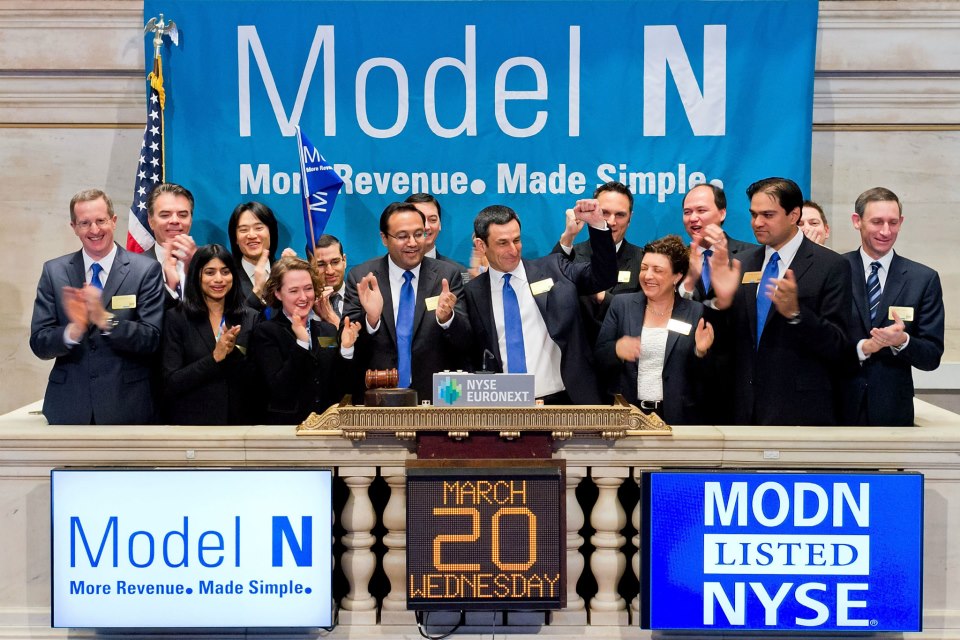
On March 20, 2013, Model N began trading on the New York Stock Exchange under MODN. Rinat rang the opening bell with members of the leadership team. The photograph is a crowded one, as it should be: people applauding, a raised fist, the company name behind them. The founder stands amid a group that spent years getting there.
A culture that could survive bad weather
Model N had started shortly before the dot-com collapse. Rinat credited the company's values with helping it through the market crash and the upheaval surrounding September 11. His account of culture was practical. People needed an agreed way to make decisions when circumstances turned against them, and a reason to keep supporting one another.
He organized the values around DARE. In discussing them, he emphasized challenging conventional wisdom, respecting individuals, aligning responsibilities with customers and pursuing excellence. He objected to the idea that pleasing engineers with expensive perks would somehow guarantee satisfied customers. A BMW is a handsome object. It is a peculiar substitute for a working customer relationship.
The customer's success came first in his hierarchy of responsibilities, followed by partners, the company, the function and the individual. He also described an internal safety net for people who attempted risky work and failed. That combination is demanding: take the ambition seriously, keep the customer in view, and leave room for an honest attempt to go wrong.
A later account from former colleague Sujay Jadhav gives the philosophy a human witness. Jadhav described fourteen years with Rinat as a second MBA, with lessons in financial discipline, customer satisfaction and market timing. He remembered pivots, difficult periods, expansion and contraction before the 2013 IPO. The education came with a long practical examination.
Who gets to keep building?
In June 2013, Rinat was honored by the Obama White House as an immigrant innovator through its Champions of Change program. In his own reflection on the recognition, he credited the team, customers and experienced investors who had helped him. He and Orli were thinking about legacy. He described passing on the lessons of entrepreneurship as part of the work ahead.
His argument extended to immigration. In a 2013 commentary, he urged the United States to attract and retain skilled people from around the world. He treated the question through the lens of assembling a team: people bring skills, build businesses and create employment. The trajectory from Israel to Harvard to Silicon Valley had made that argument personal.
Rinat's operating role at Model N changed over time. He became executive chairman in 2016, subsequently served as interim CEO from November that year, and resigned as interim CEO, president, chairman and director effective May 10, 2018. Jason Blessing became CEO. The transition included an advisory arrangement. Founding a company and continuing to run it were now different chapters.
In June 2024, Vista Equity Partners completed its acquisition of Model N at an approximately $1.25 billion valuation. The shares stopped trading on the NYSE. By then, Rinat had been out of its executive leadership for years. The company he had wanted to endure was still operating, under different leadership and a different ownership structure.
- 1999Model N founded
- 2013NYSE listing
- 2018Rinat leaves leadership
- 2024Vista acquisition
DARE beyond the office
Rinat later turned attention to the DARE Foundation and technology startups. By 2021, he described the foundation as a way to share experience, relationships and resources with social entrepreneurs. The 2024 foundation filing lists him as president and Orli as chairman. The transition carried the same four-letter name from the company vocabulary into grantmaking.
There is another, less corporate place where he likes to consider how people organize themselves: Burning Man. He has described the event as part of his way of life, admiring how its shared principles guide a large community. In his vocabulary, DARE becomes Dream, Align, Respect and Excel. A desert gathering and a software business offer very different scenery for his interest in explicit values.
The foundation's public cultural connections include support, with Orli, for a 2024 Jewish Film Institute program of short films from Sapir College. That is a concrete setting for the post-company work: helping other people's creations reach an audience. The scale and medium have changed from enterprise software, while the interest in people making things remains recognizable.
Rinat's career began with learning how little control an engineer could have over a project's fate. It has since involved recruiting partners, accepting investment, selling companies, taking one public and eventually leaving its management. Each step required sharing control. The lasting question in his story is how to build an organization that keeps making useful decisions when its founder is no longer the person making them.