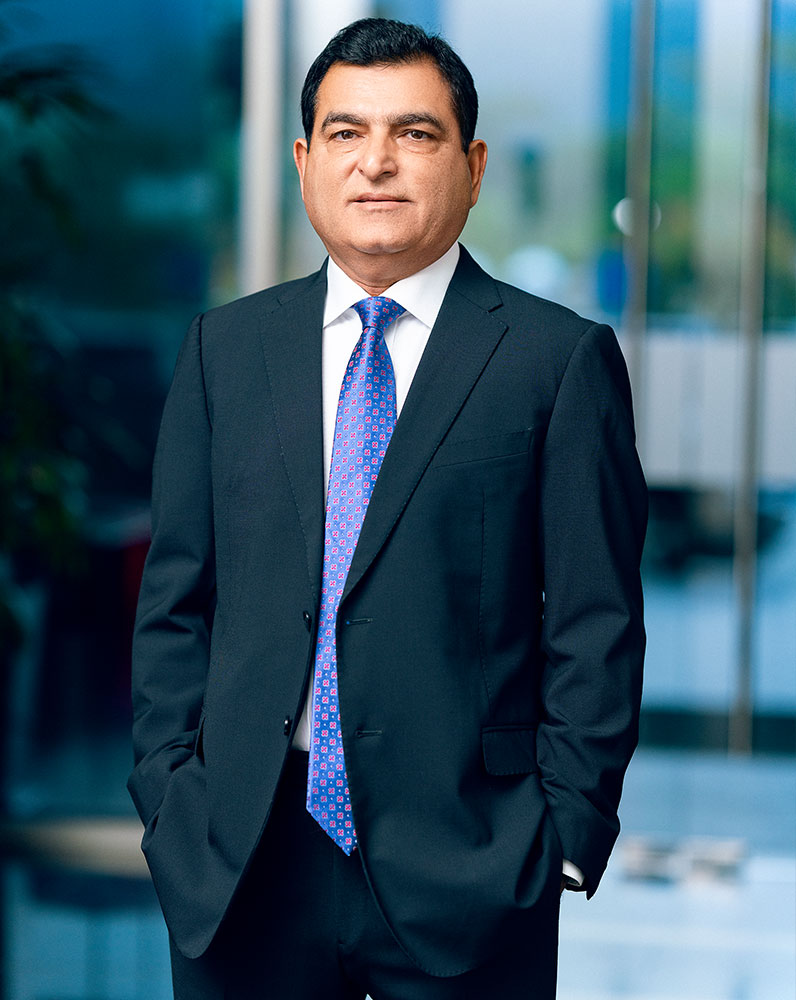
The first thing Yusuf Amdani built in Honduras was not a philosophy. It was a garment factory. In 1991, Pride Manufacturing began making clothes for export to the United States, a practical answer to a practical problem: how could a family textile business get closer to its customers? Honduras had introduced a free-zone framework, the US market was near, and Central America offered manufacturing room. Amdani saw the opening, moved in 1990, and began.
The philosophy arrived through the work. A factory needs people. People need skills, transport and a reason to imagine next year. Employers need reliable buildings and enough confidence to sign long leases. A region needs more than a visiting company with a short attention span. One dependency exposed the next, until the textile operation had become the first piece of a larger system.
Amdani's career can look like diversification when read from a distance: textiles, industrial parks, real estate, technology-oriented infrastructure, agriculture and lifestyle ventures. Up close, it looks more like adjacency. Each move tries to make the previous move sturdier. The cloth led to the factory. The factory led to the park. The park led to a pitch for other employers. The employers created demand for skills and services. The city around the payroll began to matter as much as the payroll itself.
A family loom, rewoven
Amdani was born in Karachi into a family whose textile business dates to 1946. He became the third generation in yarn and cloth, but inheritance did not mean immobility. He studied business administration at the University of Karachi and later completed an MBA focused on marketing and finance at California State University, Fullerton. In the late 1980s, he went to the United States to help establish the family business there. Soon he was scanning farther south for a production base.
The map was unsettled. El Salvador was still at war. Nicaragua was not yet a serious candidate. Honduras, meanwhile, had approved a free-zone law and was building its first zone. The conditions were not luxurious, but they were legible. For an operator accustomed to trade rules, quotas and shipping time, legibility was enough to begin a wager.
“I believe you learn more from failures than from successes.”Yusuf Amdani on persistence
He made Honduras more than a location. He became a naturalized citizen and describes the country as home. That matters because his public argument depends on rootedness: people should not be forced to leave their homelands simply to find a working future. It is a tidy sentence attached to an untidy assignment. Jobs can open a door, but keeping opportunity local requires a long corridor of investment behind it.
Build the thing behind the thing
In 1998, customers encouraged Amdani's company to establish manufacturing in Campeche, Mexico, where trade advantages under NAFTA made the location useful. The move pulled the group into real estate and surrounding services. Back in Honduras, the same instinct grew into Green Valley, an advanced manufacturing hub, and Altia Smart City, a campus designed to attract technology and business-services companies.
When Amdani first proposed a technology park and smart city, he recalls being told it would fail because the required infrastructure did not exist. The criticism contained its own answer. If the infrastructure was missing, infrastructure was the product. That is a familiar entrepreneurial inconvenience: the complaint that doubles as a specification.
He eventually gave the sequence a name: circular development. The idea is that investment should create work, work should enlarge skills and household stability, and the resulting capacity should support another round of investment. GK Foundation extends the loop through education, nutrition, sustainability and community programs in places where the group operates. The company currently reports that its investments have produced more than 30,000 direct jobs and 140,000 indirect ones.
Those numbers are large, but the mechanism is easier to understand at human scale. One stable job changes the choices available at one kitchen table. A cluster of employers changes the bargaining power and career ladder of a labor market. A technical training program changes which company can arrive next. A building is useful. A building filled with people who can advance is useful twice.
The foundation inside the loop
GK Foundation is where circular development becomes less abstract. Its social-impact work follows families beyond the workplace, concentrating on health, education and nutrition in Honduras, Pakistan, Dubai, the United States, Mexico and Bangladesh. The footprint is broad, but the premise is consistent: a job cannot carry the entire burden of opportunity if illness, hunger or an inaccessible school can still close the door.
Health is the largest expression of that premise. In Honduras, GK says its annual health fairs draw more than 1,500 people, while medical and dental brigades serve more than 3,500. The foundation also donates equipment—from beds and transport stretchers to X-ray panels—and reports providing more than one million masks and food bags. At the Love and Care Medical Clinic inside Mario Catarino Rivas Public Hospital, more than 300,000 patients have been treated.
Pakistan shows what partnership can add to the model. GK is a founding member of ChildLife Foundation, which runs pediatric emergency-care clinics in public hospitals, creates thousands of jobs and describes itself as the world's largest pediatric emergency-care NGO. In the year reported by GK, its clinics treated 2.5 million children. With SINA, GK operates 30 clinics in low-income areas of Karachi and supports a telemedicine network that reaches far beyond them.
Health
- 2.5M children treated in the reported year by Pakistan's ChildLife Foundation, which GK helped found
- 118+ telemedicine satellite centers supported in Pakistan
- 100K dialysis patients treated free each year at four supported Indus Hospital units
- 120K outpatient services provided annually at UHI Clinic in the United States
Education
- 4 fully bilingual public centers supported in Honduras
- 1,000+ Honduran girls and boys have benefited from bilingual education
- 6,000+ children reached through wider school investment in Honduras
- 3,000+ women benefited from skills training through The Citizens Foundation in Pakistan
Nutrition
- 300K+ meals delivered in Honduras in the last reported year through Alimentando Esperanza
- 1,500+ meals served daily in Karachi
- 10K+ ration bags distributed monthly in Karachi
- 6,000+ people fed weekly in Campeche through Alimentando Esperanza
Across the network: As a founding and trustee member of Memon Medical Institute, GK supports free, state-of-the-art tertiary care for more than 140,000 patients annually. Patel Hospital treats 100,000 outpatients a year across cardiology, gynecology, burns and plastic surgery, and kidney and bladder care; Pakistan Children’s Heart Foundation treats another 2,000 patients annually. Pakistan Medical Center in Dubai treats patients of all nationalities free of charge, while Mexico's Una Caricia Humana shelter supports low-income cancer patients.
Education begins close to GK's industrial base. In Honduras, the foundation brings bilingual education to children from low-income families through four fully bilingual public centers and supports six Spanish-language schools, pairing classroom access with nutrition, family medical brigades, campus maintenance, hygiene programs and Healthy Child initiatives. Its social and sustainable investment also backs teacher salaries, infrastructure, wellness campaigns and celebrations. In Campeche, GK supports 100% bilingual education at El Huerto de la Ilusión's kindergarten and elementary school, along with its cafeteria and the city's CAM centers.
In Pakistan, the foundation supports the Halima Amdani Campus through The Citizens Foundation and contributes to a network operating more than 2,000 schools. It also sponsors the H.H. Sheikh Rashid Al Maktoum project. In Bangladesh, its partnership with OBAT Helpers connects marginalized communities to education, healthcare and emergency relief. These are different programs in different systems, yet together they give Amdani's thesis a useful test: whether investment can remain present in a person's life after the workday ends.
The elegance of staying put
Amdani's recurring subject is migration by necessity. He does not argue against movement itself; his own life crossed Pakistan, the United States, Honduras and Mexico. His distinction is between choosing to move and being cornered into it. Local work, in his view, widens that choice. The aspiration behind GK's developments is therefore unusually domestic: help ambitious people build a dignified life where they were born.
This is also a hard-nosed business proposition. A company that develops people gains a deeper talent pool. A district with dependable services attracts more tenants. A community with opportunity is more stable. Empathy and economics are not asked to sit at opposite ends of the boardroom table. They are asked to share the same spreadsheet, occasionally with poor handwriting.
His management language follows the same logic. He talks about trusting employees, loosening traditional hierarchy and giving teams room to make errors. Innovation without permission to be wrong is merely a suggestion box with excellent lighting. Amdani's preferred lesson from failure is not romance but revision: learn how not to do the thing, then continue.
The years that refused to cooperate
The story has its stubborn seasons. A Honduran recession around 2000 made Amdani reconsider whether to stay. During the political crisis of 2009, international companies that had planned to enter GK's technology parks withdrew. Empty commitments are particularly eloquent when concrete has already been poured.
Yet the parks continued. The setbacks seem to have hardened his preference for patient capital and flexible teams. “Never stop” became a compact version of the operating system. It sounds cheerful on a conference stage. In practice, it means carrying fixed costs through uncertainty, keeping colleagues aligned and returning to the same difficult conversation after everyone has run out of fresh adjectives.
An operator becomes an author
After three decades, Amdani put his argument into a book. World of Opportunity: Bringing Sustainable Business to Fragile Economies appeared in September 2023. It is part memoir, part manual and part invitation to stop treating developing economies as either charity cases or pools of cheap labor. His preferred unit of analysis is the ecosystem: labor readiness, local leadership, environmental practice, infrastructure and the ability to reinvest.
The book also allowed a private-company chairman to become a public explainer. He discussed it on the Forbes Books Podcast, wrote articles on nearshoring, employee retention and education, and spoke at the Urban Economy Forum. In 2025 he served on the steering committee for the forum's seventh edition in Toronto. Revista Summa named him among its regional ethical executives in both 2024 and 2025.
His current writing has moved toward the next constraint: human capability in an age of AI and advanced manufacturing. In 2026, he argued that technical talent cannot be treated as an infinite resource waiting beside an empty facility. Companies must help develop it. The old circular model acquires a new item in the loop - workers able to use emerging tools, and institutions able to keep teaching them.
“In every city that we are building, we are generating new opportunities for those places.”Yusuf Amdani on the aim behind expansion
What the rest of us can steal
The portable lesson is not to imitate the portfolio. Few founders need a textile mill, a technology district and an honorary consulate. The useful move is to identify what must become true around a business for the business to last. Then decide which of those conditions can be built, taught or patiently financed.
Amdani chose a place and let its constraints shape the company. He used manufacturing as an anchor, real estate as an enabling layer, training as a talent strategy and community investment as part of continuity. The result is not frictionless. Economies are rude enough to ignore a founder's slide deck. But the pattern has endured longer than any single cycle.
There is something almost old-fashioned in the final picture: stay, learn the terrain, build relationships, survive embarrassment, reinvest. In an era of weightless products and instant scale, Amdani's work is heavy with land, buildings and consequence. His theory of opportunity can be stated in one line. Put the job where the person is. Then build enough around it that both have a reason to remain.