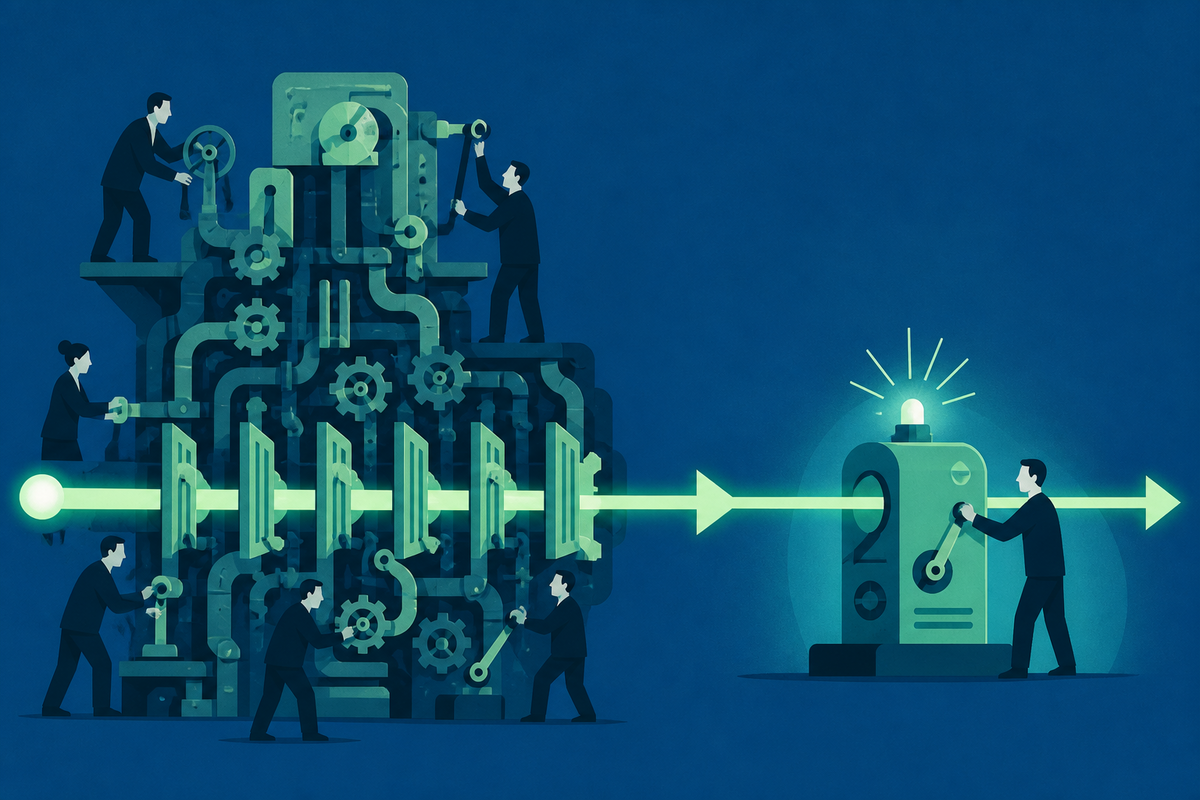
Software comparison pages have trained buyers to count. Count the intent sources, the integrations, the filters, the agents, the records and the channels. Add checkmarks until one column looks heavier. Then take that heavier column into a meeting and call it diligence. The trouble is that revenue software rarely fails because a competitor had one more filter. It fails when a signal reaches a dashboard and nobody has a reliable habit for turning it into action.
That is the useful way to read 6sense against Warmly. Both live in the crowded territory between anonymous interest and a seller's next move. Both talk about buyer signals, account or person identification, scoring, data, workflows and coordinated outreach. Their websites naturally stress technical distinctions. A buyer should first notice the human distinction: 6sense assumes a revenue organization; Warmly tries to compress one.
This does not make 6sense old and Warmly new, or one sophisticated and the other simple. It means the products begin with different beliefs about the customer. One expects specialists who can govern a broad intelligence layer across marketing and sales. The other expects a small group that wants identification, context and action packed into a shorter loop. Your org chart is part of the product specification.
The hidden invoice is paid in people
6sense's public materials describe a platform that spans predictive models, account and contact insights, third-party intent, web visitor identification, alerts, workflows, reporting and integrations. Its corporate site says the system interprets more than a trillion signals daily. Its sales intelligence page lays out multiple bundles and points the buyer toward a demo. That is a recognizable enterprise motion: scope the environment, involve stakeholders, shape a package and sell into a plan.
For the right company, that process is not friction for friction's sake. A business with regional teams, multiple products, a large account universe and existing marketing operations may need governance more than instant gratification. A common model for account prioritization can keep paid media, business development and account executives from improvising three different definitions of “in market.” Breadth has value when the organization can absorb it.
A platform does not merely automate your process. It makes a bet that your process exists.YesPress analysis
But the operating bill continues after procurement. Someone has to own the model, connect the CRM, reconcile fields, define audiences, route alerts, tune campaigns, teach sellers and decide whether a weak quarter reflects the market or the machinery. Each task may be reasonable. Together they amount to a part-time institution. If the institution already exists, 6sense can give it shared infrastructure. If it does not, the software can expose the absence in expensive detail.
Vendor-reported figures describe different things. They are useful here as evidence of positioning, not as a controlled performance comparison.
Warmly sells a shorter distance
Warmly's pitch is not merely that it can spot interest. Its how-it-works page says a team can install one line of code, connect HubSpot or Salesforce natively and configure the product itself. The system combines visitor identification with chat, scoring, enrichment and off-site orchestration. In plain terms, it wants to reduce the distance between “someone interesting is here” and “the appropriate thing happened.”
That is what self-serve means in this comparison. It is an operating model, not a promise that a credit card unlocks every plan without a conversation. Warmly's current pricing page publishes annual starting prices and also places “Talk to Sales” on its paid packages. A clean comparison should not hide that. Warmly is self-configured and designed for rapid adoption; its commercial motion still includes sales assistance.
The distinction remains material. A lean team can value a guided purchase and still reject a months-long internal program. A founder, demand-generation lead or revenue operator may prefer to place a pixel, connect a CRM, watch actual traffic and learn whether identified visitors are useful. That creates a tighter proof loop. The buyer can test the quality of the signal on the company's own messy reality before building a committee around it.
Relative organizational surface area
Compression has its own tradeoffs. When one system identifies, scores and acts, the team must inspect why it made a decision and how that decision affected a person on the other side. Fast automation can turn a thin signal into an eager message before anyone asks whether the message is welcome. Warmly itself recognizes this tension. In announcing an agreement to be acquired by HubSpot in June 2026, co-founder Max Greenwald wrote that agent-driven experiences could become more useful or more intrusive.
Feature depth is downstream of organizational fit
A feature can be valuable and still be unusable in your company. Predictive buying stages require trust in the inputs and an agreed response. Person-level identification requires privacy review, sensible confidence thresholds and restraint. Dynamic audiences require paid-media ownership. Automated outreach requires deliverability controls and a voice that does not sound like a machine discovered a first name. The checkmark is the smallest part of the work.
This is why “Which has deeper features?” produces weak buying advice. Depth depends on the job. For an enterprise team coordinating account-based marketing across thousands of accounts, a platform-wide model and controlled activation may be the point. For a company with one revenue operator and a few sellers, depth may mean seeing a visitor, understanding the context and sending the useful alert without standing up an operations group.
6sense fits when
- Marketing, sales and operations already share an account motion.
- Specialists can own data, campaigns and seller adoption.
- Governance across products or regions is worth added coordination.
Warmly fits when
- A lean team needs a short path from signal to action.
- Testing on live traffic matters more than a broad rollout.
- One operator needs identification, context and activation together.
The categories also move. 6sense now describes intelligence delivered through platforms, agents, feeds and other interfaces. Warmly's current paid packages have meaningful annual prices, professional services and sales calls. In June 2026, Warmly announced its agreement to join HubSpot, while stating that existing contracts, pricing and product experience were unchanged at the time. Challenger simplicity can become platform distribution. Enterprise platforms can make smaller entry points. A buyer should inspect the present product, not preserve an old market caricature.
Run the Monday morning test
Before a demo, write down what happens when a desirable account visits the pricing page next Monday at 10:17 a.m. Who sees it? How confident must the match be? Who decides whether to act? What context reaches that person? Which channel is allowed? How quickly should the action occur? Where is the outcome recorded? Who reviews false positives on Friday?
Then put names beside the answers. If the page fills with several specialists, you are buying a coordinated system and should evaluate 6sense on the quality of that coordination. If one or two names repeat, you are buying compression and should evaluate Warmly on how much work it actually removes. If the names are blank, pause. Software cannot route responsibility that the company has never assigned.
The stealable buying test
Score each vendor against the operating week, not the polished demo.
- Name one accountable owner.
- Trace one signal from capture to action.
- Count every human handoff.
- Price setup, governance and weekly upkeep.
- Test accuracy on your traffic and review the misses.
Finally, measure organizational latency. Vendors measure how fast a signal appears. Buyers should measure the time until a defensible action occurs. A real-time alert that waits two days in Slack is a two-day product. A broad prediction that shapes next quarter's coordinated campaign may be exactly on time. Speed only matters relative to the decision the organization can make.
The choice between 6sense and Warmly therefore starts before procurement and below the feature layer. Look at your payroll, your rituals and your tolerance for administration. 6sense asks whether a revenue machine can use more intelligence. Warmly asks whether software can stand in for parts of that machine. The honest answer may change as the company grows. For now, buy for the organization that will log in on Monday, not the organization drawn in next year's planning deck.
Questions buyers actually ask
What is the main difference between 6sense and Warmly?
The practical split is operating model. 6sense is built for a staffed enterprise revenue organization coordinating data, marketing, sales and workflows. Warmly is designed to get a leaner team from website signal to action with less internal machinery.
Is Warmly completely self-serve?
Warmly describes installation as one line of code and configuration as self-service. Its current paid pricing page also uses “Talk to Sales” actions, so self-service best describes setup and operation, not every purchasing path.
Does 6sense have more features?
6sense presents a broader enterprise platform across predictive intelligence, buyer data, advertising, workflows and sales intelligence. Warmly combines overlapping signal and activation jobs with person-level identification and website engagement. The relevant depth depends on the job and team.
Which product fits a small sales team?
Warmly is generally the more natural shortlist for a lean team that wants fast visitor identification and automated follow-up. Test match quality, integrations, price and the exact workflow with your own traffic.
What should an enterprise evaluate?
Map implementation ownership, data governance, CRM readiness, campaign operations, seller adoption, response workflows and total operating cost. The software is only one part of the system.