A baby sea turtle is an unusual mascot for a streaming company. In April 2019, Young Joon Cha used one to explain the beginning of his business. The creature stands before an ocean it cannot understand. Entering carries risks. Staying on the shore offers very little future. For Cha, who co-founded ODK Media in 2011, this was a serviceable description of entrepreneurship. The sea was large; the founder was still learning to swim.
His ocean had a particular shape. Korean programmes had viewers abroad, yet reaching those programmes legally could be difficult. The shows existed. The appetite existed. Cha wanted a service that could connect the two without sending people through pirate websites. The idea sounds straightforward when stated from the comfortable end of a company’s history. At the beginning, it meant finding collaborators, securing backing and giving the proposition somewhere to live.
The ocean, before the office
Cha brought experience from media work with Hollywood studios. He had seen a developed content market at close quarters and became interested in what that experience might contribute to Korea’s media industry. Streaming was opening another route between producers and viewers. Korean entertainment could travel along it, provided someone did the work of making the route legitimate and usable.
The audience in this story already had tastes, favourite programmes and reasons to watch. A service built for Korean viewers overseas could take those preferences seriously from the start. Its task was to make an existing relationship easier to sustain across a border. A television programme may be a commercial product, but it can also be a small piece of ordinary life carried from one country to another.
The distinction matters to Cha’s career. He began with a recognisable viewing problem. Drama, news and variety programming offered different reasons to return, and legal distribution gave the creators a place in that relationship. ODK’s business would depend on making those connections work repeatedly, through changing devices and a growing set of partners.
Boston, with a laptop
ODK Media began in Boston. The company was incorporated in December 2011; OnDemandKorea’s formal service launch followed in March 2012, after incubation at MIT. Cha’s fellow founders included Joon Seok Lee and Sam Kim, who remain listed in ODK’s leadership team. The geography is a useful corrective to the assumption that an American streaming startup must begin somewhere near a Hollywood gate.
Cha’s account of the earliest financing is less cinematic. The business started in his room. For a year, he relied on personal credit cards. An angel investment arrived, followed by early backing from Korean serial entrepreneur Young Song. In his recollection of that period, the team eventually gathered in one place so its members could concentrate on the service. Focus had a very literal address.
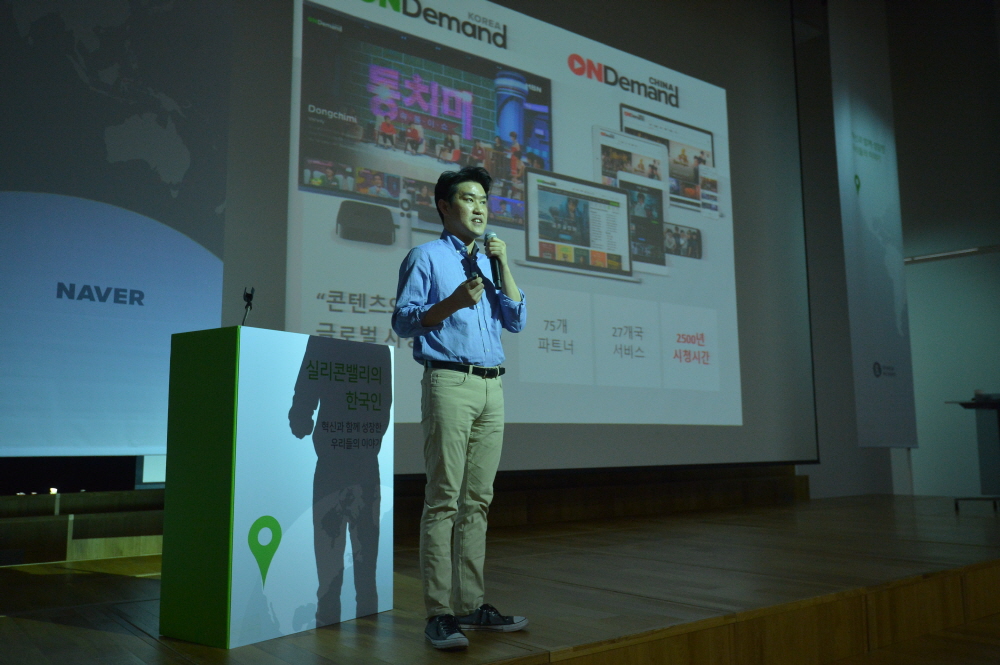
He would later tell prospective founders to let other people hear their ideas. Feedback creates opportunities to find someone interested enough to join the conversation. The advice has a pleasing lack of ceremony. A young business can spend a great deal of time protecting an idea that would improve substantially if exposed to a few sensible objections.
The sea-turtle metaphor belongs to that same account of beginning before certainty arrives. In Cha’s telling, a team matters because solving one problem tends to introduce another. The practical question is which people will work through the next difficulty together. A streaming service may present a single play button to its customer; the organisation behind it needs rather more than one skill.
“Seven years of entrepreneurship have been like a marathon.”
Young Joon Cha, April 2019
Translated from Korean
A catalogue with more than one appetite
By December 2016, Cha was discussing another gap in the menu. OnDemandKorea had offered drama and variety programmes, but viewers who wanted other kinds of material were being left out. An agreement bringing EBS content to the service made room for documentaries and educational programming. The additions included travel series, English-learning material and children’s shows.
That is a revealing decision for a founder associated with Korean entertainment. An audience assembled around a language does not acquire a single taste. Some evenings call for a drama; others call for a documentary. Children need a different menu again. Treating all of those viewers as people with particular interests makes the catalogue more useful than treating them as one convenient demographic.
Cha’s wider ambition also concerns community. In a later interview, he described media as a way to connect people with shared interests. Legal access remains part of the proposition, alongside the possibility that audiences and content businesses can grow together. Distribution, viewed this way, involves a continuing relationship rather than the isolated transaction of delivering one episode.
A schematic of the company’s work, not a measure of performance.
The remote control gets a vote
A viewer’s language is one consideration. The device in front of them is another. In February 2023, Cha explained that OnDemandKorea’s analysis of viewing by device showed substantial demand for larger television screens. The company developed apps accordingly, expanding access across major smart-TV platforms. Its Roku app had arrived in 2018; subsequent releases and updates broadened the living-room options.
This kind of decision offers a particularly clear view of an operator’s job. A customer may like the programmes and still dislike the process of reaching them. A service that works well on a laptop can feel cumbersome on a television. The remote control is a stern little editor: it removes much of the patience people bring to a keyboard.
Cha had also pursued access through commercial partnerships. In 2020, ODK’s collaboration with Bango was designed to allow mobile operators to bundle its subscriptions with phone plans or offer them as additions. The announcement covered Korean and Chinese programming for people living outside those countries. Billing and integration entered the story because they could make the service easier to obtain.
Taken together, these decisions suggest a consistent concern with the steps surrounding a programme. Where will someone watch? How will they subscribe? Which screen will feel natural? They are ordinary questions. Their answers determine whether a promising catalogue becomes part of an ordinary evening.
A ticket out of the screen
In July 2024, OnDemandKorea announced a partnership with the travel company PRTour. The arrangement offered OnDemandKorea members a five-percent discount across the travel company’s products. It formed part of ODK’s partners programme, extending the relationship with viewers into another area of Korean American life.
The link has an obvious attraction: programmes can make people curious about places, and travel gives that curiosity somewhere to go. The announced benefit was concrete enough to explain without a manifesto. Members received a discount. The arrangement gave an established audience another reason to stay connected, through a benefit that reached beyond its evening viewing routine.
ODK had also begun making room for stories from the community itself. In 2022, OnDemandKorea invited Korean American writers, directors and actors to contribute to a planned short-comedy series. The proposed episodes would run about ten minutes and draw on situations and anecdotes familiar to Korean Americans. The invitation placed local experience alongside the imported programmes in the company’s editorial interests.
A wider map of evening television
In September 2024, ODK launched Amasian TV, a free service bringing together pan-Asian entertainment for North and South America. Its programming extended across several countries and genres. OnDemandKorea, OnDemandChina and OnDemandViet already offered distinct ways into the company’s catalogue. Amasian introduced a broader point of entry for viewers willing to explore across those boundaries.
The platform also included a start-over function for live broadcasts. A scheduled channel asks viewers to arrive at the right time. Letting them restart acknowledges that the audience has its own schedule. It is a small feature with a recognisable purpose: someone who arrives late still has a chance to see the beginning.
The distribution map widened again in 2025. ODK announced new channels on Plex, including anime, Asian films, K-pop and Korean professional baseball. The baseball channel featured real-time English dubbing, developed through work involving LG Uplus and GAD Sports. A game crossing a border needs its commentary to travel, too. The picture supplies the action; language helps supply the occasion.
An October announcement added six live channels to Sling Freestream, including three Vietnamese genre channels alongside Asian entertainment and Korean baseball. These developments describe a business reaching viewers through other services as well as its own. Cha’s founding concern with the journey between content and audience now operated through a larger collection of doors.
A room key, a remote, another beginning
In April 2026, ODK announced plans to put Amasian TV on approximately 250,000 hotel television units in the United States. The service offered free viewing without a login. For a guest using a shared television, that removes a familiar chore: deciding whether to enter personal credentials into a screen they will leave behind tomorrow.
U.S. hotel TV units planned for the Amasian rollout announced in April 2026.
Announced distribution scale, not a verified count of active viewers.The company moved its headquarters to Irvine in July 2026, with plans to keep investing in discovery, advertising and distribution technology. Cha’s business had travelled some distance from Boston. Its services had moved beyond a single national catalogue and beyond the assumption that viewing always happened at home.
Yet the hotel announcement brings the career back to a modest starting question. Someone is away from home. There is a screen in the room. What would make it easier to watch something they want? Cha’s original conviction about Korean television has acquired more partners, more programmes and more settings. The distance still needs crossing. The turtle has kept moving.