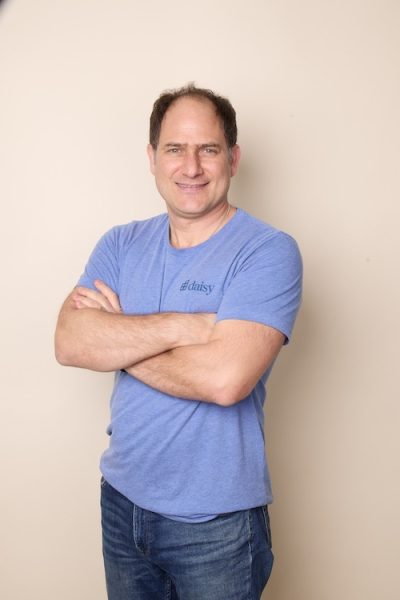
A founder who keeps picking the messy industries
Most people who exit a startup to Vimeo go find something glamorous next. Yotam Cohen went to a co-op board meeting.
Today Cohen runs Daisy, a property management company built for condos, co-ops, and homeowner associations - the kind of buildings most technologists never think about twice. It manages more than 100 buildings across New York and New Jersey, and city data has repeatedly placed it among the fastest-growing management companies in the region. That is a strange sentence to write about a proptech startup, because property management is the opposite of a hot category. Which is precisely why he chose it.
Daisy's pitch is not that buildings need an app. It is that buildings need to be run like living systems - with humans who care and software that remembers. Cohen pairs a dedicated team that fields resident requests with an operations layer that routes work to the right people and an AI layer that quietly clears the repetitive load. Two of Daisy's busiest team members, Steven and Lily, are AI agents; between them they resolve roughly a fifth of incoming resident requests before a person ever touches them.
While we're living in 2021, property management is living in a time-warp. Our approach brings property management to an entirely new level.- Yotam Cohen, at Daisy's NYC launch
The word he returns to is transparency. In the old model, he argues, a single property manager holds an entire building in their head - the vendors, the quirks, the history, the grudges. Cohen calls this the gatekeeper problem. When that person leaves, the building's memory walks out the door with them. Daisy's answer is unglamorous and total: put the building in a system, not a skull, and let residents and board members see what is actually happening.
Better amenities, worse neighbors
The idea for Daisy did not arrive in a pitch deck. It arrived in an apartment. Cohen had lived in a modest building where the neighbors were friends - people who grabbed groceries for each other and shared a genuine sense of community. Then he upgraded. Newer building, more amenities, more of everything. And it was worse. Things broke constantly. Neighbors fought. Nobody talked.
That contradiction gnawed at him. The nicer building was, by every material measure, better - and it felt like less of a home. So he did the responsible, slightly masochistic thing: he joined the board to fix it. What he found was not a one-building problem. It was an entire industry running on outdated practices, manual processes, and a near-total absence of transparency.
If you don't communicate then there is no trust.- Yotam Cohen
He teamed up with co-founder Nir Hemed, and the two asked a question that sounds obvious only after someone says it out loud: why are our homes - the single most important thing most people ever own - managed with so little care for the people who live in them? Daisy is the long-form answer. Its first building was signed in SoHo. The second was signed in Hell's Kitchen the very next day. When an industry is broken from the ground up, showing up with a better way feels less like selling and more like relief.
From the navy to Vimeo to your boiler room
The patience is the strategy
There is a tell in how Daisy onboards a building. The industry standard is 30 days. Cohen doubles it to 60 - on purpose. He believes the fastest way to lose a building's trust forever is to rush the first month. Going slow at the start is how you earn the right to go fast for years. It is the kind of counterintuitive discipline you develop after building one company across four cities and learning where speed actually helps and where it quietly burns things down.
Ask him what he is drawn to and the answer is not real estate. It is friction. "I've always been drawn to building things from the ground up," he has said, "not just companies, but teams and cultures that can take on big, messy industries." Property management, by his own estimate a roughly $130 billion market, is about as big and messy as they come.
Parents who never met
Cohen likes to tell the story of a Daisy building event where parents who had lived floors apart for years finally introduced themselves - and started spending time together. He tells it more often than the funding numbers.
The bots have names
Daisy's AI agents are not "Bot 1" and "Bot 2." They are Steven and Lily. The naming is the point: automation in service of feeling supported, not processed.
Four cities, one instinct
Wibbitz spanned New York, Tel Aviv, Paris, and London before its Vimeo exit. The throughline to Daisy isn't the industry - it's a taste for systems everyone else avoids.
2027, 2028, 2030
The plan is deliberately staged: roughly 10 new states in 2027, national by the end of 2028, global by 2030. Ambition, but on a timeline.
Community as a product
The easy version of Daisy is a maintenance-ticket startup. The real version is stranger and more interesting. Cohen keeps insisting that how a building is run shapes whether it feels like a home - whether neighbors become friends or strangers who happen to share a mailroom. That is not a feature you can put in a spec sheet, but it is the thing he is actually building toward. The leaky faucet gets fixed faster; that is table stakes. The quieter goal is trust, restored between people who live thirty feet apart.
It also has teeth in the present. With Local Law 97 forcing New York buildings to cut emissions or pay penalties, Daisy launched Carbon Curve, an AI tool aimed at helping hundreds of thousands of New Yorkers understand and meet the requirements. It is a neat encapsulation of the whole company: a genuinely tedious, high-stakes problem, met with software and a straight face. Property management, it turns out, is where the boring and the enormous overlap - and Cohen has decided to live right on that seam.
We've rethought property management from the ground up so that buildings run better, people feel more connected.- Yotam Cohen