Three companies, one obsession: building communities. From a Boston startup blog to a platform that decides whether an office building feels worth showing up to.
In the fifth grade, Chase Garbarino bought Pogs at wholesale prices and sold them to his classmates. He was less interested in flipping the little cardboard discs in the schoolyard game than in flipping them for a margin. The instinct arrived early and never really left. Both his father and grandfather were entrepreneurs, and the family business legacy gave him a way of seeing the world before he had the words for it.
That way of seeing carried him to Hamilton College, where he studied economics from 2003 to 2007 and co-founded the school's Entrepreneurship club. Around the same time he launched CampusWord, an online publication that let college students write and share their views. It was a small thing, but it contained the seed of everything that followed: give a community a place to gather, and see what grows.
In 2008, with co-founder Kevin McCarthy, he started BostInno, a scrappy blog covering Boston's startup scene. It grew into Streetwise Media, then AmericanInno, a network of local innovation-news sites spanning more than a dozen U.S. cities. Garbarino was the co-founder and CEO. In 2012, American City Business Journals, a subsidiary of Advance Publications, bought the company. He had built a media business by covering builders, and then sold it.
Most founders would have stayed in the lane they knew. Garbarino did the opposite. He founded VentureApp, a software company making communication tools for business communities, and from that effort came the pivot that would define his career. He turned toward the oldest, least glamorous asset class in the economy: commercial real estate.
The company became HqO, which Garbarino co-founded and now runs as CEO. The premise sounds simple and is not: treat an office building the way a software company treats a product. Measure how people actually use it. Give tenants an app, a set of services, a reason to walk in the door. Then give landlords the data to prove it is working.
That premise landed at exactly the right moment. When remote work emptied out offices, the buildings that survived were the ones that could compete for people rather than assume them. HqO now serves more than 60 commercial real estate clients and touches 160 million square feet across 300+ buildings in Boston, New York, Miami, Toronto, London and beyond. The company has raised more than $160 million, including a Series D.
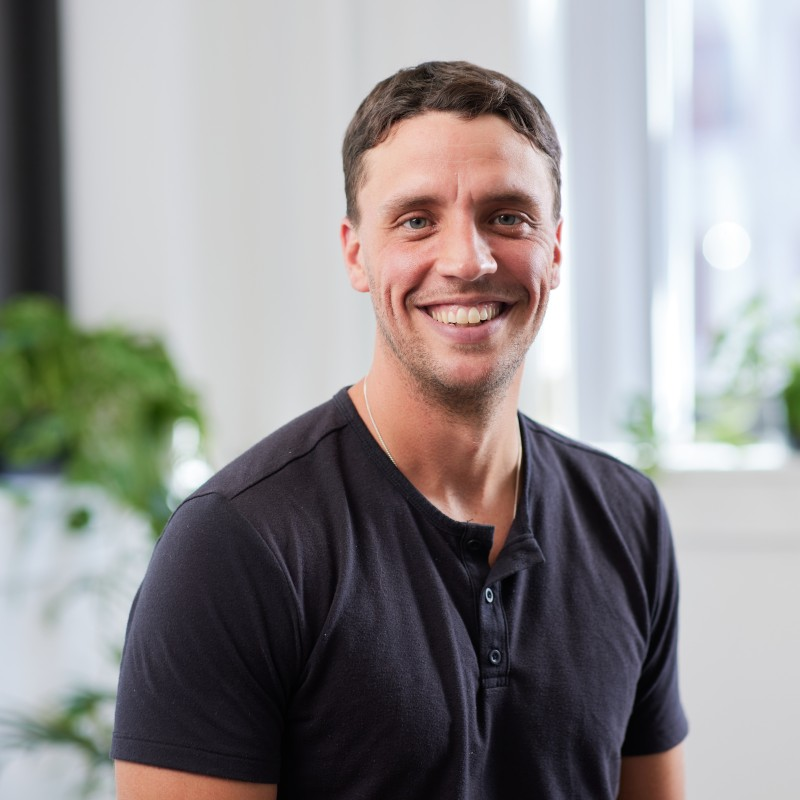
"For the first time in the history of the commercial real estate industry, prioritising the end-user experience within workspaces is not merely a choice, it is critical for future success."
Garbarino's argument about the modern office is blunt. "Lease terms are compressing. Tenant optionality is real. Presence is a choice, not a lease obligation," he says. The old model assumed people would show up because their name was on the lease. That assumption is gone.
His answer is measurement. HqO built a benchmarking system, the REX Score, to quantify how a building performs as an experience, not just as square footage. "With office occupancy at an unprecedented low and the competition for top talent reaching new heights, maintaining a strong REX Score will provide a competitive edge in this rapidly evolving market," he has said.
What he keeps returning to, though, is people. "Engaging with people in real life humanizes us. The future of our cities and workplaces are inextricably linked." For someone who sells software, it is a notably human bet: that the point of a building is the connection that happens inside it.
Figures reported publicly by HqO; bars scaled for illustration.
Every venture in Garbarino's career comes back to one word: community. The medium changes from college publishing to local news to the workplace. The mission does not.
He is candid that turning a media company into a proptech platform meant learning to communicate a pivot to investors - a subject he has spoken about openly in interviews.
Garbarino has said he organizes his life around four principles, influenced by Don Miguel Ruiz's The Four Agreements. They double as a management philosophy.
"The workplace of the future is all about empowering people to do their best work."
At 22, Chase and his co-founders showed up to a VC pitch in identical button-downs and khakis. The investors thought they were being mocked. The pitch failed - a lesson that stuck.
Both his father and grandfather were entrepreneurs. He considers his father an informal lifetime coach who taught through stories and example.
An avid Boston sports fan and a runner. He also writes a personal Substack at chasegarbarino.com.
"The smart operators are really developing a methodology for catering to different personas and stakeholders within the customer segment."