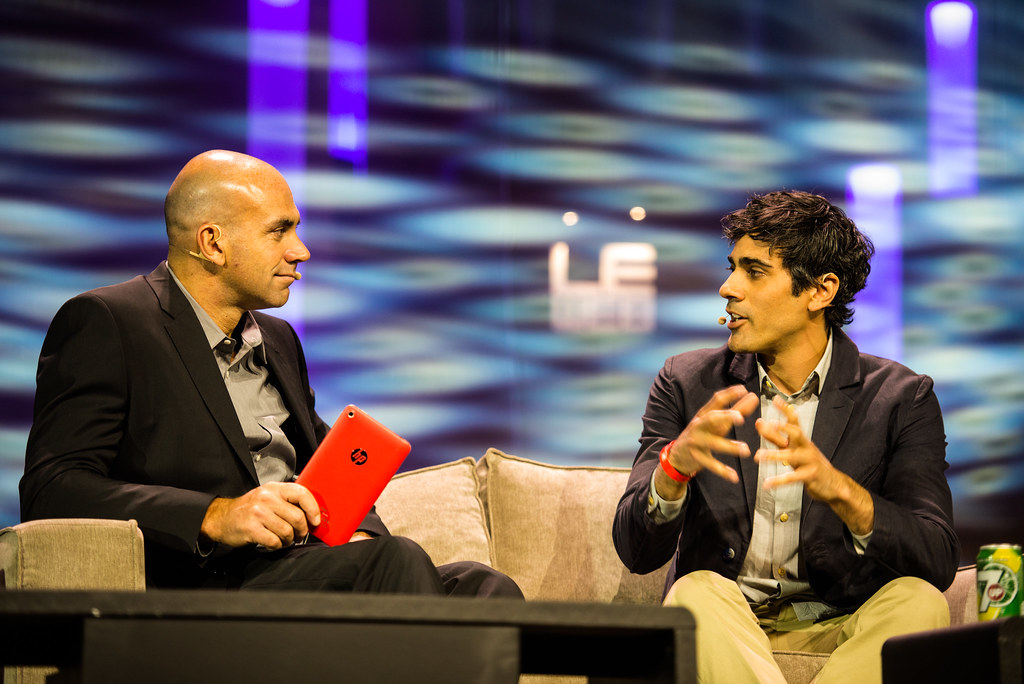
The curious thing about Yelp’s first users was that they would not wait for a question. Jeremy Stoppelman and Russel Simmons had built a service for asking friends to recommend local businesses. Buried inside it was another option: write a review. People who discovered it sometimes wrote five, ten, fifteen in a sitting. The founders had designed a request system. Their users were volunteering a newspaper column.
The story in three bites
- The surprise: services advertising brought in $948 million in 2025, more than twice restaurants, retail and other advertising combined.
- The engine: free consumer discovery attracts businesses willing to pay for attention.
- The next sale: software that answers, qualifies and books the customer who arrives.
01 / AN UNINVITED OPINIONThe feature nobody asked for
Yelp launched in 2004. Its email recommendation concept struggled. The email workflow was too complicated, Stoppelman later recalled. The unsolicited reviews supplied a clue; by early 2005, the founders had changed direction. The discovery was behavioral: people enjoyed describing their experiences even when nobody had requested a recommendation.
The early experiment had financial limits. Max Levchin supplied $1 million in angel funding. In an October 2005 investment memo, Bessemer’s Jeremy Levine reported that the founders had spent less than half of it. He proposed investing $5 million at a $13 million valuation before the new money. The business model still carried risk. An enthusiastic community was evidence of demand, rather than proof that advertisers would pay.
02 / THE MONEY TRAILFollow the pipe, follow the money
Ask someone what Yelp does and dinner will probably enter the conversation. Open its accounts and another cast appears: plumbers, mechanics, roofers and other service professionals. Services advertising produced $947.6 million in 2025. Restaurants, retail and other advertising generated $443.7 million. The familiar restaurant guide has become a customer-acquisition business for tradespeople.
services advertising.
Consumers browse reviews, photos and business details free. Owners can claim a page free, then buy advertising, primarily priced per click. Yelp also sells software and licenses data, and earns money through transaction arrangements. The customer buys a chance to be considered when somebody nearby is ready to spend. That moment can be valuable whether the purchase is tacos or a replacement water heater.
Google Maps is the broad alternative. Angi and Thumbtack compete for service projects; Tripadvisor covers travel-related decisions. Yelp combines its review archive with quote requests and transaction tools. By the end of 2025, it had accumulated 330 million reviews. That history gives a shopper something more specific than an address: other people’s descriptions of what happened after they walked in.
03 / AFTER THE CLICKThe expensive part is what happens next
Finding a business leaves plenty unfinished. Someone must answer the inquiry, understand the problem and arrange the appointment. Yelp’s current product strategy follows those loose ends. Request a Quote connects consumers with service professionals. Guest Manager handles restaurant reservations and waitlists. Yelp Assistant adds a conversational route through discovery and, where integrations support it, booking.
For a consumer, the useful approach is specific: describe the project, compare recent accounts of similar work and confirm availability. For an owner, claiming the page and keeping services, hours and photos current creates a starting point before buying anything. An ad can bring someone to the page; the information there still has to answer the questions that brought them.
In February 2026, Yelp completed its purchase of Hatch, an AI communication platform for service businesses. The terms were approximately $270 million in cash, plus $30 million in employee retention packages. Hatch engages customers through text messages, email and voice. Buying it moves Yelp further into the merchant’s working day, where a lead can easily disappear between an inquiry and a response.
Restaurant call handling.
$199 for Guest Manager customers.
Eligible service businesses.
Announced for November 2026.
Restaurant owners have a related problem. Yelp Host answers calls, handles reservations and takes pickup orders. In July, Yelp said it had passed one million calls. Its starting price was $249 monthly, or $199 for Guest Manager customers. An OpenTable integration also makes the competitive picture pleasingly untidy: the reservation alternative can be a partner inside Yelp’s product.
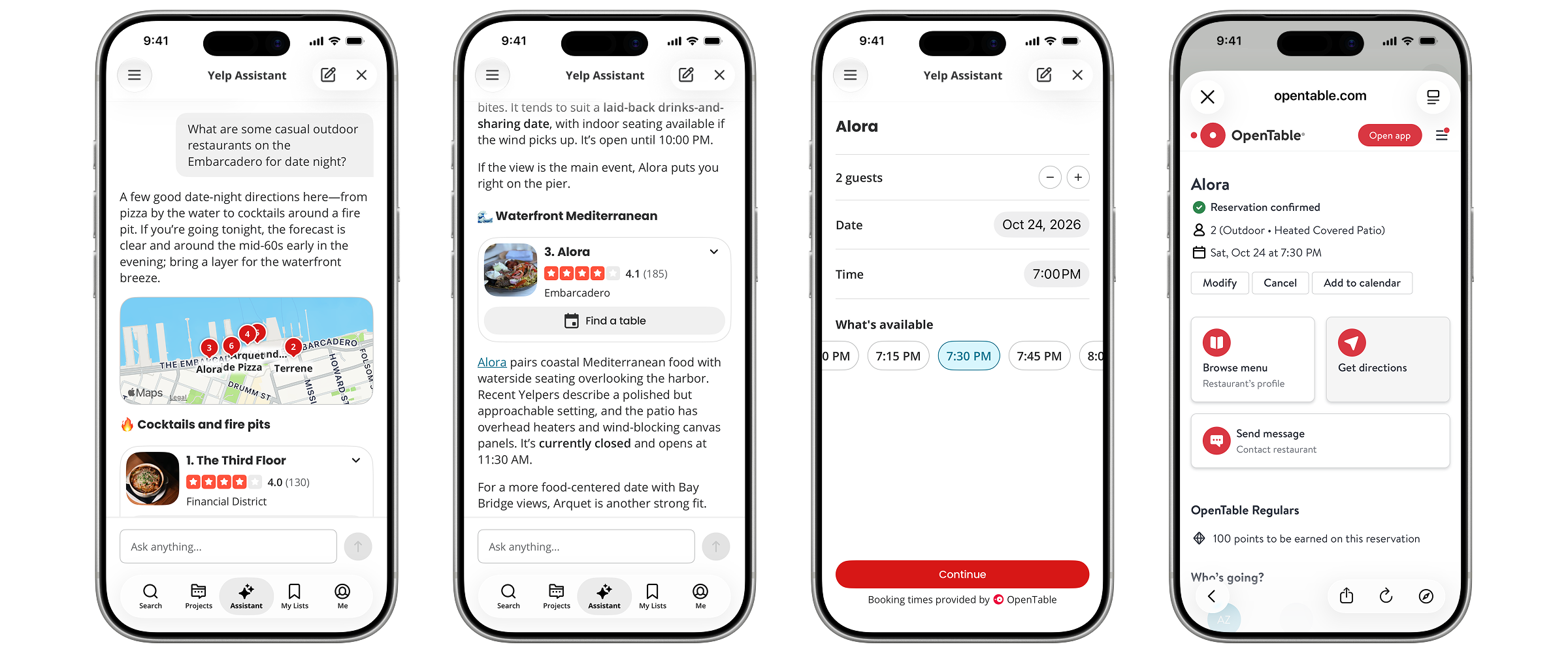
The October 20 release carries that logic further. Smart Lead Reply is due in November at $30 monthly for eligible service businesses. Check for Me, planned for eligible U.S. iOS restaurant pages in coming months, will call for a wait-time estimate and text it back. These are announced rollouts, not universal capabilities. Availability still depends on the business, integration and device.
04 / THE TRUST PROBLEMA star needs a bouncer
A review platform faces an awkward incentive: the businesses being judged also buy the advertising. Yelp says ad spending cannot influence its automated recommendation software. Only recommended reviews count toward a business’s displayed rating. The distinction matters because a collection of opinions becomes useful only when readers believe somebody is keeping the obvious nonsense out.
“It was just a little bit too complicated.”
JEREMY STOPPELMAN / ON YELP’S FIRST PRODUCT / 2014
The maintenance is considerable. Yelp says its systems filtered nearly half a million suspected AI-generated reviews in 2025. Of roughly 22 million reviews contributed that year, about 70% were recommended. Its policy requires firsthand experience and prohibits third-party AI-written reviews. The same company adopting AI to help readers navigate opinions is trying to keep generated opinions out of the pile.
05 / A USEFUL THING TO STEALCopy the observation, then count the jobs
Yelp changed its own working habits, too. It adopted fully remote work in 2022, with digital meetings and regular in-person gatherings supporting its distributed workforce.
The founder’s lesson is practical: look for work customers volunteer to do, then remove the obstacles around it. Yelp’s users revealed the product before the founders had fully recognized it. Today’s equivalent test sits with business owners. A fast automated reply matters when it helps produce a suitable appointment. Counting messages alone would miss the point.
There are limits. Sparse local reviews weaken the choice. Stale business information can spoil the handoff. Advertising can disappoint when the margin on a job cannot cover acquisition costs, or nobody follows up. Those are reasons to measure booked work and customer experience alongside clicks. Yelp’s next act will be judged in ordinary places: a restaurant doorway, a mechanic’s calendar, the kitchen where the pipe finally stops leaking.