A printing press between jobs is an expensive piece of furniture. It takes up space, ties up capital and waits for someone to give it something to do. Yasukane Matsumoto saw a business in that waiting. Years later, he would find another version of the same problem inside the modern office: applications, accounts and subscriptions that companies had acquired faster than they could keep track of them.
Printing and software make an odd pair. One smells of ink; the other sends renewal notices. Matsumoto’s route between them runs through a recurring question: could the machinery of business work better if someone changed the arrangement? His companies have tackled the answer at different scales, from an individual print order to an international IT department.
The trouble with a useful introduction
He founded RAKSUL in September 2009, after working at A.T. Kearney. Consulting had put him close to companies examining their expenses. Printing stood out as an area where costs could fall substantially. An established industry, a large number of suppliers and an awkward buying process offered plenty to investigate.
The first approach was comparison. Collect printing prices, put them online and help buyers find a supplier. The printing comparison site launched in April 2010. It was a plausible internet business, and people came to use it. Yet a busy website could still produce unhappy transactions.
Customers complained about printers’ service. Printers complained about customers who failed to pay. A directory could introduce the parties without making either one behave. Matsumoto’s answer was to take more responsibility: RAKSUL would sell the service, handle payment and stand behind quality. The company moved from matching businesses toward managing the transaction.
The distinction matters. A restaurant owner ordering flyers needs the right flyers to arrive, rather than a fascinating list of people who might print them. RAKSUL’s printing e-commerce service launched in 2013. Behind the online order sat a network of printing capacity; the customer did not need to negotiate that network personally.
Simplified business model. The opportunity sits in the gap between owning a machine and keeping it busy.
Before the presses, a student contest
Matsumoto was born in Toyama Prefecture in 1984. His parents and relatives worked in public service. Tokyo appealed to him, and he went to Keio University. The experience he later singled out as an entrepreneurial beginning happened in a student organization, well before there was a printing company to run.
The group wanted to organize a business contest involving students from Japan, China and South Korea. It had an intention before it had much of anything else: no substantial budget, no established cross-border network and no reassuring record of having done it before. Over roughly a year, the students made the event happen.
That supplied a useful memory. People had explained why the project would be difficult; doing the work revealed what was possible. For Matsumoto, the pleasure of bringing something into existence became a reference point for later decisions. A student contest is a modest credential beside a stock-market listing. It is also a rather good place to discover whether you enjoy persuading people to try.
He graduated from Keio’s Faculty of Business and Commerce in 2008 and joined A.T. Kearney. He liked thinking through problems. Consulting gave that inclination a discipline: separate facts from hypotheses, identify what could have the greatest effect and work through the details. Printing provided a problem on which to test those habits outside a client presentation.
Fifty conversations, and room to change
Early RAKSUL operated from his home, with a handful of people helping at weekends. Matsumoto spoke to roughly 50 printing companies. Some had heard promises about internet services before. Their doubts interested him: a problem others had struggled to solve was still a problem available to work on.
Enthusiasm did not make him an accomplished manager immediately. He later acknowledged expecting colleagues to share his perspective and failing to set suitable individual goals. People left. The distance between a business plan and a working business could be punishing, even when everyone was putting in effort.
His later account of leadership placed more emphasis on giving people a vision they could feel excited about. There is a change in scale there: the founder’s own appetite for a difficult project becomes insufficient. Other people need a reason to invest their effort, and enough room to contribute in their own way.
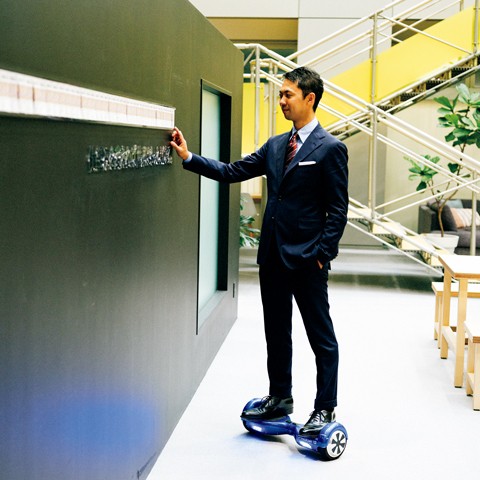
There are lighter clues to his tastes. In 2016, he named contemporary art and travel among his interests, and singled out interiors and spatial design as things he cared about. Thomas Friedman’s The World Is Flat was a memorable book; his chosen motto was “Follow your heart and intuition”. Even an entrepreneur preoccupied with utilization rates is allowed a preference for how a room feels.
A company that could outgrow its first job
The printing model became a starting point for other businesses. Hacobell launched in 2015, applying online coordination to logistics. Novasell brought the group into television advertising. The common thread was the effort to reorganize established commercial processes, with technology taking on work previously handled through fragmented arrangements.
RAKSUL listed on the Tokyo Stock Exchange’s Mothers market in 2018 and moved to the First Section in 2019. The milestones were public and measurable. A less visible task was deciding which habits a larger organization should preserve.
Matsumoto emphasized firsthand observation. RAKSUL’s code of conduct calls it “Reality”: understand what is happening on the ground, experiment and set priorities from what the team learns. That language fits a founder whose early comparison business changed because the people using it kept encountering problems. A neat diagram of a market cannot tell you everything about a late delivery.
In August 2023, Yo Nagami, who had joined as CFO in 2014, succeeded him as CEO. Matsumoto became chairman. He described the transition as the beginning of a third chapter. The founder would remain involved while another leader carried responsibility for the group’s next stage.
- 2009Found RAKSUL
- 2018Take it public
- 2023Hand over the CEO role
- 2026Participate in taking it private
The next idle asset fits in a browser
Meanwhile, another ordinary business task had caught his attention. Matsumoto tried setting up a computer himself and found the process more laborious than expected. The experience gave him a fresh appreciation of IT teams and the specialized work concealed inside apparently simple requests.
Josys addressed that administrative layer: the people, devices and applications that a company needs to understand and manage together. Who has an account? Which permissions belong to that person? What happens when someone joins or leaves? Individually, these are small questions. Across an organization, they become a substantial body of work.
Development began in India. By the service’s September 2021 launch, the team numbered about 15. Josys became a separate company in 2022, with Matsumoto as CEO. He called its role “Glue for IT”, a deliberately workmanlike description for software intended to connect other software and make administration manageable.
The ambition extended across borders. Today, Josys reports operations in more than 40 countries and a team of over 300 people across eight countries. The second business has travelled some distance from its initial development group.
“The biggest challenge we face right now is unification.”YASUKANE MATSUMOTO · 2025
The difficult part of working everywhere
International expansion brings its own untidy processes. Sales teams can develop one approach in Japan and another in the United States. Customer support can diverge again elsewhere. Matsumoto has identified unifying those operations as a central challenge, with common practices that still allow for local differences.
He has also written about annual leadership offsites as a way for colleagues to know one another beyond video calls. Shared context and trust require attention, even inside a company selling technology that makes work easier. The people still have to understand what their colleagues mean.
His interest in the organization extends to who benefits from its work. In 2022, he argued for better rewards for people creating value, including company stock. He also treated diversity as something a startup should address early, when the organization is still taking shape. These are practical positions about the distribution of opportunity inside the systems he builds.
By 2025, he was discussing a further shift toward AI agents operating software. His ambition for Josys included automating more of the work between an interface and a database. The idea remained connected to the administrative burden that had interested him in the first place: too much necessary work, done one account at a time.
Through the stock-market door, twice
RAKSUL’s next turn arrived in 2026. Following a management buyout involving Nagami, Matsumoto and Goldman Sachs, the company delisted from the Tokyo Stock Exchange Prime Market on May 29. The founder who had helped take it public was participating in taking it private.
After the tender offer completed, he said he would reinvest and remain involved in management as a founder and board member. His main operating commitment remained Josys. In explaining the transaction, he emphasized building a business for the coming decade, with less exposure to short-term market pressures.
That leaves a career with several kinds of work still visible: starting a company, making its first model useful, learning to lead people, handing over responsibility and beginning again elsewhere. The industries supply different props. A printing press waits for an order. A software account waits for someone to notice it. Matsumoto keeps paying attention to what happens in the meantime.
Keep following the work
Companies, personal writing and conversations.