An idle printing press is an expensive piece of furniture. It occupies space, ties up capital and earns nothing between jobs. RAKSUL built its opening around those empty hours: bring orders from the internet to machines that somebody else had already bought. The proposition had an appealing lack of glamour. Japan did not need another printing press nearly as much as it needed a simpler way to buy what those presses could produce.
That idea now sits inside a much larger company. RAKSUL reported ¥61.95 billion in consolidated revenue for the year ended July 2025. Its storefront reaches from business cards and flyers to packaging and promotional goods. Other services handle advertising, purchasing and websites. In May 2026, a management buyout took it off the Tokyo Stock Exchange. The company that made printing easier is trying to become a regular stop for running a business.
The website could find a printer. Then what?
Founder Yasukane Matsumoto established RAKSUL in 2009. Its early offering let visitors look up printing companies and compare prices. A 2021 interview described a site attracting more than a million monthly unique visitors. Traffic, however, was only part of the job. A customer still needed to place an order, settle payment and trust that the finished product would arrive correctly.
The consequential change came in 2013, when RAKSUL launched its printing marketplace. It accepted orders and matched them with production partners, taking responsibility for service quality, settlement and support. The early limitation was the handoff between discovery and purchase. Calling the comparison site a commercial disaster would overstate the evidence. What changed was the scope of the problem Matsumoto wanted the company to own.
That distinction matters to anyone copying the idea. A directory can help a buyer find a supplier. An ordering platform has to make the relationship work. Once RAKSUL put its name on the transaction, a production mistake became its customer-service problem. The convenient front door required a considerable amount of work behind it.
specifications
RAKSUL
network
delivered
One customer relationship. Several operational handoffs.
The flyer is cheap. Your afternoon is valuable.
The useful way to understand the customer is to picture the work: a shop preparing a promotion, a tutoring business ordering leaflets, or an office replacing business cards. These are illustrative buyers, but the tasks are the ones RAKSUL serves. Most are trying to get something done without becoming experts in paper stocks, printing specifications or supplier negotiations.
A customer selects a product, specification, quantity and dispatch schedule. Those choices determine the quote. RAKSUL’s pricing guide says paper and printing are included in the displayed price, with delivery to one location generally included except for business cards. Extras matter: some operator-checked file submissions cost ¥330, while an optional priority data check is normally ¥506, or ¥1,100 for booklets. These are published guide prices, not a universal printing tariff.
There is no honest single answer to “What does RAKSUL cost?” A thousand flyers and a thousand booklets are different manufacturing jobs. Buyers should compare identical paper, color, finishing and delivery requirements, then check the final checkout amount. A dispatch date also deserves careful reading: leaving the production facility and reaching the customer are different events.
The catalog extends beyond paper. Apparel, customized merchandise, boxes, bags and seals give businesses several reasons to return. Newspaper inserts and leaflet distribution address what happens after printing. For a small operator, the attractive part is the possibility of buying the promotion as a sequence of connected tasks, rather than collecting a pile of finished leaflets and wondering where to send them.
It earns the spread, and carries the coordination
RAKSUL is often described as a sharing-economy company. That captures the original use of spare capacity, but says little about the bill. In the core commerce business, customers buy products and RAKSUL incurs procurement and production costs. The difference supports gross profit, from which it must fund operations and overhead. Advertising and software add other revenue streams. Treating the entire group as a simple commission-taking marketplace misses those differences.
Its early appeal was avoiding the need to build a nationwide factory network from scratch. That did not make expansion free. Reported fundraising included a $14.3 million Series B in 2014, a $33.7 million Series C in 2015 and approximately $20 million in 2016. Backers across those rounds included Global Brain, GMO Venture Partners, corporate investors and financial institutions. The round amounts measure financing, not a disclosed total cost of building the business.
Marketing was part of the expense. RAKSUL began television advertising in 2014, and its integrated reporting identifies extensive marketing investment as part of its growth. That experience also helped inform Novasell, launched as a television-advertising platform in 2020. Buying attention for its own storefront became a reason to offer advertising services and measurement to other businesses.
Consolidated revenue · ¥ billions
Fiscal years ended July 31. Reported revenue includes changes in the group’s business mix and acquisitions; this is not an organic-growth chart.
The asset-light company started buying assets
Here is where the tidy startup story gets untidy. RAKSUL later acquired production businesses, including RAKSUL Factory in 2023 and NETSQUARE in 2024. Its corporate history records NETSQUARE’s absorption into the company in August 2026. The original partner-capacity model remains central to understanding RAKSUL, but “it owns no factories” has become a poor description of the group.
Other acquisitions followed the shopping basket. Danball One brought cardboard boxes and packaging. AmidA, acquired in 2023, brought the business behind Hankoya.com, the online seal-and-stamp seller. These purchases connect RAKSUL to products a business needs alongside printed promotions. A company stamp may look quaint beside marketing analytics, but both can belong on the same owner’s to-do list.
Ownership was not the answer in every category. Hacobell, the logistics business launched in 2015, became a joint venture with Seino Holdings in August 2022. The stated rationale combined RAKSUL’s technology and operations with Seino’s logistics relationships and experience. The FY2022 presentation also showed a ¥128 million non-GAAP EBITDA loss in Hacobell. That figure does not prove why the deal happened, but it prevents the expansion story from becoming a frictionless march.
The same presentation described pressure on Novasell from changes in startup clients’ financing environment and a shift in customer mix. Software cannot make an advertiser’s budget immune to tighter funding. RAKSUL’s own reporting later described a move toward businesses closer to its printing core, where shared customers and payments could make expansion more productive.
Ten thousand companies buy fewer loose ends
RAKSUL Enterprise shows how a product can grow around administrative irritation. Launched in October 2021, the service passed 10,000 adopting companies by May 2026. It adds order and invoice management, approval workflows, shared designs and dedicated ordering sites. These features address a familiar corporate mess: different branches buying similar materials through different processes, with little central control.
The company’s announcement names customers including Meiko Network Japan, insurance retailer Hoken Minaoshi Honpo, education company Conoceru and Repro. Their described uses range from consistent promotional materials to direct-mail marketing and visibility into print spending. The value is partly the physical product and partly the work that no longer has to be reconstructed in email.
Scale needs its labels. RAKSUL’s printing platform crossed three million cumulative member registrations in February 2025. Its July 2026 strategy referred to approximately 480,000 customer companies. Those are separate measures, and neither should be silently converted into active paying users. For a prospective customer, the more useful question is whether the service solves the particular ordering problem sitting on the desk.
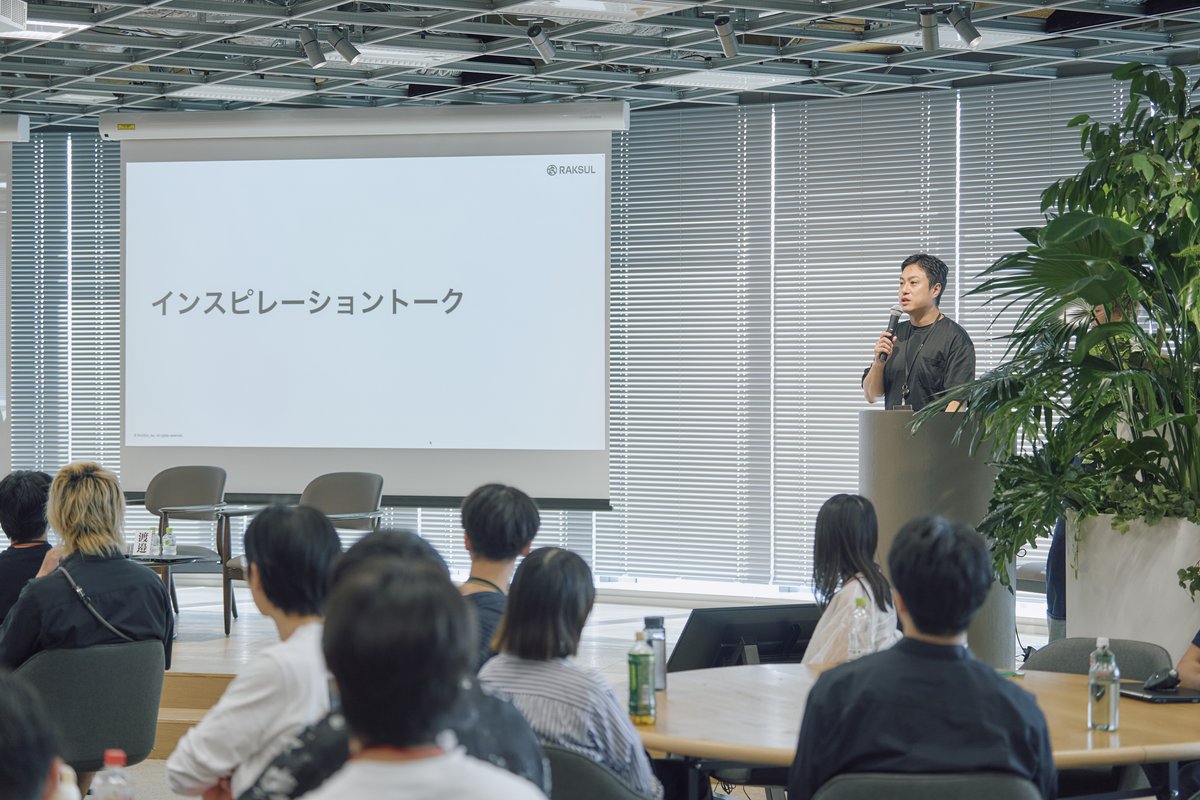
A culture with an operational vocabulary
RAKSUL calls its behavioral guidelines Reality, System, Transparency and Team First. The language fits a business where the gap between an attractive website and a correctly delivered order contains many opportunities for trouble. Its published onboarding program, Key Vision Live, puts new employees in discussions with management about the business and its working habits.
“It’s a trust-first culture here at Raksul.”Yasukane Matsumoto · 2021 interview
That is the founder’s description, rather than an independent employee verdict. The company also publishes learning support and flexible-work programs. Its FY2025 recruiting figures counted 1,227 people across the specified group and overseas development operations, including several employment types. The small founding team has become an organization with a much larger coordination job of its own.
After the buyout, a larger shopping list
The 2026 buyout supplied another reminder that plans have prices. The tender offer was raised from ¥1,710 to ¥1,900 per share in February. RAKSUL subsequently delisted in May. In July, management presented the move to private ownership as a way to sustain longer-term investment in connected services without short-term earnings pressure determining every decision.
The resulting strategy groups customer needs into growing sales, reducing costs and securing funds. Business Mall had already launched in September 2025 with more than 600,000 items. An October 2025 Canva partnership aimed to connect design with printing, websites and marketing. July 2026 announcements added expanded website options and plans for further lending, corporate-card and invoicing services through RAKSUL Bank. Announced financial services should be read as plans, not automatically as fully available products.
There are credible alternatives throughout this shopping list. Printpac, Graphic and local printers compete for print orders; specialist suppliers and agencies serve other categories. RAKSUL’s argument is the convenience of connecting jobs and purchasing relationships. It cannot assume that every customer who likes its flyers wants its next service.
The copyable lesson is specific: take a recurring purchase, make the specifications understandable, and remove the awkward handoffs around it. Then expand into work the same customer already needs. That approach depends on enough demand, dependable suppliers and products that can be specified consistently. Bespoke jobs requiring close physical supervision, unreliable production partners or urgent local needs can favor a different arrangement. An unused machine creates an opening. Keeping the buyer’s promise is what makes the opening worth anything.