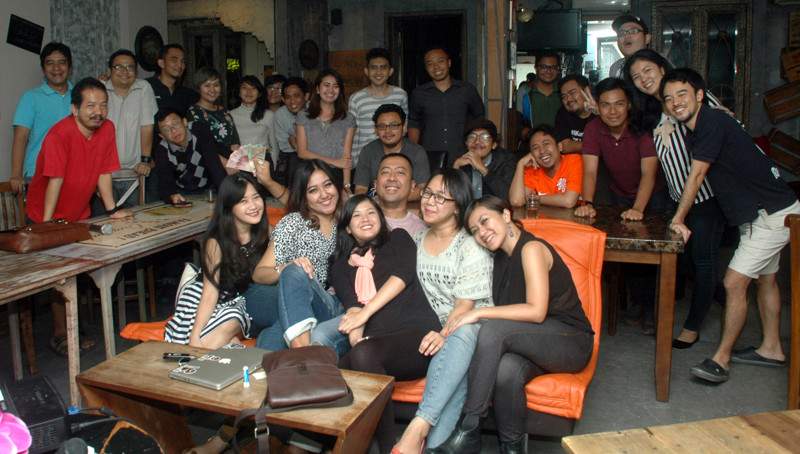
At a restaurant in Jakarta in March 2015, Tomonori Tsuji went from guest to guest asking what they thought of Pricebook. One participant wanted accessories. If the site was going to concentrate on gadgets, she suggested, it ought to make the things that went with them easier to find. She also had ideas about clothes and shoes. A founder had come looking for feedback; the customers had brought a shopping list.
The gathering had a cheerfully practical theme: how to enjoy online shopping without being carried away by it. Bloggers and businesspeople tried the comparison service, discussed their experiences and offered suggestions. Tsuji, called Tomo in the account of the evening, was there to hear them individually. The photograph shows him leaning into the group at the far right, dressed for an informal evening rather than a ceremonial announcement.
It is a useful place to begin his story. Pricebook concerns the moment before a purchase, when enthusiasm runs ahead of knowledge and a buyer still has questions. Which model? Which seller? Which price? Tsuji built a company around making those questions easier to answer. Doing so required contact with the people on both sides of the counter.
A route through three working cities
Tsuji was born in Osaka in 1987. His childhood included Moscow and New York; his university education took him to Tokyo, where he graduated in economics in 2011. His early career then moved through Itokuro and a product management job at Leapseas in Singapore. Pricebook followed in 2013, with the company established in Tokyo that September and operations moved to Indonesia in November.
The professional experience matters as much as the geography. At Itokuro, Tsuji worked on digital marketing and product management, including search advertising, search optimization and other ways of bringing customers to a business. At Leapseas, his work included leading developers and freelance writers. These were useful preparations for a service that would have to combine a working product, readable information and a way for people to discover it.
Indonesia did not begin as a childhood attachment. A later account describes a visit to a Jakarta shopping mall whose energy impressed him, and a company started with two Indonesian employees. There is something pleasingly concrete about that beginning. The attraction was visible in a place where people were already looking, comparing and buying. The business would have to understand what happened there.
The shop outside the search results
By June 2014, Tsuji was describing a change in the company’s work. The first months had concentrated on making a usable service. Attention was turning to gathering useful information, including information from individual physical shops. His reasoning was operational: a company present in the market could learn and respond to its irregularities before a distant competitor understood them.
A comparison service has a peculiar dependency. Its clean results depend on untidy inputs. A product name needs to match the right model. A price needs a seller attached to it. The offer needs to be relevant to someone who might actually buy. Software can organize those details, but the value of the answer still depends on the information entering the system. For a buyer, a missing seller can mean a missing option. For a retailer, missing information can mean never entering the buyer’s consideration at all. This gives the apparently modest job of collecting prices consequences for both parties. The search starts well before anyone types into the box.
For Tsuji, physical retail belonged inside that answer. Pricebook brought together online and offline offers rather than treating a website as the boundary of shopping. Someone could research a purchase on a screen and still want to speak to a seller in person. The service had to accommodate that journey. A shop counter was part of the product’s world, even if it lacked a convenient search result.
“Fill information gaps for a better opportunity”
Tomonori Tsuji’s stated Pricebook mission
The phone in the shopper’s hand
In September 2014, Pricebook introduced a mobile website. The company estimated that more than 65 percent of its visitors already arrived from phones or smartphones. Tsuji spoke about concentrating on gadgets and understanding customer demand more deeply. He was choosing to improve the experience within that category before pursuing a wider collection of products.
The order of those choices is revealing. A mobile visitor might be comparing a phone while holding another phone. A service designed around that person had to make filtering and comparison usable on the device already in hand. Pricebook also discussed an Android application planned for 2015. The mobile website was an immediate response to the traffic it was seeing.
At its Jakarta introduction that September, the network was reported to include more than 8,000 sellers, encompassing individuals and shops. That figure belongs to 2014. It describes the breadth Pricebook was reporting at that moment, rather than a current total. The introduction also emphasized practical distinctions shoppers could use: price, proximity and seller reputation. Cheapness had company.
By its first anniversary in December 2014, Pricebook was adding features and describing a business connected to customers, merchants, distributors and manufacturers. The company’s place in that collection was to help information circulate. A comparison table could be the visible result, while several different participants had reasons to care about what appeared in it. The buyer wanted a useful choice. The seller wanted to be considered. Bringing those interests onto the same page was the business proposition, expressed in the everyday language of products, shops and prices.
Capital follows the connections
In March 2015, Pricebook announced a second funding round involving Global Brain, IMJ Investment Partners and Hiro Mashita. Incubate Fund had backed the company at its establishment. The new money was intended to support team expansion, partner acquisition and a move toward a marketing platform serving both online and offline retailers. The announcement did not disclose the amount.
That direction extended the original idea. A shopper uses a price database to make a decision; a retailer wants to reach that shopper. Pricebook was building a business around their meeting. Tsuji’s marketing background gave that ambition a recognizable connection to his earlier work, though the company now had to maintain the product information as well as attract an audience.
Aucfan announced a capital and business partnership with Pricebook in September 2016. The agreement concerned a business already collecting physical store prices alongside online prices. It also set out a broader interest in helping buyers and sellers connect, and in providing manufacturers with branding and market information services. The shop relationships were becoming useful in several directions.
The fourth reported funding round arrived in January 2019, led by Mirai Creation Fund II with existing investor KLab Venture Partners participating. The stated plans included deeper integration with more than 1,000 offline sellers, online seller expansion and integrated marketing services. Those offline partners were a specific group in a later announcement; they should not be confused with the broader seller count reported in 2014.
Even a search engine needs a spare connection
There is an appropriately unromantic detail in Tsuji’s advice about doing business in Indonesia. In 2015, he discussed internet disruptions and the value of arranging connections from two providers, keeping mobile Wi-Fi available and knowing nearby cafés with internet access. Roadworks could damage cables. Repairs could take time. An information business still needed a way to get online.
It is a small corrective to the smoothness of a comparison page. The visitor sees an answer; the operator deals with the conditions required to deliver it. Tsuji’s comments make room for that daily work. The elegant diagram of a business has to survive the office connection, the partner conversation and the customer who needs something the diagram has overlooked.
A database learns to reach readers
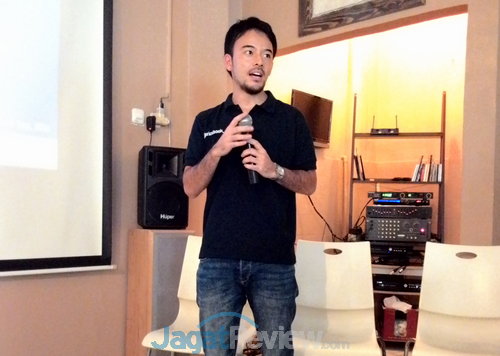
Pricebook also took shopping education into public events. At STIKOM Interstudi, its campus program introduced students to price filters, product comparisons and store locations. Tsuji appeared in the event photographs. The goal was to encourage young buyers to examine a product’s advantages and disadvantages before spending. The campus visit carried the company’s work into a setting where questions could be asked aloud.
In December 2021, another route to shoppers opened through detikcom. The two companies launched Komparasi Gadget, a microsite connected to Pricebook’s database. Readers could use smartphone recommendations, specifications and comparisons within a news network. Pricebook’s announcement also put its YouTube audience at 1.4 million subscribers at the time, showing how far the business had moved into consumer content.
The partnership brought together information and distribution. Product data becomes more useful when a potential buyer encounters it at the right moment. Video can explain a difference that a specification table merely records. The format changes, while the underlying task remains familiar: help someone decide with more information in front of them. There is a discipline to keeping that task recognizable as a company adds channels. A new audience still needs an explanation it can use. The specifications have to become understandable differences, and the shopping information has to lead somewhere useful. The consumer, mercifully, is under no obligation to admire the database.
Tsuji’s public professional profile continues to place him at Pricebook in Jakarta. Its mission, in his phrasing, concerns filling information gaps so that people have better opportunities. That can sound abstract until one returns to the restaurant: a founder asking questions, a shopper asking for accessories. The work becomes specific there. Before the next feature, another conversation.