A used-car dealer can be surrounded by money and still struggle to make the next purchase. The money has upholstery, a registration document and perhaps an especially handsome set of wheels. It also has to find a buyer. Until then, another promising car can come and go while the dealer waits.
Pandu Adi Laras has built a business around that interval. As co-founder and CEO of broom.id, he works on the financing and operational problems of Indonesia’s used-car showrooms. His customers already understand the trade. The question is how much more they could do if their existing stock did not determine when they could buy again.
There is a small domestic episode in the company’s beginnings. He tried selling his car to pay for a home renovation. Dealers offered trade-ins instead. Their cash shortage helped inspire Broom.
A trade-in is a rather inconvenient answer when the thing you need to buy is building work. The episode also gives the business a useful starting point: a transaction that made sense to one person could not happen because the other party’s money was occupied elsewhere.
Before the showroom, the operating system
Laras’s route into that problem passed through several different kinds of work. His education spans computer science at Universitas Indonesia, information technology at the University of Queensland and a master’s in finance management back at Universitas Indonesia. His early career included PwC and XL Axiata, with roles in performance management and technology audit at the telecommunications company.
At Uber, which he joined in 2015, he worked in operations and logistics before moving into public policy. Gojek followed in 2018, with responsibility for four-wheel driver core operations. These were roles concerned with the people, vehicles and processes behind a service that customers encountered through a screen.
GoFleet gave that connection a physical presence. On July 18, 2019, the Astra-Gojek joint venture launched at the Gaikindo Indonesia International Auto Show. Laras participated as a director alongside president director Meliza M. Rusli. Astra’s Prijono Sugiarto and Gojek founder Nadiem Makarim accompanied the launch; Vice President Jusuf Kalla witnessed it.
The service combined vehicle provision with maintenance, repairs, insurance and advertising opportunities for drivers. For a driver, access to a vehicle was part of a larger working arrangement. The car needed to stay usable; the surrounding services mattered to whether the driver could concentrate on passengers.
Seen beside his later work, GoFleet provides a concrete point of continuity. Both businesses deal with the arrangements around a car that allow someone to earn from it. At GoFleet, that person was a driver. At Broom, the focus moved to the dealer and the stock waiting for its next owner.
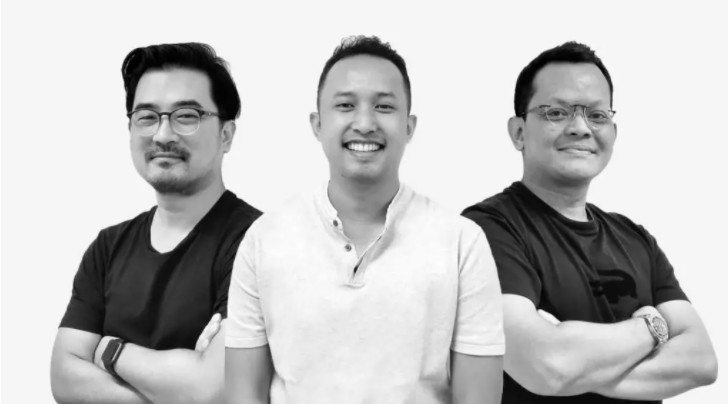
His work also reached industry discussions. In October 2021, he participated in Gambir Trade Talk on Indonesia’s readiness for digital economic transformation as deputy head of KADIN’s digital economy ecosystem development body. The panel included East Ventures co-founder Wilson Cuaca and TaniHub founder Pamitra Wineka.
The dealer keeps a place in the picture
Broom was founded in 2021. Andreas Sutanto and Pungky Wibawa joined Laras as co-founders, bringing the venture into the overlap between technology, finance and automotive trading. When the company announced $3 million in pre-seed funding in February 2022, its stated uses included new products, expansion into more Indonesian cities and a larger team.
The customer problem was specific. Laras described dealers struggling to find suitable buyers online and facing financing difficulties because their businesses lacked documentation. He also described expensive informal borrowing. A showroom could know its cars and its customers very well while having a much harder time presenting its business in a form a financial institution could use.
That helps explain why Broom’s offering extended across inventory management, selling tools and access to finance. Better records and more organized stock have a purpose beyond a tidier screen. They can help make a business easier to understand, both for its owner and for a potential financing partner.
The flagship Buyback service addresses working capital through a temporary vehicle sale with a repurchase option. A dealer can obtain money from existing inventory and later repurchase it. Broom also supports trading between dealers, giving stock another route toward a buyer.
A simplified view of Broom’s Buyback mechanism.
In his public account of founding Broom, Laras connected the decision to years of working in ride-sharing and seeing the obstacles small mobility businesses faced when trying to grow. He described financing for used-car dealers as a starting point within a broader ambition to serve the financial needs of mobility businesses.
“I co-founded broom.id to really fix this and empower Indonesian SMEs to unlock their potential”
Pandu Adi Laras · February 2022
Small enough to prove it
Laras has offered a fairly stern qualification to the ambition. In a 2023 discussion connected with Startup Studio Indonesia, he emphasized choosing the business model carefully at the beginning. Products should solve actual problems in the used-car industry, he said, while having unit economics that made sense even at a small scale.
For a business serving smaller businesses, that is a consequential standard. Growth can bring more transactions, but each transaction already needs a sensible relationship between the work required and the money it produces. A large customer count cannot perform every duty assigned to it in a pitch deck.
His comments give the funding milestones a more useful context. The investment is meant to support a model whose daily workings have their own logic. A dealer still needs the transaction to be worthwhile. Broom still needs the service to be economical to provide.
He also credited investment in talent and operational efficiency when discussing Broom’s development in 2023. The team’s composition reflected the range of work involved. In September 2022, Broom appointed Claussen Sindhuwinata, another former Uber and Gojek executive, as chief operating officer. Software, automotive knowledge, financing and operations all had places in the organization.
The hiring announcement described a company aiming to provide comprehensive support to showrooms. That ambition comes with a practical burden: each additional service has to connect with the dealer’s actual business. A product catalogue can grow faster than anyone’s capacity to make use of it.
What the numbers can tell us
In March 2023, Broom announced a $10 million pre-Series A round led by Openspace. MUFG Innovation Partners, BRI Ventures and existing investors participated. MUFG’s investment announcement described the business in terms of stock turnover and the organizational difficulties of second-hand showrooms, tying the opportunity to the founders’ experience in technology and automotive businesses.
By October 2024, the company announced another financing milestone: a $25 million Series A+ round, again led by Openspace, with AC Ventures, Quona Capital, MUFG Innovation Partners and PKSHA Capital participating. The planned work included expansion, partnerships and organizational capacity.
The operating figures attached to that announcement help explain the scale of the undertaking. Broom reported Rp1.1 trillion in Buyback disbursements for the first half of 2024 and support for more than 7,000 automotive SME dealers. The former measures money deployed through a product; it is a different measure from the equity investment announced in a funding round.
Keeping those categories clear matters. Capital raised tells part of the company’s story. Capital reaching the dealer tells another. Neither figure, by itself, describes an individual dealer’s profit or guarantees the outcome of the next sale.
The financing process also became a place to save time. Broom has used AI to reduce underwriting from an hour to ten minutes, followed by an employee’s check. In that process, applications submitted before midday could receive funds within a few hours.
Reported process timings. An employee performs the final check.
For the dealer, a shorter process can make the service more useful during the working day. For Laras’s business, the human check remains part of that process. The detail matters: the technology sits inside an operating procedure with a person still responsible for reviewing the result.
Back to the floor
Laras’s public conversations have carried the dealer problem into different rooms. He discussed working capital with Alan Hellawell on Indo Tekno in 2022, appeared on Indonesia Digital Deconstructed with Leighton Cosseboom in 2023 and joined a Japan Fintech Festival panel in March 2024 about Southeast Asia and its connections with Japan.
In March 2025, the setting was closer to the customer again. Mandiri Utama Finance announced a used-car expo at Broomhive Jatiasih in Bekasi, running from March 14 to 23. Its announcement identified Laras as Broomhive’s CEO and co-founder and described the event as a joint effort to help buyers obtain inspected used cars with financing options.
The expo put several parts of the trade in one physical place. There were vehicles to consider, a showroom to visit and financing to arrange. For all the digital machinery around the business, the purchase still ended with someone choosing a car.
Laras has stated his ambition for dealers plainly: equal access to technology and finance, and an improvement in the quality of service. That gives his career a recognizable destination. The work at Broom is measured against what an existing dealer can do with the support available.
A showroom owner needs stock, customers and room to make the next decision. Laras has chosen to work on the arrangements between those things. The forecourt may look much the same from the street. Inside the business, the useful change is whether the next purchase has to wait.