A car can be worth hundreds of millions of rupiah and still behave like dead weight. For a small used-car dealer, value parked under fluorescent lights is not the same as money available for tomorrow's purchase. Until a buyer appears, the showroom owns an asset that cannot pay the rent, refresh the lot or chase the model customers suddenly want. This is the unglamorous delay on which broom.id built a company.
The Jakarta startup is often filed under marketplace or auto finance, but neither label catches the loop. Broom gives independent dealers a mobile system for managing vehicles and accessing several connected services. Buyback converts a vehicle into short-term working capital through a temporary sale with a repurchase option. BroomHive gives stock another place to meet retail buyers. Broom Leasing Channeling, or BLC, routes a buyer's credit application toward multiple finance companies. Inspection and valuation data make the whole system more legible.
Broom is betting that Indonesia's neighborhood showroom does not need to be removed from the transaction. It needs better plumbing.
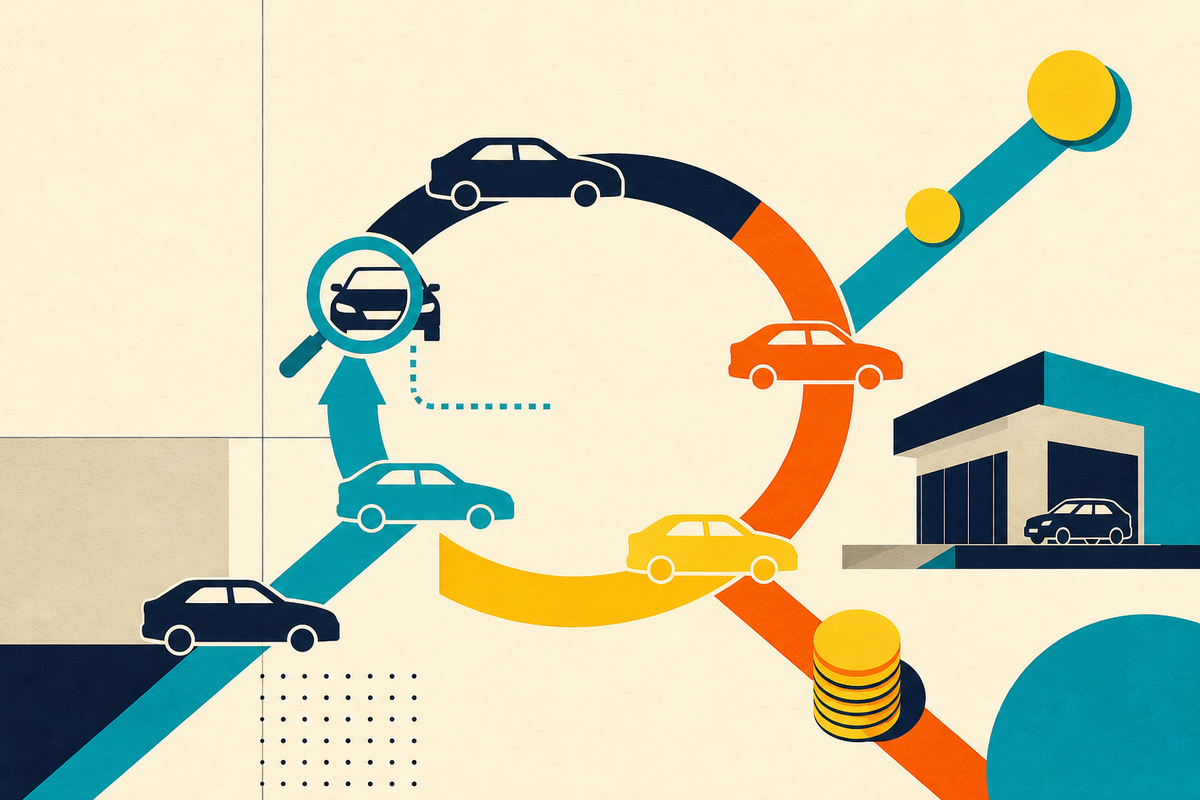
A founder tried to sell a car. The dealers wanted it, but not the bill.
The origin story begins with CEO Pandu Adi Laras trying to raise money for a home renovation. Dealers he visited were interested in his car, yet several could offer only a trade-in. They did not have enough cash to buy it outright. Laras, whose career had run through Uber, Gojek and the Astra-Gojek fleet venture GoFleet, recognized an operating problem wearing the costume of weak demand.
A typical small dealer might wait for one car to sell before buying the next. Customer taste moves faster. A popular model appears, but the dealer's money is stuck in an older sedan at the back of the lot. Formal lenders may see a thin credit file, informal bookkeeping and hard-to-standardize collateral. The showroom sees something simpler: a car worth money and no usable money today.
The traditional approach is more like opening mom-and-pop stores, where sellers need to wait for their inventory to get sold.Pandu Adi Laras, co-founder and CEO
Broom began operating in June 2021 with five showrooms. Laras and finance executive Andreas Sutanto are identified by the company as co-founders; early accounts also name used-car entrepreneur Pungky Wibawa in the founding team. Their combined vantage points mattered. This was not only a software workflow or only a credit product. It depended on knowing cars, paperwork, dealer behavior and the rhythms of local demand.
Buyback changes ownership before it changes the dealer's ambition.
Buyback is Broom's central device. A verified showroom submits a vehicle and its documents through the app. After valuation and checks, the dealer temporarily sells the car to Broom, releasing cash for fresh inventory. The dealer receives the option to repurchase the vehicle by an agreed deadline at a higher amount. Broom has described this as a temporary sale rather than a conventional loan - a distinction that places the actual vehicle transaction at the center of the arrangement.
One vehicle, four state changes
The company advertises processing through the app in as little as five hours. More recently, a financial-services case study described Broom using AI to cut underwriting analysis from roughly one hour to 10 minutes, followed by a human accuracy check. That last step is revealing. Used cars resist perfect standardization: two vehicles with the same badge and year can carry very different histories. Automation makes the queue move; an inspector still has to look under the metaphorical rug.
The volume gives the idea weight. Broom reported that Buyback disbursements reached Rp1.1 trillion, about $72.5 million, in the first half of 2024. That represented a 144.9 percent increase from the comparable period a year earlier and supported more than 7,000 small and midsize dealers. The important number is not a download count. It is the amount of capital that moved through vehicles which had previously been waiting.
Every reason a car stays parked becomes another product surface.
Working capital solves only one stall. A dealer may have the wrong vehicle for the neighborhood, too little foot traffic, or a willing buyer whose finance application goes nowhere. Broom's adjacent products follow those points of friction instead of wandering into unrelated features.
BroomHive is the sales outlet. Opened in Jatiasih, Bekasi in 2023, it takes dealer cars on consignment, inspects them, agrees on a price and markets them online and offline for up to 30 days. The dealer gains a second storefront without carrying another location's operating cost. The consumer gains a inspected pool of vehicles and a physical place to browse. One dealer testimonial says 22 cars sold after 40 to 50 had been consigned - the sort of untidy, believable ratio that sounds more useful than a victory-lap percentage.
BLC attacks the checkout. Launched in the fourth quarter of 2023, it lets a showroom submit a retail buyer's financing application through one channel rather than hunt for a leasing company willing to cover the customer or region. Broom reported 2,300 BLC transactions and more than $17 million in revenue in the first half of 2024. It also said it was working toward API connections with 23 multifinance partners. The dealer keeps selling; Broom becomes the routing layer.
More dealers create more vehicle, price and repayment signals. Better signals can speed valuation and underwriting. Faster decisions attract more dealers and finance partners. The data advantage is plausible, but execution still depends on inspections, collections and local operations.
The mobile app ties these pieces together: register the showroom, verify inventory, watch a Buyback transaction, reach dealer-to-dealer stock and enter other Broom services. In a business often managed through personal networks and chat threads, the unromantic achievement is a shared record. Who owns the car? What documents exist? What price did the inspection support? What stage has the transaction reached? Software turns those questions from phone calls into fields.
Carro, Carsome and OLXmobbi face the shopper. Broom stands behind the dealer.
Indonesia is not short of places to list a used car. Regional platforms such as Carro and Carsome, and Astra-backed OLXmobbi, connect directly with consumers, acquire vehicles, inspect inventory and offer financing in various combinations. Traditional auctions, classified sites and bank loans remain alternatives too. Broom's difference is not that no competitor touches dealers or finance. It is the priority: preserve the independent showroom as the main customer and build tools around its balance sheet.
That stance turns fragmentation into distribution. Indonesia has tens of thousands of used-car dealers, many of them family-run or home-based. They already know local buyers, source vehicles through relationships and carry the entrepreneurial risk. Replacing them would require enormous retail and inventory infrastructure. Equipping them lets Broom aggregate a network it does not have to own outright.
The model is not lightweight. Temporary ownership brings asset and price risk. Credit partners expect clean processes. Inspections must be consistent across cities. A digital interface does not make repossession, vehicle storage or document verification virtual. Broom's expansion from Jakarta into Bogor, Bekasi, Tangerang, Surabaya, Yogyakarta, Solo, Malang and Bali shows why branches still matter. Fintech here has tires and keys.
The company is not trying to win the listing. It is trying to make the dealer's whole transaction possible.The dealer-first thesis
The balance sheet behind the balance sheets.
Broom has needed substantial capital to fund its own growth and the liquidity flowing toward dealers. After $1 million in initial backing, it announced a $3 million seed round in early 2022 led by AC Ventures, followed by $10 million in pre-Series A financing led by Openspace Ventures in March 2023. DBS Indonesia supplied a Rp100 billion credit facility in 2022, while BRI-linked companies also became financing partners.
In October 2024, Broom announced a $25 million Series A+ financing package. Deal records separate the package into roughly $20 million of equity and $5 million of credit facilities. Openspace again led the equity, joined by AC Ventures, Quona Capital, MUFG Innovation Partners and PKSHA Capital; the lending group included DBS, Funding Societies, Helicap, KoinWorks, Komunal, ALAMI and Modalku. The structure mirrors the company itself: venture money builds the platform, credit money helps the inventory turn.
Broom's stated mission is to improve the welfare and competitiveness of automotive small businesses. The practical version is more interesting than the slogan. Give a showroom a way to free cash from the wrong car, find the right car, put both into a trackable system, expose the old one to more shoppers, and help the eventual buyer finance it. None of those actions reinvents the automobile. Together, they shorten the time between parked value and spendable money.
That is where Broom fits: below the glossy marketplace, above the scattered spreadsheet, between the finance company and a dealer with three white MPVs and one stubborn black sedan. Its opportunity is the connective tissue. The next test is whether a branch-heavy, risk-aware operation can keep the intimacy of the local showroom while standardizing enough of the transaction to scale. In Indonesia's used-car trade, the winning interface may not be the page where someone finds a car. It may be the system that finally lets the seller afford to stock it.