Before Yannick Namia learned how to build a company, he learned how to make a computer do something useful. He was 10 or 11. The programs were gloriously practical: a talking clock, a currency converter, a time converter, a résumé database. He sold them as shareware, with a trial period followed by a small payment. Roughly 2,000 licenses went out at 50 French francs apiece. It was not a fortune. It was something more dangerous to a curious child: proof.
Proof that code could leave his room, solve a stranger's problem, and return carrying money. Plenty of careers begin with a plan. Namia's began with a loop. Notice an annoyance. Make a tool. Put it in front of people. Watch what happens.
He kept the loop and changed the scale. After completing engineering studies at Polytech Grenoble in 2004, he faced the ordinary graduate's bargain: accept a respectable salary or earn less while attempting something much larger. About a month after school, at 23, he started Asolution, a web agency. The first customers were not discovered through a grand launch. They were businesses he already knew whose websites looked, in his phrase, prehistoric. He offered to rebuild them. The first three became something closer to the first 30.
The engineer meets the customer
There was one inconvenience: Namia was an engineer who did not know how to sell. He has said this with the cheerful bluntness of somebody reporting an old bug. A commercial partner helped. The agency grew organically, systematizing production and using online acquisition until it reached a ceiling. Digital demand could be centralized; trust remained stubbornly local.
The solution was NetinUp, a franchise network launched in 2013. Local operators would sit closer to small companies, while the central organization supplied production and support. By 2015, Namia said the parent business had helped create more than 3,000 websites. The wider network eventually reached roughly 40 franchisees across France. Asolution had also appeared in Deloitte's 2012 regional Fast 50 and in the Pépites program for growth companies.
The appealing part of a franchise is replication. The maddening part is that people refuse to behave like duplicated code. Namia described the work as far more complicated than he expected. Recruiting well, supporting local operators, keeping service consistent, and retaining trust all happen at once. A system can be copied. Judgment cannot. It has to be developed in other people.
His original logic was almost mathematical. The agency had centralized production and could make far more websites than it was selling. Small businesses, however, bought these services through confidence and proximity. Put entrepreneurs in the territories, give them the central tools, and unused capacity would meet local trust. The arithmetic was persuasive. The human work arrived afterward: recruit the right people, teach them, support them, and make dozens of local promises feel like one dependable company.
This distinction - between a model that works in a spreadsheet and a model that works through people - became a recurring education. Namia spoke publicly about ambitious expansion beyond France, yet he also kept returning to daily customer satisfaction as the proof that mattered. Scale made the story interesting. Repetition made the business real.
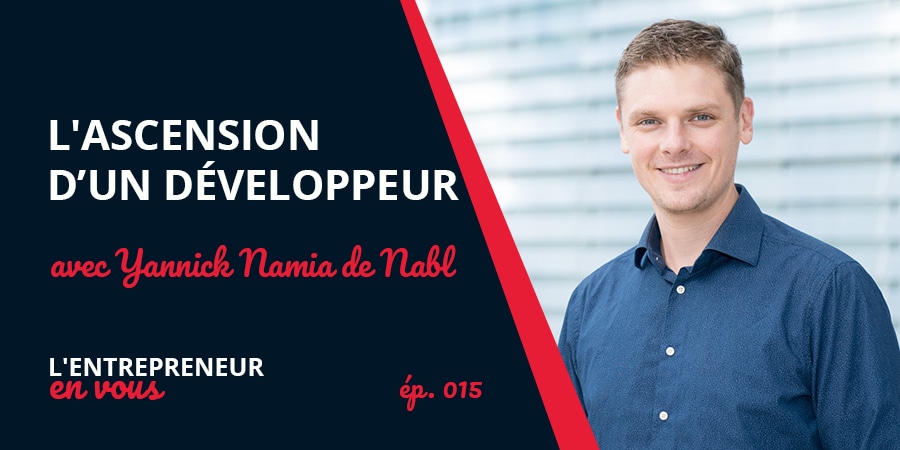
The expensive education of letting go
Asolution was sold in 2017. Exits are often written as a full stop with a number attached. Namia's version is less decorative. Selling a company, he later explained, creates a peculiar stretch when yesterday's promises and tomorrow's ownership overlap. He wished he had made the handover cleaner: explicit dates, objectives, boundaries, and commitments on both sides. When memory becomes the project-management system, everyone remembers a different project.
He had also made the classic founder's mistake of beginning the next thing before the previous thing had quite released him. Nabl, a customer-feedback product, grew from a pattern observed inside the agency. Local businesses could buy websites and advertising, but public customer opinion increasingly shaped whether anyone chose them. Nabl tried to capture feedback while the experience was still fresh.
The first version took eight months. Namia later regretted taking so long. The regret was not about laziness; eight months of building is the opposite of idle. It was about allowing workmanship to delay contact with reality. An accelerator stint with METRO and Techstars sent him back to customers, surrounded him with mentors, and forced the company's language to become simpler. A product can be technically complete and commercially tongue-tied.
During the accelerator, he met around a hundred mentors and returned to the field to ask customers what they actually needed. The process challenged assumptions the team had acquired too easily. It also produced a practical test in Paris restaurants. The lesson was not that mentors possess secret answers. Their value was in making the team expose its answers to sharper questions.
An engineer can spend months eliminating uncertainty inside a product while the larger uncertainty waits outside: will anyone care? Namia's account of Nabl is candid because he does not pretend the long build was heroic merely because it was difficult. Difficulty is not evidence of direction. Customers are less sentimental. They edit the idea by using it, misunderstanding it, or walking away.
A company should not wear its founder like a backpack
The most transferable part of Namia's story is the change in how he hired. In the earlier company, he said, many team members were junior and not especially autonomous. Responsibility drifted back toward him. The founder became the universal adapter: available, capable, and increasingly necessary.
For the next company he inverted the specification. He sought experience, but autonomy mattered more. People had to accept responsibility, make repairable mistakes, and solve important problems without waiting for a rescue. His remote-work test was wonderfully severe: if a candidate could not work from home, he did not want them coming into the office either. Location was beside the point. Self-direction was the job.
This sounds like a human-resources preference. It is closer to architecture. A company in which every decision routes through the founder is not scalable; it has simply installed a charismatic single point of failure. Hiring better people was, Namia said, the best investment he made. The statement has teeth because better people are useful only if the founder allows them to be better in public.
That means tolerating decisions you would not have made, provided they are thoughtful. It means distinguishing a mistake from a pattern. It means asking whether a problem was repaired, not whether the room remained spotless. Namia's language for setbacks is revealing: an attempt that does not work has brought the team closer to the truth. The failed route can be closed. The map improves.
Optimism, in this frame, is not compulsory cheerfulness. It is an operating policy. Namia has described himself as somebody who prefers looking forward to looking backward. That can sound breezy until it is paired with accountability. The mistake may be accepted; repetition is not. Repair still belongs to the person who made the call. Forward motion earns its seriousness from the cleanup.
The metric that did not fit the dashboard
Asked about the finest moment in his entrepreneurial career, Namia did not choose the childhood sales, the fast-growth recognition, the franchise count, the accelerator, or the acquisition. He chose a conversation from two days earlier.
A colleague came to tell him, directly, that she appreciated working with him. She said she had learned beside him and that he had been present when it mattered. After about 14 years of running companies, he could not remember anyone saying it so plainly. It warmed him. Perhaps, he said, it was the best moment.
There is a useful correction in that answer. Founders keep one ledger because markets insist upon it: customers, revenue, growth, locations, rounds, exits. Teams keep another. Did I become more capable here? Was I trusted with meaningful work? When the work became difficult, did somebody remain available without taking the work away?
Namia's career since Nabl has moved through MyMark, Find Out, and the founding and operating team around Lifespanning and Biohackers Magazine. The settings have changed from French web services to American consumer ventures, publishing, commerce, and technology. The old loop remains visible. Find an awkward problem. Build a practical response. Put it near the customer. Revise. Then find people who can carry pieces of it without carrying you.
The child programmer's first sale proved that software could travel farther than its maker. The mature founder's harder task is making judgment travel too. Code follows instructions perfectly. People require context, trust, room to err, and a reason to care. It is less tidy. It is also how a collection of capable strangers becomes a company.