He wrote a script to stop answering the same question - where is my package - over and over. The script grew into a company that answers it for tens of thousands of stores.
Teddy Chan runs AfterShip, and he would rather be writing code. He says as much, plainly: he wants to be a software engineer forever, because he really likes writing code. This is an awkward thing for a chief executive to admit, and he admits it anyway. AfterShip is the software that draws the little map on the tracking page after you buy something online - the "your order has shipped" email, the estimated delivery date, the branded page that is not quite the store and not quite the courier. It sits in the seam between the checkout and the doorstep, a seam most people never think about until a package is late.
The company operates across five countries out of Singapore and Hong Kong, and it handles shipments at a scale measured in the billions per year, across more than 740 carriers. It reached that scale while profitable, and for years without much of a sales team. In 2021 Tiger Global led a $66 million Series B that pushed AfterShip past a billion-dollar valuation. Chan's response to the money was, roughly, to keep going - the funding was for hiring internationally and building more products, not for changing what the company was.
What AfterShip is, at bottom, is the productized version of a problem Chan had personally and solved for himself first. That is the whole story, really. The rest is scale.
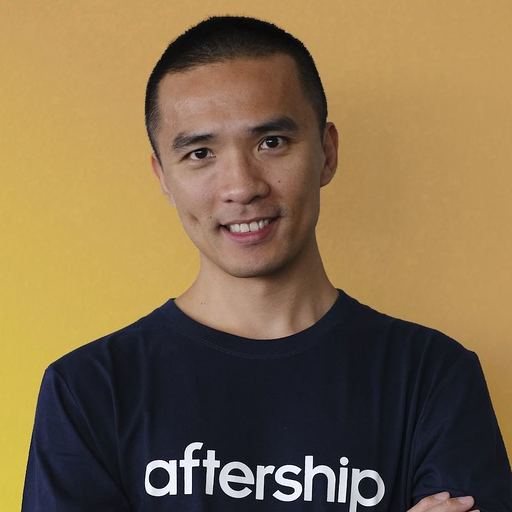
Before AfterShip, Chan sold things online - remote-control toys and MP3 players - for more than fifteen years, and ran Fever Toys Ltd., one of the larger radio-control toy B2C businesses in Hong Kong. Selling physical goods to strangers overseas means one recurring headache: people write in constantly to ask where their package is. So Chan, an engineer, wrote a program that tracked shipments automatically and notified customers of progress. It cut his customer inquiries by somewhere between 50 and 60 percent.
That is the origin. Not a market-sizing spreadsheet, not a thesis about post-purchase engagement - a man tired of answering the same email, writing code to make the email unnecessary. The thesis came later, once it turned out that every other online merchant had the same inbox problem.
He had wanted a co-founder for about five years and kept getting turned down. In 2011 he went to Startup Weekend Hong Kong, a 54-hour hackathon, and met Andrew Chan. Their team won the Hong Kong event and then won the global competition. AfterShip launched in October 2012.
“A great team with an average idea is far better than an average team with a great idea.” - Teddy Chan
Customers said they wanted to know where their package was. AfterShip realized they actually meant when it would arrive, and shifted from location tracking toward delivery-time prediction. As Chan puts it: what a customer says they need may not be the same as their actual needs.
An engineer's accidental infinite loop ran up around $160,000 in cloud charges in a single day. Leadership treated it as a process failure to fix rather than a person to punish. Nobody was blamed; the guardrails were rebuilt.
AfterShip deliberately targeted small and mid-size merchants in the US and Europe over its home market. The logic: win overseas, where the volume is, and Hong Kong comes along for free.
“If I really did die now, then apart from having earned a bit of money, what would I have contributed?”On why he wanted to build something
“In B2B SaaS, we not only need to make products which create value, we also need to win customer trust.”On selling to enterprises
“Rather than going out to find people, you should let people find you.”On hiring
“What the customer says they need may not be the same as their actual needs.”On product
Chan talks about SaaS the way people who have watched a revenue graph for a decade talk about it: the early line is nearly flat for years before it bends. He built accordingly. AfterShip was profitable early and grew for a long stretch without the usual sales-and-marketing machinery, which is another way of saying it grew because merchants kept needing the thing and telling each other about it. When the venture money finally arrived, it arrived at a company that did not strictly need it.
His stated ambition is unglamorous and enormous at the same time: to be the trusted shipment platform for more than half of the world's e-commerce brands. Trust is the operative word, and he keeps returning to it. Early on, large customers passed on AfterShip even when its technology was better, and the lesson stuck - in B2B you earn the right to the deal before you win it. Value gets you in the room. Trust gets the signature.
There is a version of this profile that would call him a visionary. He would probably rather you called him an engineer who noticed his inbox was full and did something about it. The billion-dollar valuation is downstream of that. The map on your tracking page is upstream of nothing - it is the whole point.
Teddy Chan is the CEO and co-founder of AfterShip, the shipment-tracking and post-purchase platform he started in 2012 after building a package-tracking script for his own online toy store cut customer emails by more than half. A self-described software engineer who says he wants to write code forever, Chan grew AfterShip from a Startup Weekend Hong Kong hackathon win into a company handling billions of shipments a year for tens of thousands of merchants, profitable long before Tiger Global led a $66M Series B in 2021 that valued it above $1 billion.
Last updated: