The object that redirected Geng Wang’s third startup was not a smartphone, a pitch deck, or a prototype with delightful animations. It was a binder. A nonprofit executive director showed him the sign-in sheets used to track volunteers and explained that counting their hours consumed 80 to 100 hours every year. This did not include onboarding, follow-up, scheduling, persuasion, gratitude, or any of the other human work hiding behind the tidy phrase “volunteer management.” It was just the counting.
Wang had arrived with a more playful proposition: a mobile game for volunteering, something like Pokémon Go with small acts of service in place of cartoon creatures. The idea had charm. It also had the familiar appetite of a game, forever asking for new content and another reason not to be deleted. Conversations with nonprofits revealed a plainer and more durable need. Nine out of the first ten organizations his team approached were still tracking people with paper. Many disliked the software they had, if they had any at all.
So the game gave way to infrastructure. Civic Champs would let volunteers check in on a phone, at a web kiosk, or through an administrator. Geofencing could recognize arrival at a service site. The records would synchronize. Hours would stop living in several incompatible realities. The founder’s lively idea became the customer’s useful one.
An entrepreneur trained by wrong answers
Wang’s career is a collection of ideas improved by reality. He graduated from Michigan State University in 2008 with honors degrees in supply chain management and international relations. As a senior, he and fellow student Dan Clay created College Entertainment, printing and distributing more than 5,000 calendars around campus before selling the business. Ink, paper, distribution: the future SaaS founder began with an admirably physical product.
McKinsey followed. Wang has credited the firm with teaching him to break problems into components, test assumptions, and present conclusions to people who knew an industry better but lacked time to examine one particular question. He also met Jon Pastor there, a colleague who became his business partner.
Together they founded Rent Jungle, an apartment search engine that crawled listings across the internet. The initial thesis was that renters would value seeing everything in one place. The market offered a refinement: people needed enough good information, not necessarily every last listing. The underlying technology also proved useful for selling data. Then apartment clients began asking a different question. Could these seemingly capable internet people handle Facebook for them?
Wang and Pastor offered to do it for $300 a month. That recurring customer question became Community Elf, a social-media management company. Rent Jungle was acquired in 2014. Community Elf followed in 2017. Two exits emerged from paying attention not only to what customers bought, but also to the adjacent chores they kept trying to hand over.
“The longer you’re in the space, the more you learn.”Geng Wang
There was formal education between those exits, too: an MBA from Harvard Business School in 2015. Wang later worked as vice president of product at Ardeo Education and served as an entrepreneur in residence at Indiana University’s Kelley School of Business. But his sharper lesson for student founders sounds less polished than a case study. Talk to the people you expect to sell to, then try to make the sale. Praise is socially easy. Payment clarifies.
The people on the other side of the software
Civic Champs launched in early 2019 with Wang, technical cofounder Mike Jeffery, and a broader founding team. Jeffery was no cold introduction from a founder-matching service. He and Wang had lived together for four years in college. Wang knew he wanted the technical partnership settled before launch, and an old roommate with enterprise software experience offered a useful answer to a notoriously delicate hiring question.
The company appeared at TechCrunch Disrupt’s Startup Battlefield that October. Its mobile-first platform could cut a small nonprofit’s volunteer tracking from roughly ten hours per month to one, Wang said at the time. It also accommodated people who had no smartphone or simply did not want another app. Good technology sometimes proves its sophistication by making room for people who decline it.
Then the pandemic arrived and volunteer activity contracted. Civic Champs entered MassChallenge and Techstars programs, adjusted its product, and launched Helping Hands, matching volunteers with older residents who needed food or medicine collected. By 2022, the program had served more than 3,500 people. It became the practical foundation for a HungerTech Innovation Challenge proposal to help SNAP recipients receive online grocery orders. Wang thought the entry stood out for one charmingly blunt reason: “Not only did we have a history, but we actually made a delivery.” The proposal won.
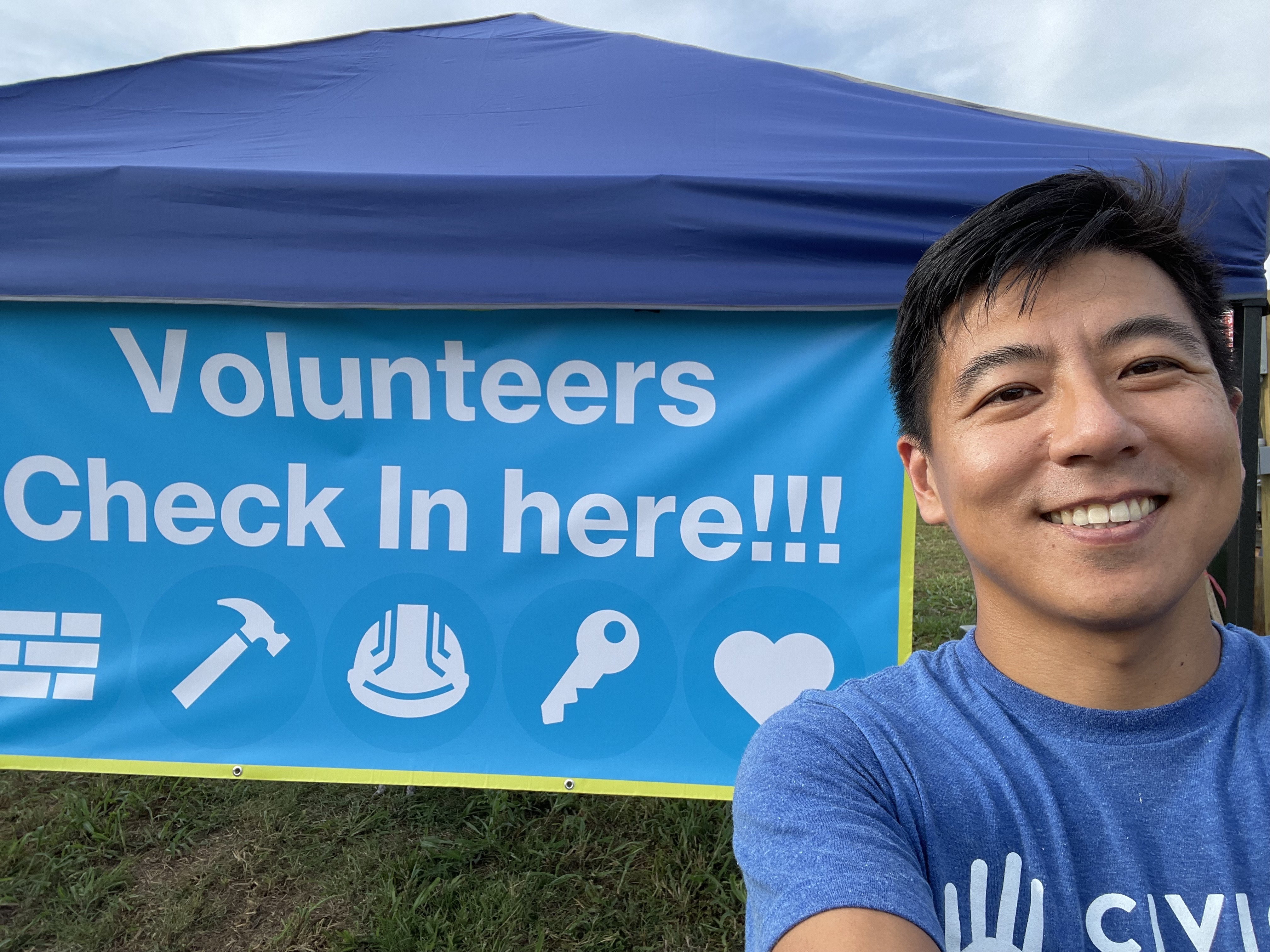
The logic behind the company was larger than administrative efficiency. Wang moved from China to the United States at five. His parents were already in America, where his father was pursuing a doctorate, but the Chinese government had initially prevented their child from leaving. The family stayed. Money was limited, and Wang remembers benefiting from community services such as the Boys & Girls Club. He also volunteered from a young age.
He came to see service as a rare social room where people cross political, economic, racial, and ideological lines to do something tangible together. Feed a neighbor. Teach a child. Build a home. “There’s something special about that in terms of building empathy,” he once observed. Software could not manufacture that fellow feeling. It could clear away some of the paperwork preventing it.
“Volunteering is such a great way to show love and kindness.”Geng Wang
Wang’s own service became increasingly local and specific. He joined nonprofit boards, including United Way of Monroe County and The Mill. More recently he served Westminster Neighborhood Services and helped launch a chess club at West Clay Elementary School. The club has supported roughly 50 to 70 children each week; its sixth-grade-and-under team placed third at state competition, with individual state champions in first and fifth grade. A serial founder spending afternoons explaining forks and pins to grade-school students feels less like a detour than another version of his thesis: community is built through repeated presence.
A company that grows in the same direction as its mission
Social-impact companies often acquire an uncomfortable split personality. Revenue wants one thing; mission wants another. Wang argued that Civic Champs could keep both arrows aligned. More paying customers meant more nonprofits receiving useful tools, more volunteer time organized, and less staff capacity spent on manual work. “The bigger we grow, the more impact we have,” he said. His economical companion line was even better: “You can’t have impact if you have no money.”
That model did not make the company easy. Civic Champs passed through the repeated financial and operational crises familiar to small software businesses, including painful downsizing. It raised capital, won pitch competitions, and kept refining its focus. A 2021 charitable-giving challenge selected its micro-donations concept as one of ten winners from more than 400 entries across 68 countries. By 2025, Civic Champs served more than 200 nonprofits in the United States and Canada. Its current footprint reaches hundreds of organizations across more than 40 states and Canada.
The platform’s customers include Habitat for Humanity affiliates, animal shelters, food pantries, conservation groups, schools, and United Way organizations. The list is less a market segment than a tour of the institutions that quietly prevent community life from fraying. Their software needs are unromantic and consequential: registration, waivers, schedules, records, reporting, messages, and the small rituals that help a volunteer return.
The founder uniform goes into partial retirement
For almost every day of his seven and a half years building Civic Champs, Wang wore one of the company’s T-shirts. Every color they made. It became a signature and, perhaps, an elegant solution to morning indecision. In May 2026, he announced that the uniform would be retired, mostly, because he was stepping down as CEO.
The handoff came at an unusually composed moment. Civic Champs had reached cash-flow break-even and was growing consistently. Peter Haralovich, who had led product and design for four years, became CEO. Wang remained as board chair to support him and the team. Founder stories lavish attention on beginnings; a considered succession deserves equal curiosity. Choosing a leader already steeped in the product suggested that continuity mattered more than spectacle.
Wang thanked colleagues, customers, funders, investors, and advisers by name. He singled out the first two customers for being brave enough to say yes when belief was still a larger asset than evidence. It was a farewell shaped like a cap table of gratitude.
He also left one door open. The next project would be in a new industry, with the same mission to build something that matters. No name, pitch, or carefully rationed teaser followed. The omission feels appropriate for an entrepreneur whose useful moves have arrived after listening. First comes the new room. Then come the questions. Somewhere inside, one suspects, an unloved binder is already waiting.